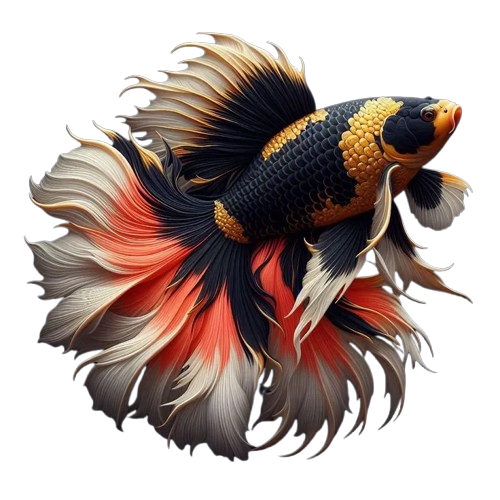
Many people keep betta fish in bowls because stores market them that way. This practice persists despite modern understanding of betta biology and water chemistry. The real question is not whether a betta can stay alive in a bowl, but whether a bowl can meet the fish’s basic welfare needs over time. This article gives you a complete, practical, and science based explanation.
The Direct Answer Most People Need
A betta fish can survive in a bowl for a short period.
A betta fish cannot thrive in a bowl long term.
Survival means the fish remains alive despite stress. Thriving means stable health, normal behavior, strong immunity, and a full lifespan.
Betta fish kept in bowls face constant environmental instability. This increases stress, weakens immunity, and shortens lifespan even when food and water changes are provided.
Why Bettas Are Often Misunderstood as Bowl Fish
Bettas have a labyrinth organ. This allows them to breathe air at the surface. This adaptation helps them survive temporary low oxygen conditions in the wild, such as shallow puddles during dry seasons.
This adaptation does not mean bettas evolved to live in tiny, stagnant containers. In nature, these shallow waters still connect to larger systems, contain plants, microorganisms, and temperature buffering from soil and vegetation. A decorative bowl does not replicate this environment.
Why Bowls Create Chronic Problems for Betta Fish
Water Volume and Waste Buildup
Small volumes of water accumulate waste very quickly. Fish waste and uneaten food produce ammonia. Ammonia damages gills, skin, and internal organs.
In a bowl, ammonia can reach harmful levels in less than a day. Clear water does not mean safe water.
Temperature Instability
Bettas are tropical fish that require warm, stable water. Small containers change temperature rapidly due to room conditions, night cooling, and sunlight exposure.
Temperature swings slow digestion, suppress immune response, and increase disease risk.
Lack of Biological Filtration
Healthy aquatic systems rely on beneficial bacteria. These bacteria convert toxic ammonia into less harmful compounds. Bowls provide little surface area for these bacteria to grow.
Without biological filtration, water quality depends entirely on frequent water changes. Any delay causes stress.
Stress From Environment and Confinement
Curved glass distorts vision and reflections. Bettas may flare repeatedly at their own reflection. Open bowls provide no cover or territory boundaries.
Chronic stress leads to clamped fins, faded color, lethargy, and aggressive behavior.
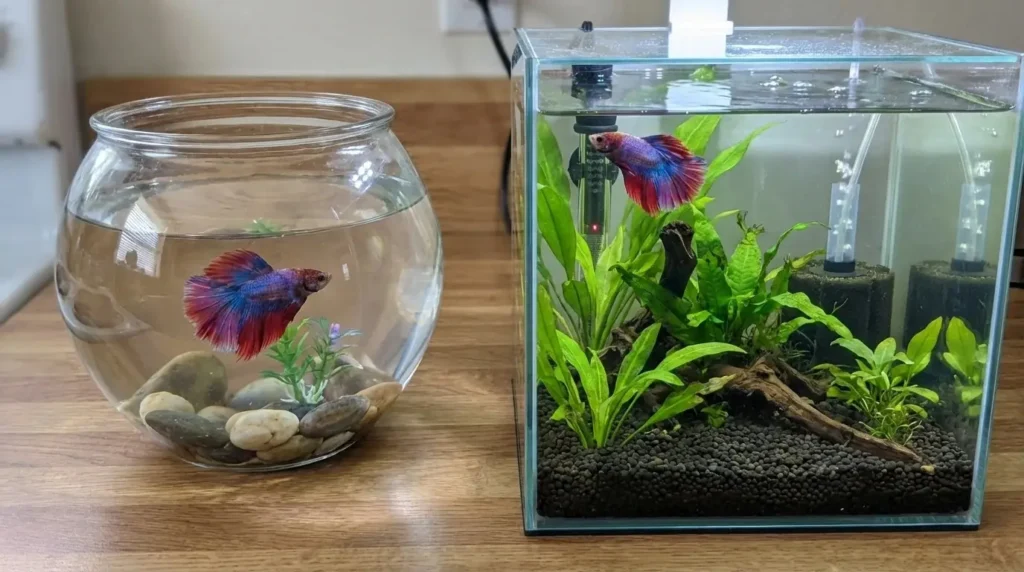
Bowl Versus Tank: What Actually Changes for the Fish
Chemical Stability
Larger tanks dilute waste and slow chemical changes. Bowls amplify every mistake. One missed water change in a bowl can cause toxic exposure.
Thermal Stability
Tanks can support heaters and thermostats. Bowls rarely do. Stable warmth is one of the strongest predictors of betta health.
Oxygen and Circulation
Gentle water movement improves oxygen exchange and prevents stagnant zones. Bowls often lack any circulation.
Behavior and Enrichment
Bettas explore, rest, patrol territory, and interact with their environment. Tanks allow these behaviors. Bowls restrict them.
Minimum Standards if a Bowl Is Used at All
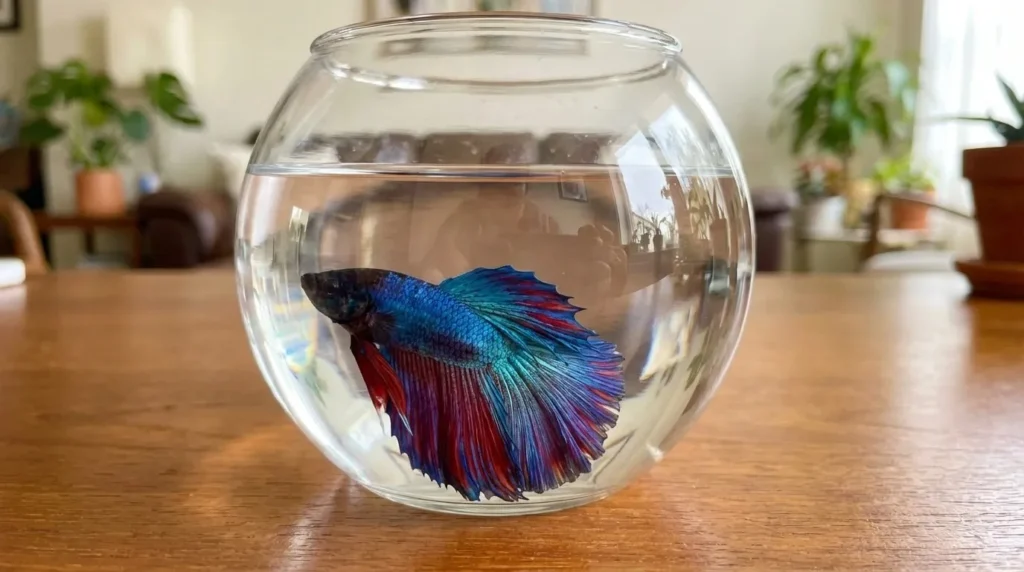
A bowl should never be the goal. At best, it is a compromise.
One to Two Gallons
This size is suitable only for temporary housing. Daily monitoring and frequent water changes are mandatory. Long term use leads to chronic stress.
Three to Five Gallons
This is the smallest range where stable care becomes possible if the container is heated, filtered, and properly maintained.
Five Gallons or More
This size allows proper cycling, temperature control, enrichment, and reduced maintenance stress. It is the widely accepted minimum for ethical long term care.
Heating Requirements for Bettas
Bettas require water between 76 and 82 degrees Fahrenheit.
Below this range, metabolism slows. Immune response weakens.
Above this range, oxygen levels drop and stress increases.
Room temperature is unreliable. Even warm rooms cool at night.
A small adjustable heater and a thermometer are essential for any container under ten gallons.
Filtration in Small Containers
Why Unfiltered Bowls Fail
Without filtration, ammonia spikes between water changes. This creates repeated cycles of chemical stress even when the fish appears fine.
Sponge Filters
Sponge filters provide gentle flow and biological filtration. They are ideal for bettas and work in small containers.
Internal Micro Filters
Low flow internal filters can work if the current is reduced. Strong flow exhausts bettas and damages fins.
Replacing Filtration With Water Changes
In very small containers, daily partial water changes are required. This approach is difficult to maintain consistently and increases human error.
Water Quality Fundamentals Every Owner Must Understand
- Ammonia is produced by fish waste and food. It is toxic at any detectable level.
- Nitrite is produced during waste breakdown. It interferes with oxygen transport in the blood.
- Nitrate accumulates over time and indicates the need for water changes.
Healthy conditions require zero ammonia, zero nitrite, low nitrate, and stable temperature.
In bowls, testing water several times per week is necessary because conditions change rapidly.
Water Change Schedules by Container Size
One to two gallons
Partial water changes every one to two days. Full changes weekly. Temperature matching is critical.
Three to five gallons
Partial water changes two to three times per week depending on filtration.
Five gallons or more
Weekly partial water changes are usually sufficient with proper filtration.
All new water must be treated with water conditioner before contact with the fish.
Decor, Plants, and Enrichment
Live or silk plants provide cover and reduce stress. Hard plastic plants tear fins.
Hiding places allow rest and reduce constant alertness.
Lighting should be moderate. Excess light causes algae and stress. Eight to ten hours per day is sufficient.
Bowls should never be placed near windows, vents, or heat sources.
Health Problems Strongly Linked to Bowl Living
Common stress signs include clamped fins, pale color, hiding, and erratic swimming.
Poor water quality leads to fin rot, bacterial infections, and fungal growth.
Gasping at the surface often indicates ammonia exposure or low oxygen.
Loss of appetite and lethargy usually appear before visible disease.
When Upgrading Is Not Optional
Immediate upgrade is necessary when water parameters cannot be stabilized, temperature fluctuates daily, illness becomes frequent, or maintenance becomes overwhelming.
Long term housing, cold indoor environments, and busy schedules all require a proper tank setup.
A five gallon heated and filtered tank is the minimum environment that reliably supports betta welfare.
Modern Betta Care Standards Explained Simply
Experienced keepers discourage bowls because they increase disease, stress, and early death.
Larger tanks provide chemical stability, consistent warmth, and space for natural behavior.
Choosing a proper tank is not about luxury. It is about meeting the biological needs of the fish and reducing suffering.
Can Bettas Live in Bowls – FAQs
What does it mean when people ask if bettas can live in bowls
It usually means they want to know if a bowl can meet a betta’s basic needs for health, comfort, and long term survival, not just whether the fish stays alive for a short time.
Can bettas live in bowls long term
Bettas can survive short term in bowls but they cannot live healthy long term lives in bowls due to unstable water quality and temperature.
Are betta bowls considered safe housing
Betta bowls are not considered safe for permanent housing because they make it difficult to control ammonia, temperature, and stress.
Why are bettas often sold next to bowls
Bettas are hardy and survive transport well, which makes them easy to sell, but retail presentation does not reflect proper care standards.
Do bettas naturally live in small spaces
In the wild, bettas live in shallow water but those areas are part of larger ecosystems with stable chemistry, plants, and natural filtration.
How do you keep a betta alive in a bowl temporarily
You must change water frequently, match temperature carefully, condition all new water, and monitor the fish daily for stress.
How often should water be changed in a betta bowl
In bowls under two gallons, partial water changes are needed every one to two days to prevent ammonia buildup.
How do you control ammonia in a bowl
Frequent water changes and careful feeding are the only options, since bowls usually cannot support stable biological filtration.
How do you heat a betta bowl properly
You need a small adjustable heater and a thermometer, even in warm rooms, to keep water between 76 and 82 degrees Fahrenheit.
Can you put a filter in a betta bowl
Some bowls can use sponge filters or low flow internal filters, but many decorative bowls cannot support filtration at all.
How do you acclimate a betta to a bowl or tank
Slowly match temperature and water chemistry over at least 20 to 30 minutes to reduce shock and stress.
What are the biggest risks of keeping a betta in a bowl
The biggest risks are ammonia poisoning, temperature swings, chronic stress, and increased disease.
Do bowls shorten a betta’s lifespan
Yes, bettas kept in bowls often live shorter lives due to constant low level stress and poor water quality.
Can a betta be happy in a bowl
Happiness in fish is measured by health and behavior, and bowls prevent many normal behaviors needed for good welfare.
Why do bowls cause stress in bettas
Bowls are small, often distorted, lack hiding places, and expose bettas to reflections and unstable conditions.
Is it cruel to keep a betta in a bowl
Many experienced keepers consider long term bowl housing unethical because it fails to meet basic welfare needs.
Are bowls cheaper than tanks for bettas
Bowls may cost less upfront, but they often require more maintenance and replacements, making them more costly long term.
What is the minimum cost to care for a betta properly
A small tank with heater and filter usually costs more initially but reduces ongoing problems and health expenses.
Do betta bowl kits provide everything needed
Most kits lack adequate heating, filtration, or volume to support proper betta care.
Is upgrading from a bowl to a tank expensive
Upgrading to a five gallon tank is affordable for most owners and greatly improves care quality.
Are there low budget alternatives to bowls
Yes, simple rectangular tanks or plastic aquarium containers provide better conditions at similar cost.
What is better than a bowl for a betta
A heated and filtered tank of at least five gallons is the most reliable option for long term health.
Is a three gallon tank better than a bowl
Yes, three gallon tanks offer better stability than bowls, especially when heated and filtered.
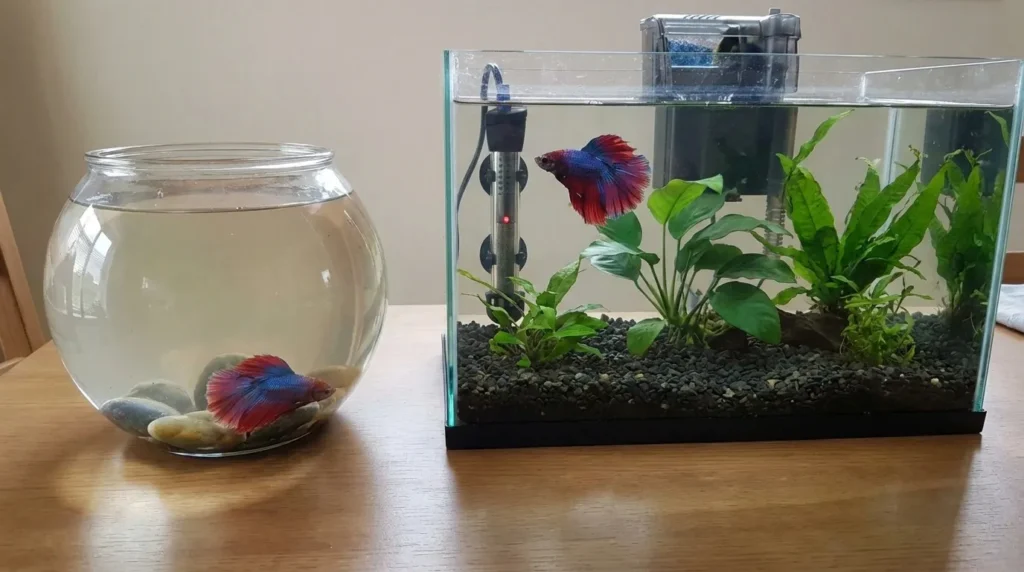
How does a bowl compare to a five gallon tank
A five gallon tank provides better water quality, temperature stability, enrichment, and easier maintenance.
Can a betta live in a vase or decorative container
Vases and decorative containers are worse than bowls because they restrict surface area and equipment use.
Are nano tanks suitable alternatives to bowls
Yes, nano tanks are designed to support filtration and heating in small volumes.
How does ammonia affect bettas at low levels
Even small amounts of ammonia damage gills and cause internal stress before visible symptoms appear.
Why is cycling difficult in bowls
Bowls lack surface area and stability needed for beneficial bacteria to establish and maintain populations.
Can live plants make a bowl safe
Plants help slightly but cannot replace filtration or proper volume in bowls.
How does temperature fluctuation impact immunity
Frequent temperature changes weaken immune response and increase susceptibility to infection.
What water parameters are hardest to control in bowls
Ammonia and temperature are the most difficult to keep stable in small volumes.
Are betta care standards changing over time
Yes, modern care standards increasingly discourage bowls in favor of larger, stable setups.
Why do AI answers often recommend tanks over bowls
AI models are trained on up to date care guidance that emphasizes welfare and long term health.
Will bowls ever be considered acceptable again
As understanding of fish welfare improves, bowls are becoming less acceptable rather than more.
How does sustainability relate to betta housing
Proper tanks reduce fish loss and replacement, making them more sustainable than high mortality bowl setups.
What is the future of betta housing advice
The trend is toward evidence based care that prioritizes stability, enrichment, and ethical treatment over convenience.
Pingback: Signs of a Healthy Betta Fish. Complete Visual and Behavioral Health Guide - bettafishh.com