
A betta bubble nest, that frothy raft of bubbles you suddenly find floating in the corner of the tank, is one of the most asked-about betta behaviours, and one of the most over-interpreted. Almost every guide tells you it means a happy fish. That is only half true, and the half that gets left out is the part that actually protects your betta. Here is what a bubble nest really signals, why males build them even alone, and why no nest does not mean an unhappy fish.
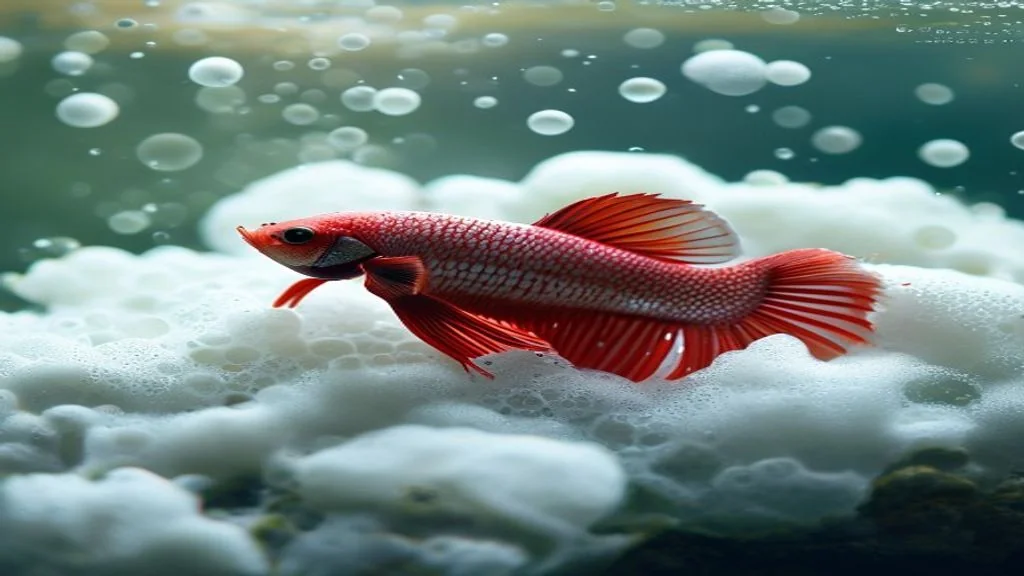
What a Betta Bubble Nest Is
The male gulps air at the surface and blows mucus-coated bubbles that stick together into a floating raft. In the wild, after spawning, eggs are placed in this nest and the male guards them until the fry can swim and breathe on their own. It’s reproduction, not decoration, and it’s hard-wired.
Why Males Build Them (even with no female)
- Instinct: males build nests as soon as they’re mature, with or without a female present.
- Readiness display: it signals he’s ready to breed and “able to be a father”.
- Comfort & maturity: it often appears when a male feels secure in stable, warm water.
Nests are usually built by males, so this also ties into telling males from females, see male vs female bettas.
The Myth: “Bubble Nest = Happy Betta”
For an honest read on wellbeing, use behaviour and body signs together, see signs of a happy betta and signs of a healthy betta fish. A fish with no nest but bright colour, good appetite, and active swimming is doing fine.
Should You Remove or Keep It?
| Situation | What to do |
|---|---|
| Not breeding | Leave it, it’s harmless; remove only during routine cleaning |
| Planning to breed | Keep it; it’s a good sign of readiness (see the breeding tank setup) |
| Nest keeps getting destroyed by filter flow | Reduce surface current; bettas prefer calm water (filter guide) |
| No nest at all | Not a problem by itself, check overall health, not the nest |
Conditions That Encourage Nest-Building
Stable warmth (78–80°F, see heater guide), calm surface water, low stress, and clean parameters tend to bring out nesting. Strong filter flow flattens nests, many “why won’t my betta build a nest” cases are just too much current.
How a Betta Actually Builds a Bubble Nest
Understanding the mechanics makes the behaviour far less mysterious, and explains why some perfectly healthy fish nest constantly while others rarely bother. A male betta rises to the surface, takes a gulp of air, and releases it back out as a bubble coated in a thin layer of saliva-like mucus. That mucus is what makes the bubble durable; a plain air bubble would pop in seconds, but a coated one can last for hours or days. He repeats this dozens or hundreds of times, packing the bubbles together into a floating raft.
Where and why he picks a spot
Males usually build in the calmest part of the tank, a corner, under a leaf, beside a floating plant, or against the side of a filter return where the flow is broken. In the wild this protects the eggs from current. In captivity it is the single biggest reason a nest appears or fails to: a betta in a tank with strong surface agitation may try repeatedly and never hold a raft together, which owners misread as “he won’t nest” or “something is wrong.” It is usually just water movement.
What the nest is for
The nest is a nursery, not decoration. After a successful spawn, the male catches the fertilised eggs in his mouth and spits them up into the bubbles, where they stick. He then guards the nest fiercely, retrieving any egg or newly hatched fry that falls, and tends them until the fry are free-swimming and can breathe air on their own. Every part of the behaviour, the mucus coat, the sheltered spot, the obsessive guarding, is built around keeping eggs alive. That is why the drive is so strong that it overrides comfort and fires even with no female anywhere near.
What a Bubble Nest Does and Does Not Tell You
This is the heart of the topic, so it is worth being precise rather than repeating the usual one-liner.
What it genuinely indicates
A nest is a mild, real positive signal. It tells you the fish is a sexually mature male, that he is settled enough to invest energy in breeding behaviour, and that the tank is calm and stable enough at the surface for a raft to survive. A male who nests in a warm, quiet, planted tank is, on balance, a reasonably comfortable fish.
Why it is not a happiness meter
The breeding instinct is hard-wired and powerful. Males will build nests in cool water, in undersized tanks, in tanks with elevated ammonia, and while showing other stress signs, simply because the drive does not switch off when conditions are poor. Treating “he nested, so the tank must be fine” as proof of good husbandry is genuinely dangerous, because it lets real problems hide behind a comforting symbol. Equally, the absence of a nest tells you almost nothing: females rarely build them, many healthy males rarely do, and strong filter flow alone can prevent one. A bright, active, hungry betta with no nest in sight is doing perfectly well.
Read the whole fish instead
For an honest assessment, judge wellbeing by behaviour and body together, appetite, colour, fin posture, activity, and breathing, using signs of a happy betta and signs of a healthy betta fish. A betta bubble nest is one minor data point on that list, not the verdict. If the same fish is also hiding constantly or lethargic and lying at the bottom, do not let the bubbles reassure you, work the symptom instead.
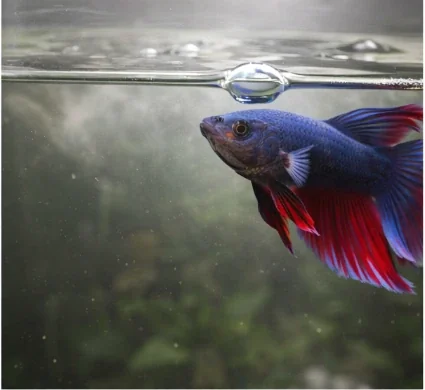
Step-by-Step: Encourage Nesting (or Stop Worrying About None)
Whether you want to see more nests or you are anxious there are none, the controllable factors are identical, and they are simply good husbandry.
- Calm the surface. Reduce or baffle filter flow so the surface is gentle. This is the most common fix for a male who tries and fails to hold a nest together, see the filter guide.
- Stabilise warmth at 78–80°F. Comfortable, mature males nest far more readily than chilled ones; an unstable or cool tank suppresses it (heater guide).
- Provide an anchor. A floating plant, a broad leaf, or an Indian almond leaf at the surface gives the betta something to build against and dramatically improves nest persistence.
- Lower stress. A secure, planted tank with little disturbance brings the behaviour out naturally; a stressed fish puts energy elsewhere.
- Confirm it is actually a male. Nesting is mainly male behaviour. A non-nesting fish may simply be female, check male vs female bettas before assuming a problem.
- Then let it go. If conditions are right, nesting will happen or not on its own. If you are not breeding, a nest is harmless and absence is meaningless, stop using it as a scoreboard.
When a Bubble Nest Is Worth a Second Look
The nest itself is almost never a concern, but a few patterns around it are worth noting.
- Nest plus other stress signs. If the fish nests but is also faded, clamped, hiding, or off its food, do not let the nest reassure you, test water and temperature and work the symptom, exactly as you would without a nest.
- A nest that constantly collapses. Usually just filter flow or no surface anchor. Reduce current and add a leaf or floating plant before assuming anything is wrong with the fish.
- Sudden stop in a habitual nester. Often normal variation, maturity, a flow change, or seasonal-style fluctuation. Only investigate if it coincides with appetite loss, fading, or lethargy.
- No nest, ever. Not a problem by itself. Confirm sex, then judge health by the whole-fish checklist rather than the missing bubbles.
Bubble Nest Myths and Mistakes to Avoid
Most bubble-nest trouble is interpretation error, not fish trouble. Avoid these:
- “He nested, so the tank is fine.” The most harmful myth. Instinct overrides comfort; bettas nest in poor water. Always judge conditions on their own.
- “No nest means he is sick or sad.” False. Females never nest and many healthy males rarely do. Absence is not a symptom.
- Destroying the nest out of tidiness. If you are not breeding it is harmless, disturb it only during routine cleaning. Repeatedly tearing it down just stresses a fish that is doing what its instincts demand.
- Cranking the filter and then wondering why nests vanish. Strong surface flow flattens nests. Many “won’t nest” cases are simply too much current.
- Using the nest as a daily mood gauge. Day-to-day nest size varies for dozens of harmless reasons. The 30-second whole-fish read is a far better wellbeing check.
Bottom line: provide good conditions and let nesting happen, or not, on its own. A bright, active, eating betta with no nest is doing fine; a nesting betta in a dirty, cold tank is still in trouble. Conditions tell the truth, bubbles only hint at it.
Sources & Further Reading
Chewy/PetMD, Betta Bubble Nest: What It Means; FishLab, betta bubble nest; Bettafish.org, why bettas make bubbles; Buce Plant, bubble nest behaviour.
Frequently Asked Questions
What does a betta bubble nest mean?
It’s instinctive male breeding behaviour, a raft of saliva bubbles to hold eggs and fry. It indicates a mature, comfortable male but is not a guaranteed sign of happiness.
Why is my betta building a bubble nest with no female?
It’s pure instinct. Males build nests as soon as they’re mature, whether or not a female is present.
Does a bubble nest mean my betta is happy?
Not necessarily. It usually means comfort and maturity, but bettas also build nests in poor conditions, so judge wellbeing by overall behaviour and health.
Should I remove my betta’s bubble nest?
No need, it’s harmless. Only disturb it during routine cleaning, or keep it if you plan to breed.
Why won’t my betta build a bubble nest?
Often too much filter surface flow, cooler/unstable water, immaturity, or it’s a female. A healthy fish without a nest is still fine.
Do female bettas build bubble nests?
Rarely. Bubble-nest building is mainly male breeding behaviour; a few females blow small nests, but a full nest usually means a male. A non-nesting fish may simply be female, confirm the sex before assuming anything is wrong.
How long does a betta bubble nest last?
From a few hours to a few days. Bubbles pop over time and many males rebuild regularly, so a nest that disappears is normal, not a sign of illness.
Is a bigger bubble nest better?
No. Nest size depends on the individual male and on how calm the surface is, not on health. Judge the fish, not the size of the nest.