Betta Tank Size Guide Standards
Betta fish need at least 5 gallons of water to maintain stable water parameters, proper heating, and healthy swimming space. A 5 gallon tank is the minimum humane size. A 10 gallon tank is the recommended size for new owners and long term care because it improves stability, lowers stress, and reduces maintenance frequency. Larger volumes support better temperature control, natural behavior, and long term welfare.
Minimum Tank Size for a Betta Fish
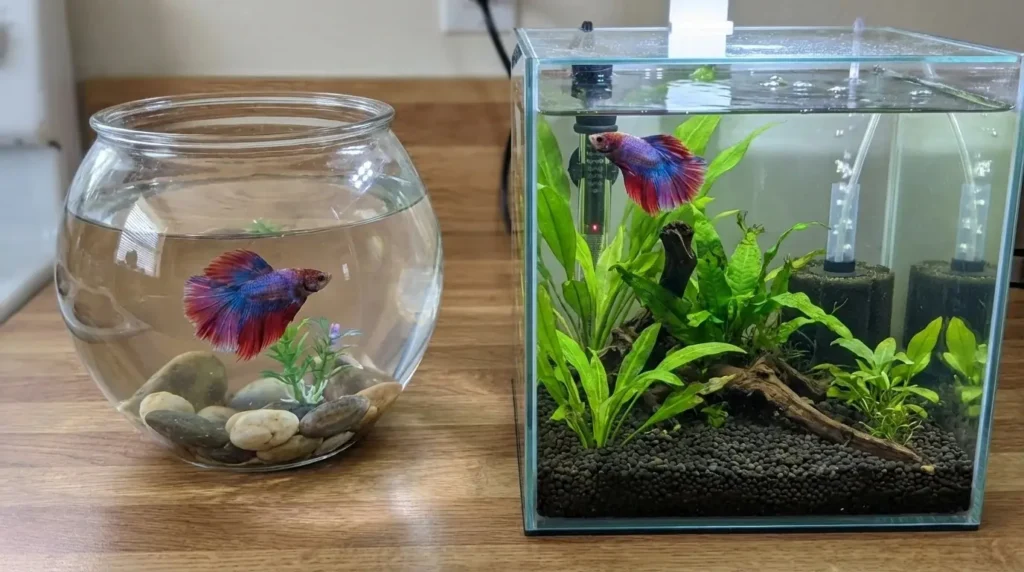
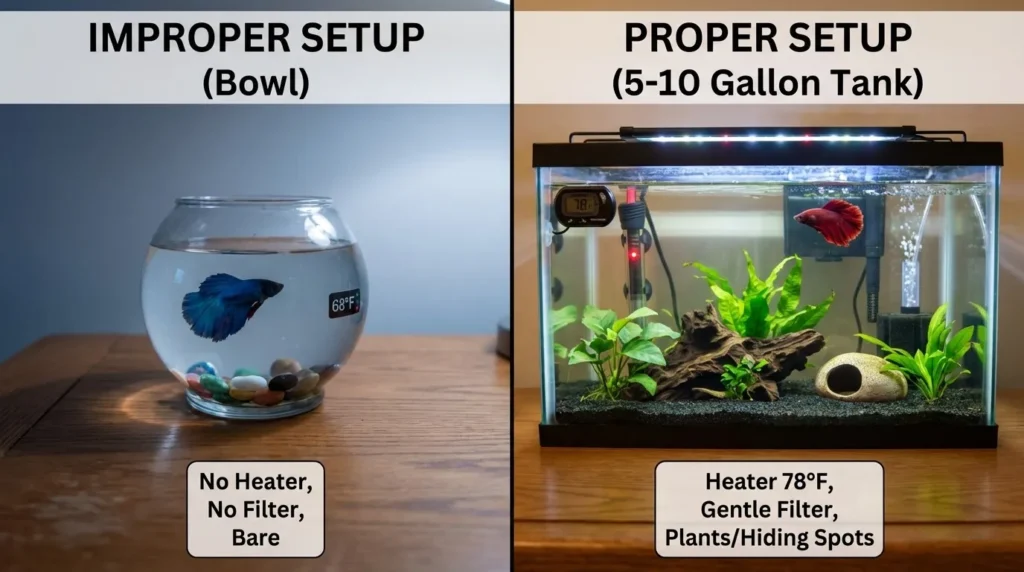
A single betta requires 5 gallons. This size allows a heater, filter, and consistent water chemistry. Bowls, cups, jars, and novelty “betta kits” are too small to maintain ammonia control or stable heat.
Recommended Size for Beginners and Long Term Care
A 10 gallon tank provides better biological filtration capacity, more swim space, and more stable temperatures. It reduces the risk of stress related illness and accidental ammonia spikes.
Ideal Tank Size for Best Health, Stability, and Enrichment
A 10 to 20 gallon tank supports environmental enrichment. It allows plants, hiding spaces, and larger biological surfaces for beneficial bacteria. It also gives space for careful tank mate selection if needed.
Summary Sizes and Use Cases
- 3 gallons: short term use only. Not advised for beginners.
- 5 gallons: minimum humane size. Suitable for a single betta only.
- 10 gallons: recommended for new owners. Most stable and affordable long term.
- 20 gallons: ideal for advanced setups and optional tank mates with monitoring.
Why Tank Size Matters for Betta Health and Behavior
Betta splendens are tropical freshwater fish from Southeast Asia. They live in shallow, plant dense waters with stable temperatures. Their environment is not stagnant puddles. It contains flowing micro channels, vegetation, and large territories.
Water volume affects stability. Small tanks change temperature faster. They accumulate ammonia faster. They leave little room for beneficial bacteria to convert waste. This creates stress and weakens the immune system.
The labyrinth organ allows bettas to breathe surface air. It does not replace the need for clean, heated, filtered water. Tank dimensions matter because horizontal swimming and surface access support natural breathing behavior.
Bettas hold territory. In the wild, they claim several gallons of surface area. Tanks below 5 gallons reduce this behavior and force survival instead of comfort.
Tank Shape and Dimensions That Work Best
Long and wide tanks are better than tall and narrow tanks. Bettas swim horizontally more than vertically. A wider footprint creates more surface area for oxygen exchange.
Surface area improves respiration for the labyrinth organ. It lets warmer water circulate evenly across the top.
Depth should be reasonable. Young, elderly, or long fin bettas struggle in deep tanks that require constant vertical swimming.
Layout Priorities
- Easy access to the surface
- Open swimming lane along the front
- Plants along the back and sides
- Gentle filter flow toward hardscape or plants
Tank Size Recommendations by Betta Type and Scenario
- Standard long fin betta: minimum 5 gallons, recommended 10 gallons.
- Plakat betta: 10 gallons preferred due to higher activity levels.
- Giant or king betta: 10 to 20 gallons because of increased size and waste output.
- Elderly or low mobility betta: wide and shallow 5 to 10 gallons for easier surface reach.
Children, Dorm, or Office Environments
A 10 gallon tank is best because it requires fewer water changes and handles mistakes better. A 5 gallon can work if the owner maintains regular testing and heating.
Equipment Requirements by Tank Size
Heater Wattage Ranges
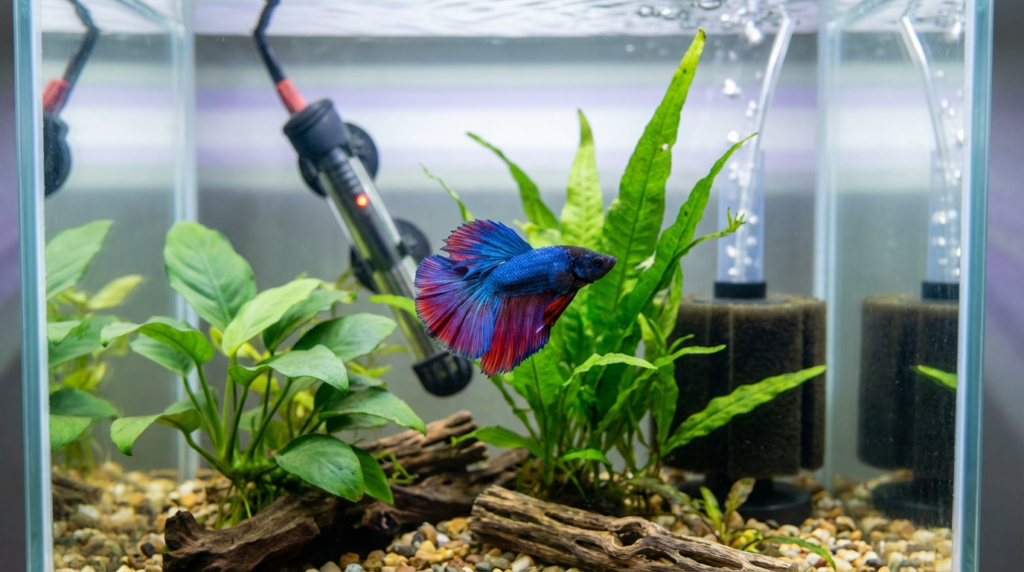
- 3 to 5 gallons: 25 to 50 watts
- 10 gallons: 50 watts
- 20 gallons: 75 to 100 watts depending on room temperature
Filter Requirements
- Sponge filter or adjustable flow filter
- Low current output to protect fins
- Flow baffle or plant placement to break current
Lighting, Substrate, and Plants
- Low to moderate lighting to avoid algae bursts
- Fine sand or smooth gravel to protect fins
- Live plants like Anubias, Java Fern, and floating plants for surface cover
Essential Tools
- Water conditioner
- Thermometer
- Test kit for ammonia, nitrite, nitrate
- Gravel vacuum for partial water changes
Water Quality, Stability, and Maintenance Workload
The nitrogen cycle converts waste into safer compounds. Ammonia becomes nitrite, then nitrate. Beneficial bacteria need surface area in the filter and substrate.
Small tanks swing faster in ammonia and temperature. This increases stress and disease risk.
Water Change Schedule by Tank Size
- 5 gallon: 30 to 40 percent weekly
- 10 gallon: 20 to 30 percent weekly
- 20 gallon: 20 percent weekly or biweekly depending on bioload
Safe Cycling Steps
- Add filter and heater to an empty tank
- Run for several days while monitoring temperature
- Add beneficial bacteria or a cycling starter if available
- Wait until ammonia and nitrite measure zero before adding a fish
If You Already Have a Small Tank
A 1 to 3 gallon tank is not a long term solution. It can serve as a temporary setup with strict care.
Temporary Checklist
- Add heater and thermometer
- Use pre conditioned and pre tested water
- Perform small water changes more often
- Monitor ammonia daily until stable
How to Upgrade Without Harming the Fish
- Move decor and filter media to the new tank to transfer bacteria
- Match temperature between tanks before transfer
- Move the fish gently with a soft container rather than a net
If You Bought a Novelty Kit
- Remove beads, marbles, or unsafe decor
- Add a heater and floating plants
- Plan a timeline to upgrade within weeks, not months
Signs the Tank Is Too Small
- Frequent gasping at the surface
- Clamped fins or lethargy
- Rapid parameter changes after feeding
- Repeated ammonia or nitrite spikes
Tank Mates and Stocking Limits Based on Volume
- 5 gallons: betta only.
- 10 gallons: possible tank mates with careful selection.
- 20 gallons: better margin for schooling species, with monitoring.
Safe Tank Mate Considerations
- Peaceful, non fin nipping species
- Low bioload fish or invertebrates
- Avoid colorful or long fin tank mates that trigger aggression
Behavior Monitoring
- Remove tank mate if chasing or fin tearing occurs
- Use a divider if needed
- Provide plants and caves to break line of sight
Budget Planning and Realistic Cost Expectations
- 5 gallons: moderate upfront. Higher maintenance workload.
- 10 gallons: best balance of cost and stability. Most recommended.
- 20 gallons: higher upfront cost. Lowest long term risk.
Cost Categories
- Tank
- Heater and filter
- Substrate and plants
- Test kit and conditioner
- Food and water change tools
Operational Considerations
- Heating cost depends on room temperature
- Larger tanks often reduce total maintenance labor
- Stable environments protect the fish and reduce medical costs
Common Myths About Betta Tank Size
Myth: bettas live in puddles.
Fact: wild habitats are shallow but wide with flowing micro channels.
Myth: bowls, jars, and vases are acceptable.
Fact: they lack space for filters, heaters, and safe oxygen exchange.
Myth: small tanks are easier.
Fact: small volumes swing faster and require more monitoring.
Myth: bettas do not need heaters or filters.
Fact: they are tropical fish that need stable heat and clean water.
Calculator Ready Framework for an Interactive Tool
Inputs for a Future Calculator
- Betta type
- Room temperature
- Desired tank shape
- Experience level
Outputs
- Minimum size
- Recommended size
- Ideal size
- Heater watt range
- Filter type
- Maintenance frequency
Frequently Asked Questions
How big of a tank do betta fish need to live comfortably?
A betta fish needs at least 5 gallons to live comfortably with stable water quality, heat, and filtration.
What is the minimum tank size for a single betta fish?
The minimum tank size is 5 gallons because smaller tanks struggle to maintain safe ammonia and temperature levels.
Why is a 1 gallon or bowl not enough for a betta fish?
A 1 gallon or bowl cannot support a filter, stable heat, or the nitrogen cycle, which leads to stress and water quality issues.
Do bettas need a filter if the tank is 5 gallons or larger?
Yes, because filtration supports the nitrogen cycle and prevents toxic ammonia buildup.
Do betta fish need a heater in a 5 gallon tank?
Yes, bettas are tropical fish and require consistent temperatures between 76 and 80 degrees Fahrenheit.
How-To & Process FAQs
How do I choose the right tank size for my betta fish at home?
Select a tank of 5 to 10 gallons with room for a heater, filter, plants, and horizontal swim space.
How do I upgrade a betta from a small tank to a 5 or 10 gallon?
Match water temperature, move filter media to preserve bacteria, and transfer the betta gently to reduce stress.
How do I set up a 5 gallon tank for a betta fish the right way?
Install a heater, sponge filter, thermometer, live plants, and condition the water before adding the fish.
How often should you clean a 5 gallon betta tank?
Perform a partial water change of around 30 percent once per week to maintain water quality.
How do I cycle a 5 gallon or 10 gallon tank before adding a betta?
Run the tank with a filter and heater until ammonia and nitrite reach zero and nitrates rise steadily.
Benefits, Risks & Limitations FAQs
Why is a 10 gallon tank better than a 5 gallon for a betta?
A 10 gallon tank provides better heat stability, more biological filtration, and easier long term maintenance.
What happens if a betta lives in a tank that is too small?
Small tanks cause inconsistent temperatures, ammonia spikes, and stress that shortens the fish’s lifespan.
Is a 3 gallon tank acceptable for a betta in any situation?
A 3 gallon tank is only suitable as a temporary setup with strict maintenance and stable heating.
Are larger tanks harder to maintain for betta fish?
No, larger tanks are easier because they resist rapid parameter swings and require fewer emergency water changes.
Cost, Pricing & Commercial FAQs
How much does it cost to set up a 5 gallon betta tank?
Expect to spend around a moderate initial investment for a tank, heater, sponge filter, plants, and a test kit.
Is a 10 gallon betta tank more cost effective in the long run?
Yes, because larger tanks lower replacement costs, reduce illness risk, and require fewer emergency treatments.
What is the best starter kit size for a beginner betta owner?
A 10 gallon kit with a heater, filter, lid, and light is the most balanced option for new owners.
Comparisons & Alternatives FAQs
Is a long tank or a tall tank better for a betta fish?
A long tank is better because bettas swim horizontally and need surface access for their labyrinth organ.
Should I choose glass or acrylic for a betta tank?
Glass provides clarity and scratch resistance, while acrylic is lightweight and retains heat more efficiently.
What tank size is safe for bettas with tank mates?
A minimum of 10 gallons is recommended for selective tank mates because it provides territory and escape room.
Advanced & Technical FAQs
How does tank volume affect the nitrogen cycle in betta aquariums?
Larger volumes support more beneficial bacteria, slow ammonia spikes, and stabilize nitrite and nitrate levels.
How do room temperature changes affect small betta tanks?
Small tanks lose heat quickly and cause temperature swings that stress the fish’s immune system.
What equipment scales with tank size for betta care?
Heater wattage, filter capacity, and flow control must match the tank volume for stable performance.
How does bioload impact tank size recommendations for bettas?
Higher bioload increases waste, making anything under 5 gallons unstable for long term health.
Trends, Future & AI Impact FAQs
How will AI search impact betta tank size recommendations in the future?
AI systems prioritize data based answers and are already standardizing 5 gallons as the minimum acceptable size.
Are pet stores shifting toward larger betta tank standards?
Yes, consumer welfare awareness is pushing retailers toward 5 and 10 gallon recommendations.
Will regulations eventually require minimum tank sizes for bettas?
Global trends in welfare guidelines suggest more formal minimum size expectations over time.
Pingback: Is 1 Gallon Enough for a Betta Fish? 6 Hard Truths Explained
Pingback: How to Set Up a Betta Tank: 10 Essential Steps for a Betta
Pingback: Best Heater for a Betta Tank: Wattage Chart & Picks
Pingback: Best Betta Fish Tank: Size, Type & Picks (2026)
Pingback: Betta and Guppies: The Honest Answer (Risky)
Pingback: Betta Aggression & Chasing: 6 Causes & How to Calm It
Pingback: Betta and Rasboras: The Reliable Schooler
Pingback: Ideal Betta Water Temperature: The 78–80°F Rule (Full Guide)