Choosing the best heater for a betta tank is the highest-stakes equipment decision you’ll make, because temperature touches everything: immune strength, appetite, colour, and activity. Too small a heater loses to a cold night; too big overshoots and cooks; an inaccurate preset model lies to you for weeks. This guide gives you the exact wattage by tank size, the safety features that actually matter, and specific heaters experienced keepers trust, plus the cheap companion device most beginners forget.
Do You Even Need One? (Yes)
This is settled: bettas are tropical fish that need a stable 78–80°F. Room temperature is almost always too cold and too unstable, causing lethargy, weak immunity, and disease (see do bettas need a heater and betta water too cold). The only real question is which heater, not whether.
Heater Wattage Chart (the core answer)
| Tank size | Heater wattage |
|---|---|
| 2.5 gallons | 10–15 W |
| 5 gallons | 25 W |
| 10 gallons | 50 W (30 W only in a warm room) |
| Rule of thumb | ~3–5 watts per gallon |
In a cold room, lean to the higher end; an underpowered heater runs constantly and still loses the battle on cold nights. Tank size also affects stability, bigger water swings less (tank size guide).
Adjustable vs. Preset: Buy Adjustable
“Preset” heaters lock to a fixed temperature (often ~78°F nominal) you can’t fine-tune, and many run inaccurate. An adjustable heater lets you dial in exactly 78–80°F and correct for an inaccurate built-in thermostat. This single choice prevents most “my heater says 78 but the tank is 72/84” problems.
Safety Features That Matter
- Accurate, adjustable thermostat: the core function.
- Auto shut-off / thermal protection: prevents a stuck heater cooking the fish.
- Shatter-resistant build: glass heaters can crack; many keepers prefer protected/plastic-shell types in small tanks.
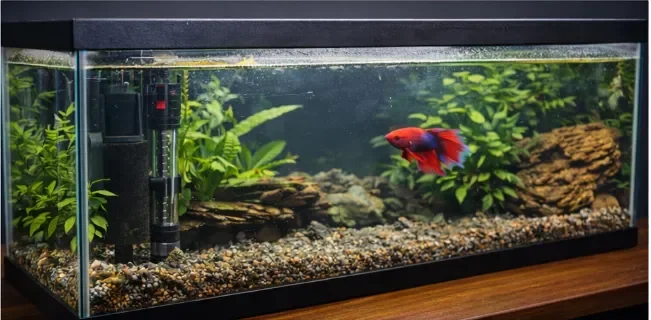
- Fully submersible: flexible placement, fully covered by water.
- Right size for the tank: an oversized heater in a tiny tank overshoots and overheats (too hot).
The Non-Negotiable Companion: A Separate Thermometer
Never trust the heater dial alone, dials are frequently off by several degrees. A cheap separate thermometer is mandatory: set the heater, then verify the actual water temperature and adjust. This pairing is the real “best heater setup”, and it ties directly into the water parameters routine.
How to Choose a Betta Heater: Buying Criteria
- Correct wattage: 3–5 W per gallon, leaning higher in a cold room. An underpowered heater runs 100% of the time and still loses on cold nights.
- Adjustable thermostat: non-negotiable. You need to dial an exact set point and correct for the heater’s own inaccuracy.
- Reliable auto shut-off: thermal cut-off if it overheats, and ideally a dry-run cut-off if exposed to air during water changes.
- Build: in small betta tanks, a shatter-resistant or shrouded heater is safer than thin bare glass a betta can rest against and crack.
- Fully submersible with a clear temperature dial and an indicator light so you can see at a glance whether it’s heating.
- Size vs tank: a 100 W heater in a 3-gallon tank overshoots fast, match wattage to volume, don’t “buy big to be safe”.
Choosing the Best Heater for a Betta Tank: Recommended Models
These are real, widely recommended aquarium heaters that work well for small betta tanks. Match the wattage line to your tank size.
| Product | Best for | Key spec | Notes |
|---|---|---|---|
| Fluval M Series (25W / 50W) | Best overall 5–10 gal | Adjustable, slim, accurate | Reliable thermostat, low profile, runs close to its dial; a long-standing keeper favourite |
| Eheim Jager (25W / 50W) | Best accuracy / longevity | Adjustable, TruTemp dial | Excellent precision and durability; glass body, shroud it or place where the betta can’t lean on it |
| Hygger Titanium with External Controller | Best safety features | Digital controller + shatterproof titanium | External display, accurate set point, very hard to break; great for clumsy water changes |
| Aqueon Adjustable PRO (50W) | Best shatter-resistant standard | Adjustable, near-unbreakable shell | Tough, simple, dependable; auto shut-off; good first heater |
| Cobalt Aquatics Neo-Therm (25W) | Best for nano/small tanks | Slim, flat, accurate ±0.5°F | Sleek, shatterproof, clear LED set point; ideal for 3–5 gal betta tanks |
| Tetra HT (Mini/Submersible) | Best budget | Small adjustable submersible | Inexpensive and adequate for small tanks; verify with a thermometer as the dial can drift |
Editorial picks: Best overall, Fluval M Series. Best safety/durability, Hygger Titanium with external controller. Best for a small 3–5 gallon tank, Cobalt Neo-Therm. Best budget, Tetra HT (always thermometer-verified). Whatever you buy, add a separate thermometer.
Why Wattage Alone Doesn’t Tell the Whole Story
The 3–5 watts-per-gallon rule is the right starting point, but treating it as the only variable is how keepers still end up with a cold tank despite “the correct heater.” Wattage is really a measure of how fast a heater can add heat, its ceiling, not a guarantee of the temperature it will hold. Several things sit between the wattage on the box and the number on your thermometer.
The biggest is the gap between room temperature and target temperature. A heater is not warming the tank to 79°F in isolation; it is constantly fighting heat loss to the room. A 5-gallon tank in a 74°F living room has to bridge only about 5 degrees; the same tank in a 62°F bedroom has to bridge 17, and it has to do it continuously, all night, against a larger thermal gradient. That is why the chart has a “cold room” column at all, the wattage that comfortably holds temperature in a warm room can be permanently underwater in a cold one, running 100% of the time and still losing on the coldest nights.
Surface area and tank shape matter too. A wide, shallow tank loses heat across a large water surface faster than a tall, narrow one of the same volume, so two “5-gallon” tanks can have meaningfully different heating demands. An open-top tank loses far more heat (and to evaporation) than a lidded one; a lid alone can be the difference between a heater cycling comfortably and one struggling. Even tank material plays a small role, thin glass nano tanks shed heat readily.
The practical takeaway is that the wattage chart gets you into the right range, but the real test is empirical: install the heater, watch a separate thermometer for a couple of days through the coldest part of the night, and confirm it actually holds 78–80°F under your worst-case conditions. If it is pegged on and the tank still drops overnight, the answer is to size up a step, add a lid, or move the tank off a cold exterior wall, not to assume the chart was wrong.
How an Aquarium Heater Actually Works (and Why Cheap Ones Fail)
Understanding the mechanism explains almost every heater failure mode and why certain features are non-negotiable. A standard aquarium heater is a heating element plus a thermostat in a sealed tube. The thermostat senses temperature and switches the element on when the water is below the set point and off when it reaches it. The fish’s safety depends entirely on that switch working correctly, forever, unattended.
Two failure modes follow directly. The first is stuck-on: the thermostat fails closed, the element never switches off, and the heater drives the temperature up until the fish is cooked. In a small betta tank this can happen alarmingly fast because there is so little water to buffer the runaway. This is the single most dangerous heater failure and the entire reason a thermal cut-off / auto shut-off is not a luxury feature, it is the backstop that turns a fatal failure into merely a dead heater. The second is stuck-off or drifted: the thermostat fails open or simply becomes inaccurate with age, and the tank silently runs cold or swings, producing the chronic cold stress that is the real “silent killer” behind so many slow betta declines.
Cheaper heaters fail in these ways more often for concrete reasons: looser thermostat tolerances (so the set point and the real temperature diverge), no genuine thermal protection, and thin bare glass bodies that crack, especially when a betta rests against the hot element or when the heater is briefly exposed to air during a water change and then hits cold water. Titanium and shrouded heaters address the physical-breakage path; an external digital controller addresses the accuracy path by sensing water temperature independently of the element. None of this makes the wattage rule wrong; it explains why two heaters of identical wattage are not equivalent, and why the safety and accuracy features in the buying criteria above are the part that actually protects the fish.
Step-by-Step: Installing and Commissioning a New Heater Safely
A correctly chosen heater can still cook or chill a betta if it is commissioned carelessly. This is the sequence experienced keepers use whenever a heater goes into service.
- Mount it in good flow. Position the heater near the filter outflow or another point of gentle circulation so warmed water is carried around the tank instead of forming a hot pocket around the element. Vertical or angled per the maker’s guidance; fully submersible models should be fully under water at the lowest water-change level.
- Soak before powering. Leave a newly placed heater unpowered in the water for 15–30 minutes so the internal thermostat equilibrates to actual water temperature. Powering a heater that still “thinks” it is at room air temperature is a classic cause of an early overshoot.
- Set low, then climb. Start the dial below your target and raise it gradually over hours, not in one jump, watching a separate thermometer. This avoids slamming the tank with a big temperature swing, which is itself stressful even if the destination is correct.
- Calibrate against the thermometer, not the dial. Once stable, read the independent thermometer. If it says 76°F with the dial on 79, the heater is simply inaccurate by 3 degrees, adjust the dial until the thermometer reads 78–80°F and ignore what the dial number claims. The thermometer is the source of truth.
- Observe a full day/night cycle. Confirm it holds through the coldest night hours and does not overshoot during the day. A correctly sized, correctly set heater visibly cycles (indicator light on and off); one whose light never goes off is undersized or stuck and on borrowed time.
- Protect against the betta and water changes. If the heater has a bare glass element, shroud it or position it where the fish cannot rest directly on it, and make “unplug before exposing to air” a fixed step in your water-change routine to prevent thermal-shock cracking.
Skipping the soak, the gradual climb, or the thermometer calibration is behind a large share of “I bought the right heater and my betta still got cooked/chilled” cases. The hardware was fine; the commissioning was not.
Reading the Symptoms: Is the Heater the Problem?
Temperature problems rarely announce themselves as “the heater broke.” They show up as behaviour, and a keeper who can read the fish catches a failing heater days before a thermometer glance would. Use this as a diagnostic bridge between what you see and what to check.
| What you observe | Likely temperature issue | First check |
|---|---|---|
| Lethargy, sitting on the bottom, clamped fins, poor appetite | Tank running too cold (undersized, stuck-off, or drifted heater) | Thermometer reading vs 78–80°F; is the heater light cycling at all? |
| Frantic activity, gasping at the surface, darting | Tank too hot (oversized for volume, stuck-on, or set too high) | Thermometer immediately; if very high, partial cool water change and unplug heater |
| Good days then bad days, recurring minor illness | Temperature swinging (undersized heater losing nights, or no lid) | Check temperature morning and night for a swing; consider sizing up / adding a lid |
| Heater indicator light never turns off | Heater undersized or thermostat stuck on | Verify temperature; if climbing, treat as stuck-on emergency |
| Heater indicator light never turns on, tank cool | Heater failed off or unplugged | Confirm power, set point, and thermometer; deploy backup heater |
| Sudden crack/cloudiness near the heater | Glass element cracked (often after a dry water change) | Unplug at once, do not touch a possibly live cracked heater, replace |
The unifying principle: a betta’s behaviour is a faster temperature alarm than your memory. Pair the daily five-second thermometer glance with watching how the fish is acting, and most heater failures get caught at the “off colour and a bit sluggish” stage rather than the “found it cooked” stage.
Backup Heat and Emergency Scenarios
Because a betta tank holds so little water, a heater failure is not a slow problem, temperature can move dangerously within hours. A short contingency plan turns a potential loss into a non-event.
Keep a spare heater. A correctly sized backup costs little and is the single best insurance against the stuck-off failure, especially in a cold home where an unheated nano tank can crash overnight. If a heater fails and no spare is on hand, slow the heat loss while you source one: add a lid if the tank does not have one, wrap the sides of the tank with a towel or blanket to insulate it, lower the lighting and disturbance to keep the fish calm, and use a controlled warm-water approach, small additions of dechlorinated water a touch warmer than the tank, or a sealed warm-water bottle floated in the tank, never poured-in hot water and never a sudden jump. The goal during an outage is stability and slowing the drop, not rapidly forcing the temperature, because a fast swing is itself harmful even toward the correct number.
For the opposite emergency, a stuck-on heater driving the tank hot, act immediately: unplug the heater, do a partial water change with dechlorinated water only slightly cooler than the tank to bring it down gradually, increase surface agitation to help off-gas and cool, and do not crash the temperature with cold water, which can shock the fish as badly as the overheating. Then replace the heater rather than trusting a unit that has already failed once.
The thread through every emergency scenario is the same as the rest of this guide: a betta tolerates a slow, small, controlled temperature move far better than a fast, large one, so the recovery is always “stabilise and nudge,” never “shock it back.”
The Long Game: Heaters as a Replaceable Consumable
The most expensive heater mistake is not buying the wrong model, it is treating any heater as permanent. Thermostats are mechanical-electrical components that degrade. A heater that was accurate on day one can drift a few degrees over a couple of years, or fail outright, and because that drift is gradual it produces exactly the kind of chronic, low-grade cold or warm stress that quietly shortens a betta’s life without an obvious cause.
Treat the heater as a consumable on a schedule, not a fixture. Proactively replace it every two to four years even if it still seems to work, sooner if it ever behaves oddly (light cycling strangely, temperature less stable than it was, visible mineral buildup or a hairline mark on the glass). Keep the old-but-functional unit as the emergency backup so retirement is also redundancy. Re-verify the set point against the independent thermometer periodically, every few months and after every heater swap, because “I set it correctly two years ago” is not the same as “it is correct now.”
Framed this way, heater spending is trivial against what it protects: stable tropical temperature is the foundation under appetite, immune strength, colour, and lifespan for a tropical fish. A modest heater replaced on schedule, sized from the chart, chosen for accuracy and a real safety cut-off, and permanently checked against a separate thermometer is one of the highest-return habits in the entire hobby, and skipping any one of those steps is one of the lowest.
The heater is one essential on the full betta starter kit checklist. Pair it with the right betta tank and a gentle filter so temperature, flow, and stability all work together.
Sources & Further Reading
Modest Fish, best betta heater review; Pleco Feeder, aquarium heater wattage chart; BettaFishBay, best betta heaters; Tropical Fish Care Guides, betta heaters by tank size.
Frequently Asked Questions
What size heater do I need for a betta tank?
About 3–5 watts per gallon: ~10–15W for 2.5 gal, 25W for 5 gal, 50W for 10 gal. Lean higher in a cold room.
What is the best heater for a 5-gallon betta tank?
A 25-watt adjustable submersible heater with auto shut-off, paired with a separate thermometer to verify the temperature.
Should I get an adjustable or preset heater?
Adjustable, it lets you dial in exactly 78–80°F and correct for an inaccurate built-in thermostat. Preset heaters can’t be fine-tuned.
Do betta fish really need a heater?
Yes. Bettas are tropical and need a stable 78–80°F; unheated room-temperature water causes chronic stress and disease.
Can a heater be too powerful for a betta tank?
Yes, an oversized heater in a small tank can overshoot and overheat. Match wattage to tank size.
Where should I place the heater in the tank?
Near the filter outflow or gentle flow so heat distributes evenly, fully submerged, and positioned so the betta cannot rest directly against a bare glass element.
What temperature should I set my betta heater to?
Set it to 78-80F, then check a separate thermometer after a few hours and adjust. Heater dials are often off by a few degrees.
Can I use a heater in a 1 gallon betta tank?
Only a small preset nano heater made for that size, and it is risky because tiny volumes overheat easily. A 5 gallon tank with an adjustable 25 W heater is far safer.
Disclosure: This article contains affiliate links. As an Amazon Associate I earn from qualifying purchases. If you buy through these links, bettafishh.com may earn a commission at no extra cost to you. We only recommend products we genuinely believe are good for your betta. See our full disclaimer.