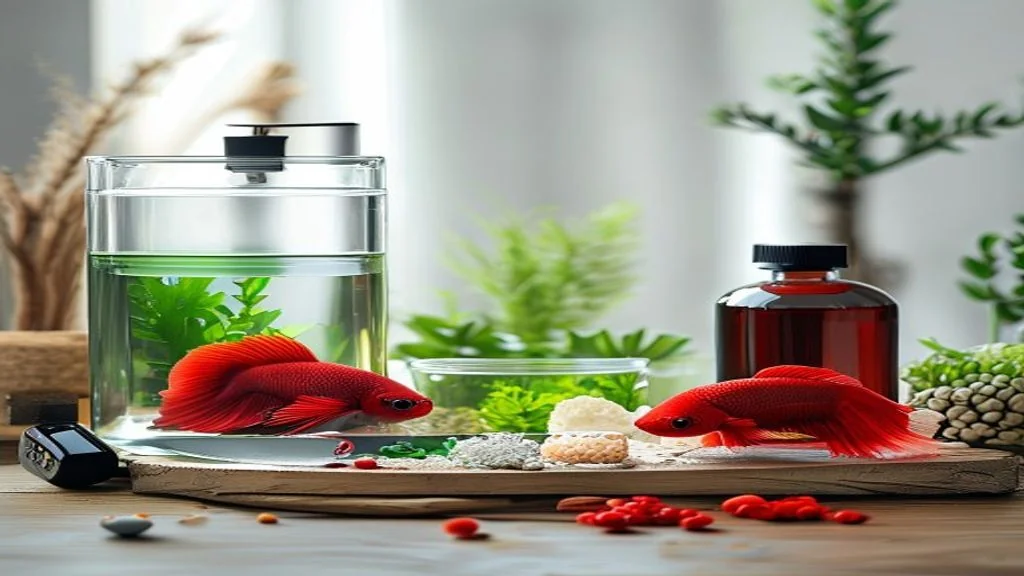
A complete betta starter kit isn’t a single boxed product — it’s a short list of items that each prevent a specific way new bettas die in their first month. Miss the conditioner and chlorine burns the gills; miss the heater and cold stress wrecks the immune system; miss the test kit and invisible ammonia builds until it’s too late. This checklist covers every must-have, names specific products experienced keepers buy, and gives you the exact order to set everything up before the fish ever comes home.
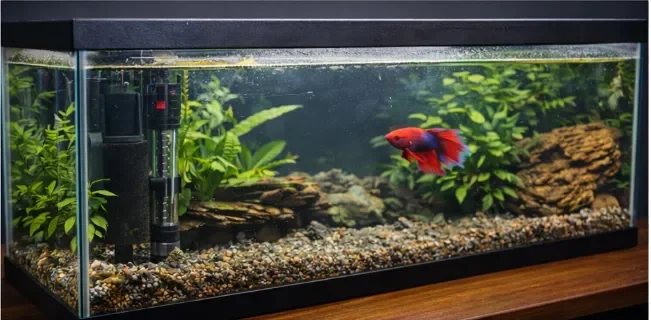
Quick answer: The essential betta starter kit is a 5-gallon+ tank with lid, adjustable heater, thermometer, gentle sponge filter, water conditioner, liquid test kit, quality pellets, fin-safe substrate and plants, and a siphon — all set up and cycled before the fish.
The Complete Checklist
| Item | Why it’s essential | Guide |
|---|---|---|
| Tank 5 gal+ with lid | Stable water; bettas jump | Best betta tank |
| Adjustable heater | Tropical fish; stable 78–80°F | Best heater |
| Thermometer (separate) | Dials are inaccurate — verify temp | Water temperature |
| Gentle sponge filter + air pump | Nitrogen cycle, low flow | Best filter |
| Water conditioner | Removes chlorine/chloramine (lethal) | Conditioner guide |
| Liquid test kit | Ammonia/nitrite/nitrate/pH are invisible | Test kit |
| Quality betta pellets | Carnivore staple diet | Best food |
| Substrate (sand/smooth gravel) | Bacteria bed; fin-safe | Best substrate |
| Live/silk plants + a hide | Enrichment, cover, less stress | Plants · Décor |
| Siphon / gravel vacuum + bucket | Water changes & substrate cleaning | Cleaning |
| Soft net / cup | Gentle handling/acclimation | Acclimation |
“Nice to Have” (not essential day one)
- Frozen/live foods (bloodworms, daphnia) for variety — best live foods.
- Bottled beneficial bacteria to speed cycling.
- Outlet timer for the light.
- Indian almond leaves (mild benefits, gentle tannins).
- A small backup/hospital container + spare heater (for emergencies & quarantine).
The Critical Part: Set Up BEFORE the Fish
The single biggest beginner mistake is buying the fish the same day as the tank. The tank must be set up, heated, and ideally cycled first — an uncycled tank causes the ammonia poisoning that kills most first-month bettas. Recommended order:
- Buy and set up everything on the checklist (no fish yet).
- Rinse substrate/décor; fill with dechlorinated water; install heater & filter.
- Cycle the tank (fishless if possible) while testing with your kit.
- Only when ammonia/nitrite read 0 and a heater holds 78–80°F → buy and gently acclimate the betta.
- Follow the first-month routine in how to prevent betta diseases.
How to Choose Your Starter Gear: Buying Criteria
- Buy for stability, not price-per-item: the cheapest possible version of each item often fails first — focus spend on the heater, filter, conditioner, and test kit.
- Heater must be adjustable and correctly sized (3–5 W/gallon). A preset or undersized heater undermines everything else.
- Filter must be gentle: sponge filter or a baffled low-flow filter, never a torrent.
- Test kit must be liquid: liquid drop kits are far more accurate than paper strips for the parameters that matter (ammonia, nitrite, nitrate, pH).
- Conditioner must neutralise chloramine, not just chlorine — most tap water now contains chloramine.
- Food must be a betta-specific carnivore staple, not generic tropical flakes.
- Everything bought before the fish: the most important “criterion” is timing — the tank is set up and cycled first.
Recommended Betta Starter Kit Products
These are real, widely recommended products covering every essential. You can mix and match; the goal is one reliable item per checklist line.
| Product | Category | Best for | Notes |
|---|---|---|---|
| Fluval Spec V (5 gal) | Tank | Best overall tank base | Glass, integrated filter (baffle it), LED; add a heater — solid all-round starter tank |
| Fluval M25 / Cobalt Neo-Therm 25W | Heater | Best adjustable heater | Accurate, reliable; pair with a separate thermometer |
| Hygger / Aquarium Co-Op Sponge Filter + Tetra Whisper Pump | Filter | Best gentle filtration | Low flow, strong bio media, cheap; add a check valve |
| Seachem Prime | Water conditioner | Best overall conditioner | Neutralises chlorine, chloramine and detoxifies ammonia; tiny dose, long-lasting |
| API Freshwater Master Test Kit | Test kit | Best accuracy | Liquid kit for pH/ammonia/nitrite/nitrate; the standard for cycling a tank |
| Hikari Betta Bio-Gold / Fluval Bug Bites Betta | Food | Best staple pellet | Protein-rich, betta-formulated; small pellets sized for a betta’s mouth |
| Aqueon Siphon Vacuum + Bucket | Maintenance | Best budget essential | For weekly water changes and substrate vacuuming; dedicate the bucket to fish only |
Editorial picks: Best overall conditioner — Seachem Prime. Best test kit — API Master Kit. Best staple food — Hikari Betta Bio-Gold or Fluval Bug Bites. Best tank base — Fluval Spec V. Best budget must-have people skip — a basic siphon and dedicated bucket.
Setup Order & First-Month Specifics
- Days 1–2: assemble tank, substrate, décor, heater, and filter; fill with dechlorinated water; run equipment.
- Weeks 1–4: fishless cycle — add an ammonia source, dose beneficial bacteria, and test every few days with the liquid kit.
- Cycle complete: ammonia 0, nitrite 0, some nitrate, stable 78–80°F.
- Day of the fish: gently acclimate the betta, feed lightly the next day, keep testing weekly for the first month.
- Ongoing: 20–30% weekly water change with conditioner, weekly parameter check until everything is consistently stable.
Maintenance & Restocking the Kit
- Conditioner & food: consumables — keep them topped up; don’t run out of dechlorinator before a water change.
- Test reagents: liquid test kits expire; replace if results look off after a couple of years.
- Filter media: rinse in old tank water, replace only partially when worn.
- Spares: a backup heater and a small hospital container are cheap insurance for emergencies and quarantine.
Dos and Don’ts
| Do | Don’t |
|---|---|
| Buy every essential before the fish | Bring the betta home the same day as the tank |
| Use a liquid test kit and proper conditioner | Skip the test kit/conditioner to save a few dollars |
| Cycle the tank before stocking | Add the betta to an uncycled tank |
| Pick an adjustable, correctly sized heater | Rely on a weak preset kit heater |
| Keep a dedicated fish-only bucket | Reuse a soap-contaminated household bucket |
Why Each Item Maps to a Specific Way Bettas Die
This checklist looks like a shopping list, but it is really a list of causes of death with the prevention next to each one. Beginners cut items because they look optional in a pet-store display; understanding what each missing item actually does to the fish is what stops the cutting.
| If you skip… | What kills the betta | How fast |
|---|---|---|
| Water conditioner | Chlorine/chloramine in tap water burns the gills directly | Hours to days — a known killer with no warning |
| Heater | Chronic cold suppresses immunity and digestion | Slow — weeks of decline, then disease “out of nowhere” |
| Test kit | Invisible ammonia/nitrite from an uncycled tank poisons the fish | The classic first-month death; silent until severe |
| Adequately sized tank | Tiny volume swings in temperature and toxins too fast to manage | Compounds every other risk; punishes small errors hard |
| Lid | Betta jumps out, or the warm humid air it breathes is lost | Sudden (a jump) or slow (labyrinth-air stress) |
| Gentle filter (or baffling a strong one) | Strong flow exhausts a long-finned fish; no filter means no cycle | Slow exhaustion/stress, or a toxin build with no biofilter |
| Quality staple food | Wrong diet for an obligate carnivore; poor health over time | Slow — dull colour, weak condition, lowered resilience |
Two patterns stand out. First, the two cheapest items on the entire list — conditioner and a test kit — guard against the two fastest, most common killers (chlorine and ammonia). Cutting them to save a few dollars is the single worst value decision a new keeper can make. Second, most of these deaths are slow: the fish does not drop the day the item was skipped, it declines over weeks, which is exactly why beginners do not connect the death back to the missing piece and repeat the mistake with the next fish. The checklist is not gear for its own sake; it is a death-prevention list.
A Realistic Budget Tier Breakdown
“How much does a betta cost to set up” is one of the most common pre-purchase questions, and the honest answer is a range with very clear rules about where money must go and where it can be saved. The fish is the cheapest part; the system around it is the real cost, and it is one-time.
Where you must not cut
The heater, the water conditioner, the liquid test kit, and adequate tank volume are non-negotiable spend. These four are the ones tied directly to the fastest killers above. A “budget” build still buys a proper adjustable heater and a real liquid test kit — economising here does not save money, it just moves the cost to repeatedly replacing dead fish and treating illness.
Where you can sensibly save
A sponge filter with an air pump is one of the cheapest filtration options and also one of the best for a betta, so “budget” and “correct” align perfectly here. Substrate can be inexpensive smooth gravel or sand rather than premium aquasoil for a non-planted or low-tech tank. Decorations and silk plants can be modest. A basic siphon and a dedicated bucket cost very little. Live plants, frozen foods, and extras are genuinely optional at the start.
The false economy to avoid
The cheapest possible path — a tiny bowl, the fish, and a tub of food — is not actually cheap. It reliably produces a sick or short-lived fish, replacement fish, and sometimes medications, which over a year costs more than doing it correctly once. The full kit is a one-time outlay that, spread across the multi-year life a properly kept betta can reach, is a small recurring cost dominated by just food and conditioner. Frame the spend as “set it up right once” rather than “minimise the receipt today,” because the minimise-the-receipt path is the more expensive one in the end.
The Fishless Cycle: The Step Beginners Skip and Regret
The most important sentence in this entire guide is “set up and cycle the tank before the fish,” and it is also the one beginners ignore most, because it requires patience and the tank looks “ready” long before it is. It is worth understanding what cycling actually is, because understanding it is what makes people willing to wait.
A new tank has no biological filtration. Fish constantly produce ammonia (through waste and respiration), and ammonia is highly toxic. In an established tank, colonies of beneficial bacteria living in the filter and substrate convert ammonia to nitrite (also toxic) and then nitrite to nitrate (far less toxic, removed by water changes). That bacterial system does not exist on day one — it has to grow, and it takes roughly a few weeks to establish. Putting a fish into an uncycled tank means its own ammonia accumulates with nothing to process it: this is the invisible poisoning behind the majority of first-month betta deaths.
A fishless cycle grows that bacteria before the fish arrives, so no animal is harmed building it. In outline: set up the fully equipped, heated, dechlorinated tank with no fish; add an ammonia source (a bottled ammonia product, or a method that introduces ammonia); optionally dose bottled beneficial bacteria to seed the colonies; and test every few days with the liquid kit. You will watch ammonia rise, then nitrite appear as the first bacteria establish, then nitrite fall and nitrate appear as the second group catches up. The cycle is complete when added ammonia is processed to zero, nitrite reads zero, and some nitrate is present, with the heater holding a stable 78–80°F throughout. Only then is the tank a safe home.
The discipline this requires is simply waiting two to four weeks while an empty tank runs, which feels pointless when the tank looks finished — and that feeling is exactly the trap. The keeper who waits almost never has a first-month ammonia death; the keeper who skips it very often does. Of every item and step on this checklist, this is the one where impatience is most directly lethal and patience is most directly protective.
Bringing the Fish Home: Acclimation Done Right
The kit and the cycle get you to a safe tank; the last failure point is the transfer itself. A betta moved abruptly from store water into different-temperature, different-chemistry tank water can go into shock even though the destination is perfect, so the final step has its own short protocol.
- Confirm the tank is genuinely ready. Cycle complete (ammonia 0, nitrite 0, nitrate present), heater holding 78–80°F verified on the separate thermometer, flow gentle. Do not acclimate into a tank that is not finished “because the fish is already here.”
- Temperature-match first. Float the sealed transport container in the tank for around 15 minutes so the water inside it slowly reaches tank temperature. This removes the temperature-shock risk, which is the most acute one.
- Mix water gradually. Over the next 20–40 minutes, add small amounts of tank water into the container in stages so the fish adjusts to your tank’s chemistry rather than being dumped into it.
- Net or cup the fish across — not the store water. Move the betta into the tank with a soft net or by cupping it, and discard the transport water rather than tipping it in; that water can carry whatever was in the store system.
- Dim and leave it alone. Lower lighting, minimise disturbance, and do not feed on day one. A new betta is stressed; a calm, dark, undisturbed first night lets it settle.
- Feed lightly the next day and keep testing weekly. Start with a tiny portion the following day and continue weekly liquid tests through the first month, since a newly stocked tank can still show small parameter movement as the bioload settles.
Done this way, the transition is low-stress and the carefully prepared tank actually delivers the safe start it was built for. Rushing the acclimation can undo weeks of correct setup in a few minutes.
Common Starter-Kit Mistakes That Survive Even a Full Checklist
Owners can buy every item on this list and still get the first month wrong, because some mistakes are about how the kit is used, not whether it was bought.
- Buying everything but skipping the cycle. The full kit on a shelf around an uncycled tank still kills the fish with ammonia. The cycle is a step, not a product, and it is the most-skipped one.
- Trusting the heater dial. The thermometer is on the list for a reason — an unverified dial can run the tank silently too hot or too cold for weeks. Set by the thermometer, not the dial.
- Running the kit filter at full force. All-in-one tanks often ship with a return flow far too strong for a long-finned betta. The fix (baffling/reducing the flow) is free but routinely missed, leaving the fish fighting current constantly.
- Overfeeding from day one. Quality food on the list does not prevent feeding too much of it. Tiny eye-sized portions; uneaten food fouls a freshly cycled tank fast and can stall the new biofilter.
- Soap-contaminated bucket or hands. Using a household bucket that has held detergent, or hands with soap residue, introduces toxins no conditioner is meant to handle. Dedicate equipment to the fish only.
- Not rinsing new substrate/décor. New gravel and ornaments carry dust; unrinsed, they cloud the tank and can irritate the fish. A pre-fill rinse is a small step that is easy to skip.
- Letting conditioner or test reagents run out. These are consumables. Running out of dechlorinator the night before a water change tempts a “just this once” untreated change — exactly the chlorine exposure the conditioner was bought to prevent.
The pattern: the kit removes the hardware excuses, but a safe first month still depends on cycling, verifying, gentle flow, restraint with food, and clean equipment. Buy the list, then use it correctly — both halves are required.
Dig into each item with the dedicated guides: the right betta tank, an adjustable heater, a gentle filter, fin-safe substrate and decorations, and a carnivore-correct betta food with a weekly fasting day.
Sources & Further Reading
Bettafish.org — betta setup essentials; Aquarium Co-Op — beginner aquarium gear; The Spruce Pets — betta starter guide; Aquarium Store Depot — betta supplies.
Frequently Asked Questions
What do I need to buy for a betta fish?
A 5-gallon+ tank with lid, adjustable heater, thermometer, gentle sponge filter, water conditioner, liquid test kit, quality pellets, fin-safe substrate and décor, and a siphon — all before the fish.
What is the most important item in a betta starter kit?
Arguably the heater (tropical fish need stable warmth), tied with the water conditioner and test kit, which prevent the two biggest killers — chlorine and ammonia.
Do I need a test kit for one betta?
Yes — ammonia, nitrite, and pH problems are invisible and the leading causes of betta death. A liquid test kit is essential.
Should I set up the tank before buying the betta?
Absolutely. Set up, heat, and cycle the tank first. Buying the fish the same day as the tank is the top beginner mistake.
Is a betta starter kit (all-in-one) enough?
Often not quite — included heaters are frequently weak/absent and filters too strong. Verify/upgrade the heater and baffle the filter flow.
What food should a new betta owner buy?
A quality betta-specific pellet as the staple, ideally with some frozen/live food for variety later.
How much does a proper betta setup cost?
More than the impulse “bowl + fish,” but far less than repeatedly treating a sick betta — the full kit pays for itself in avoided problems.
What is the best water conditioner for a betta starter kit?
Seachem Prime is a top pick — it neutralises chlorine and chloramine and temporarily detoxifies ammonia, and a tiny dose treats a lot of water.
Liquid test kit or test strips for a new betta tank?
A liquid kit such as the API Freshwater Master Test Kit. Liquid drop tests are far more accurate than paper strips for cycling and ongoing monitoring.
How long before I can add the betta to a new tank?
Typically 2–4 weeks — until a fishless cycle finishes (ammonia 0, nitrite 0, some nitrate) and the heater holds a stable 78–80°F.