Shopping for betta tank decorations is where good intentions meet shredded fins. The aquarium aisle is full of bright, spiky plastic plants and pointy ornaments that look fun in the box and then catch a betta’s flowing fins like Velcro. The good news: the rule for picking safe décor is simple and takes ten seconds per item. This guide covers the décor every betta actually needs, the items that quietly cause fin rot, and specific products experienced keepers reach for.
Why Décor Isn’t Optional (Enrichment)
Bettas are intelligent and get bored and stressed in bare tanks, boredom drives glass surfing and tank-edge pacing. Cover also reduces stress: a betta with hides feels secure and is actually more active and visible (the counter-intuitive truth from why is my betta hiding). Good décor = a calmer, healthier, more colourful fish.

Safe Decorations (Use These)
| Décor | Why it’s good |
|---|---|
| Live plants | Best option, hides, oxygen, absorbs nitrate; see live vs fake plants |
| Silk plants | Soft, fin-safe fake option (not stiff plastic) |
| Smooth caves / tunnels / coconut huts | Security & resting spots, no sharp edges |
| Driftwood (aquarium-safe) | Natural cover; gentle tannins |
| Betta leaf hammock | Resting spot near the surface for sleeping |
| Smooth, rounded rocks/ornaments | Visual breaks & territory definition |
Dangerous Decorations (Avoid These)
- Hard/jagged plastic plants & ornaments: a leading cause of torn fins → fin rot. Stiff plastic also frays and snags over time.
- Sharp rocks, raw shells, anything with edges or points.
- Items with small holes/gaps a betta can wedge into and get stuck.
- Metal objects: rust/leach toxins.
- Painted/non-aquarium items: paint and unknown materials leach into water.
- Anything small enough to swallow.

How to Arrange Décor for a Betta
- Rinse everything in plain water (no soap) before it goes in.
- Provide at least one enclosed hide (cave/hut) so the betta can fully retreat.
- Add a surface resting spot (leaf hammock / broad plant leaf), bettas rest near the top.
- Create sight breaks with plants/décor (reduces flaring at reflections and tank-mate stress).
- Leave open swimming space too, don’t cram the tank.
- Periodically scrub algae off décor during tank cleaning.
Betta Hammock: Does Your Betta Need One?
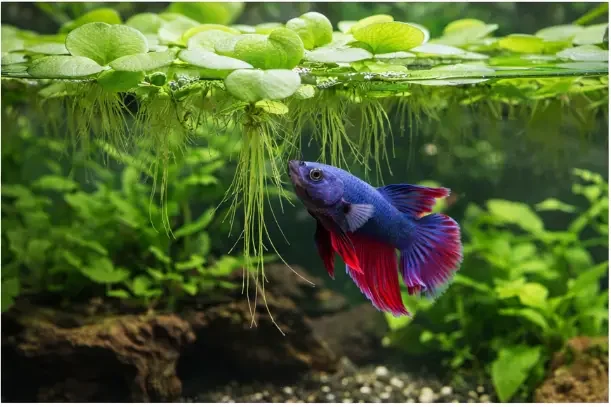
A betta hammock is a soft leaf on a suction cup that sits just below the water surface. It is not essential, but most bettas use one, because they like to rest near the top where they gulp air with their labyrinth organ. Long-finned males, older bettas and sick fish benefit most, since swimming up to breathe costs them more energy.
- Placement: a few inches below the surface, in a calm corner away from the filter outflow.
- Material: soft silk or plastic leaf with no sharp edges; run the pantyhose test.
- Cleaning: wipe off algae during water changes and replace the suction cup when it stops gripping.
- Alternatives: a floating betta log, or a broad live plant leaf such as Anubias near the surface.
If your betta ignores the hammock, try moving it closer to where it already likes to rest. A betta that always lies on the bottom instead may be unwell; see why is my betta lethargic.
How to Choose Betta Décor: Buying Criteria
Every decoration that goes near a betta should pass this checklist before it goes in the cart:
- Fin-safe surface: smooth, soft, or fabric. This is the deal-breaker, a betta’s fins are thin tissue and tear easily on stiff plastic edges.
- No entrapment gaps: avoid décor with narrow holes or slots a betta can swim into and get wedged. Caves should have openings clearly larger than the fish’s body, and ideally a second exit.
- Aquarium-rated material: only resin, ceramic, silk, glass, or aquarium-safe wood/stone. No painted craft items, no real metal, no porous rock you can’t identify.
- Provides a real function: the best décor isn’t just pretty, it’s an enclosed hide, a surface resting spot, or a sight break that lowers stress.
- Stable footing: caves and ornaments should sit flat and not topple if the betta bumps them or you do a water change.
- Cleanable: smooth surfaces you can wipe algae off beat fussy textured pieces that trap gunk.
Recommended Betta Tank Decorations
These are real, widely available décor products that betta keepers consistently recommend as fin-safe and functional. Pick at least one enclosed hide and one surface resting spot.
| Product | Best for | Key spec | Notes |
|---|---|---|---|
| Zoo Med Floating Betta Log | Best overall hide | Floating resin tube | Doubles as a near-surface rest, hide, and bubble-nest spot; smooth bore, no sharp edges |
| Zoo Med Betta Hammock (leaf) | Best surface rest | Soft silk leaf + suction cup | Cheap, fin-safe; gives the betta a leaf to lounge on near the top where it likes to rest |
| SunGrow / Generic Coconut Hut (with moss) | Best budget cave | Natural coconut shell | Inexpensive, fully natural, no sharp edges; sand off any rough rim before use |
| Marina / Imagitarium Silk Aquarium Plants | Best fake plant cover | Soft fabric leaves | Fin-safe alternative to plastic; passes the pantyhose test; multiple heights for sight breaks |
| Universal Rocks / Resin Smooth Cave | Best enclosed hide | Aquarium resin, wide mouth | Smooth interior, no trapping holes; choose one with an opening bigger than the fish |
| Malaysian / Spider Driftwood (aquarium-grade) | Best natural centrepiece | Pre-soaked hardwood | Natural cover and gentle tannins; soak before use; great anchor for Anubias/Java fern |
Editorial picks: Best overall, Zoo Med Floating Betta Log (hide + rest in one). Best budget, coconut hut plus a Zoo Med Betta Hammock. Best for a natural planted look, aquarium driftwood with silk plants filling the gaps. Avoid all stiff plastic plants regardless of price.
Sizing & Layout Specifics by Tank Size
- 3–5 gallon: one enclosed hide + one leaf hammock + 2–3 silk/live plants. Don’t overfill, leave a clear front swimming lane.
- 5–10 gallon: one or two hides, a hammock or floating log, a driftwood or rock centrepiece, and a planted background for sight breaks.
- Cave opening size: aim for an entrance noticeably wider than the betta’s body at its widest (with fins relaxed) so it never wedges.
- Vertical layering: bettas use the whole water column, combine a low cave, mid-height plants, and a near-surface rest for the most natural setup.

Why Décor Is Both Enrichment and Hazard at the Same Time
The defining tension in this whole topic is that the same ornament can be the best thing in the tank or the thing that maims the fish, and the difference is one property: its surface. Understanding why décor is simultaneously essential and dangerous is what turns “buy some decorations” into a real decision.
On the enrichment side, a betta is an intelligent, territorial, curious fish, and a bare tank is a genuinely impoverished environment for it. Without structure, bettas become bored and chronically stressed, and that state expresses as the classic problem behaviours owners then ask about separately, pacing the glass, “glass surfing,” and restless edge-patrolling. Cover changes this. A betta with hides and sight breaks is not a hidden, less-visible fish; counterintuitively it is usually a calmer, bolder, more active, and more colourful fish, because security reduces the baseline stress that was driving both the pacing and the washed-out colour. Décor, in other words, is not decoration for the owner, it is psychological infrastructure for the fish.
On the hazard side, that same fish trails large, thin, delicate fins that tear on any hard edge as it moves through its territory. A stiff plastic plant with moulded leaf tips, a jagged ornament, or a sharp rock does not need the fish to crash into it; the betta only has to brush past it during the normal patrolling that good décor is supposed to encourage. A single snag tears the fin, and a torn fin very reliably progresses to fin rot in anything less than perfect water, which is how a cheap ornament becomes weeks of treatment and a stressed, possibly disfigured fish.
So the goal is not “more décor” or “less décor”, it is specifically fin-safe décor that delivers the enrichment without the injury. Every recommendation and warning in this guide is just a consequence of holding those two truths at once: the betta needs structure to be healthy, and the wrong structure is one of the most common preventable injuries in the hobby. The pantyhose test, the material rules, and the layout advice all exist to resolve that single tension.
The Pantyhose Test, Done Like a Keeper
The pantyhose test is the most valuable ten seconds in this entire subject, because it is the only objective check that overrides packaging, brand claims, and how an item looks in the box. It deserves to be done properly rather than casually.
The method: take a piece of sheer nylon stocking or tights, chosen deliberately because it snags at roughly the threshold a betta’s fin tissue does, and draw it firmly over every surface, every edge, every leaf tip, every join, and the rim and interior of any cave. Move it the way the fish will actually meet the item: along and around edges and points, not just flat across a smooth face. If the nylon glides everywhere with no catching, pulling, or pilling, the item is fin-safe. If it snags, drags, or pulls a thread anywhere, that exact spot will catch a fin, and the item does not belong in a betta tank no matter what the label says.
Three things make the test trustworthy. First, test the whole item, not one representative surface, ornaments and plastic plants very often have safe broad areas and one vicious moulded tip or seam, and a single bad edge is enough to injure the fish. Second, the test must defeat assumptions in both directions: “betta-branded” plastic plants routinely fail it, while the occasional genuinely soft item passes, the nylon is the authority, not the marketing. Third, re-test fake items over time, because plastic that passed when new stiffens and develops frayed, sharp edges after months submerged; “safe once” is not “safe forever.” Anything that fails goes back to the store or stays out of the tank.
Material Safety: What’s Actually in the Decoration
Fin-safety covers physical injury; the second hazard category is chemical, and it is quieter because it does not produce a visible wound, it slowly poisons the water. The rule is to use only genuinely aquarium-rated materials, and it is worth understanding why each banned category is banned.
- Real metal. Metal objects can rust and leach metal ions into a small enclosed volume of water, which is toxic to fish. There is no safe casual metal ornament; if it is not explicitly aquarium-inert, it does not go in.
- Painted or craft items. Hobby and craft decorations are not formulated to be submerged indefinitely. Paints, sealants, and unknown plastics can leach into the water as they degrade. “It looks fine” is not reassurance, leaching is invisible.
- Unidentified porous rock. Random rock can contain metal veins or alter water chemistry, and porous stone can harbour and release whatever it absorbed. Only use stone you can positively identify as aquarium-safe and inert.
- Raw shells and coral (in most betta setups). These can slowly dissolve and shift hardness and pH, which is generally undesirable for a betta and a source of unwanted parameter drift.
- Anything small enough to swallow, or with entrapment gaps. This straddles physical and practical safety: small parts can be ingested, and narrow holes or slots are a wedging-and-stuck hazard for a fish that will try to explore them.
The safe-material whitelist is correspondingly short and easy to remember: aquarium resin, ceramic, glass, silk fabric, and properly sourced aquarium-grade wood and inert stone. The discipline is simple, if you cannot confidently say the material is aquarium-rated and inert, treat it as unsafe by default, because the cost of being wrong is a slow water-quality problem you may not connect to the ornament until the fish is already sick.

The Décor Every Betta Actually Needs (by Function, Not Looks)
Once safety is handled, the right way to choose décor is by the job each piece does for the fish, not by which ornament looks nicest. A well-set-up betta tank covers four functional needs.
An enclosed retreat
Every betta should have at least one fully enclosed hide, a smooth cave, tunnel, or coconut hut, that it can completely disappear into. This is the single highest-value piece because the ability to retreat at will is what lowers the baseline stress that otherwise drives glass-surfing and edge-pacing. The opening must be clearly wider than the fish’s body with fins relaxed, ideally with a second exit, so it can never wedge.
A near-surface resting spot
Bettas naturally rest near the top of the tank, propped on something, partly because they breathe air at the surface. A leaf hammock or a broad-leaved plant near the surface, or a floating log, gives them a place to do this. Owners who provide one often report the fish “sleeping” on it within days, a sign of a secure fish, not a sick one.
Sight breaks
Plants and ornaments that interrupt the line of sight reduce constant flaring at the betta’s own reflection and at tank mates or neighbouring tanks. Continuous flaring is a real, draining stressor; breaking up sightlines with cover is a direct, cheap mitigation.
Open swimming space
The final “feature” is restraint: a betta also needs clear lanes to patrol. A tank crammed wall-to-wall with décor is as poor as a bare one. The target is a balanced layout, secure cover and structure on the sides and back, an open swimming corridor kept clear, especially across the front.
Choosing by function this way prevents the two opposite mistakes: the bare “I added one plastic plant” tank that leaves the fish stressed and pacing, and the over-decorated tank that leaves it no room to be a fish. The aim is every safe piece earning its place by doing one of these four jobs.
Aquascaping a Betta Tank Step by Step
Knowing the right pieces is not the same as arranging them well. This is the sequence that produces a safe, enriching, low-maintenance layout.
- Pantyhose-test and material-check every item first. Nothing enters the cart, let alone the tank, until it has passed the snag test and is confirmed aquarium-safe material. This gate comes before any aesthetic decision.
- Rinse everything in plain dechlorinated water, never soap. New décor carries dust and residues; soap residue is toxic and no conditioner is meant to handle it. A thorough plain-water rinse is mandatory pre-install.
- Place the enclosed hide first. Set the cave or hut toward the back or side, sitting flat and stable so it cannot topple if bumped or during a water change. Build the rest of the scape around this anchor.
- Add height and sight breaks with plants. Use silk or live plants at varied heights along the back and sides to create cover and interrupt sightlines, leaving the front comparatively open.
- Add the surface resting spot. Position a leaf hammock or floating log near the top in a calm area, away from any filter outflow so it is genuinely restful.
- Protect the open corridor. Step back and confirm there is a clear, unobstructed swimming lane, especially across the front glass. If the tank looks busy, remove a piece, open space is a feature.
- Introduce or re-acclimate the fish calmly. If rescaping an existing tank, expect the territorial betta to need a short, calm settling period afterward; dim the light and minimise disturbance while it re-maps its territory.
The order matters: safety screening gates everything, the retreat is the structural anchor, and protecting open swimming space is the final sanity check that prevents over-decoration.
Décor Maintenance and Knowing When to Retire a Piece
Décor is not a one-time decision; safe items can become unsafe, and dirty items degrade water quality, so a small routine keeps the setup honest over the fish’s life.
On a routine basis, wipe visible algae off smooth décor during the regular water change, smooth surfaces are chosen partly because they clean easily, which is the practical payoff of avoiding fussy textured pieces that trap gunk. Rearranging décor occasionally provides genuine enrichment for an intelligent fish, but do it sparingly: too-frequent rescaping re-stresses a territorial betta that has just mapped its space, so novelty is a benefit only in moderation. Natural items like driftwood and coconut typically release tannins at first, tinting the water tea-coloured; this is harmless and can be reduced with pre-soaking or activated carbon if the look is unwanted, but it is not a safety issue.
The most important maintenance habit is periodic inspection for wear, because this is where a “safe” tank silently turns dangerous. Plastic that has aged underwater can go brittle and develop sharp, frayed edges; silk can stiffen and fray at the leaf margins; a cave can crack. Any item that has hardened, splintered, or developed a sharp edge should be removed immediately and re-tested with the pantyhose method before it is ever trusted again, and usually it is simpler to retire it. The principle that runs through the entire guide applies here too: the safety of the tank is a property of the décor’s surface today, not the day it was bought, so the test is not a one-time purchase gate but an ongoing habit.
Décor sits alongside everything else on the betta starter kit checklist. Pair fin-safe decorations with the right betta tank, a fin-safe substrate, and soft live or silk plants for a setup that enriches rather than injures.
Sources & Further Reading
Betta Care Hub, betta tank decoration; Acuario Pets, silk vs plastic for bettas; Bettafish.org, betta plants/décor; Petco, betta décor guidance.
Frequently Asked Questions
What decorations are safe for a betta?
Live or silk plants, smooth caves/tunnels, aquarium driftwood, leaf hammocks, and rounded ornaments with no sharp edges or small swallowable parts.
What decorations should I avoid for a betta?
Hard/jagged plastic plants and ornaments, sharp rocks, items with small trapping gaps, metal, and painted/non-aquarium objects.
How do I know if a decoration is safe for my betta?
Do the pantyhose test, rub nylon over it; if it snags or tears, it will tear your betta’s fins too.
Do betta fish need decorations?
Yes, bettas get bored and stressed in bare tanks. Décor provides enrichment and hides that make them calmer, more active, and more colourful.
Are plastic plants bad for bettas?
Hard/stiff plastic is, it tears fins. Use silk (fabric) plants or live plants instead.
Does my betta need a hiding spot?
Yes, at least one enclosed hide. Bettas with secure hides are actually more visible and less stressed than those in a bare tank.
Do bettas need a hammock?
Not essential, but most bettas use one. It gives them a resting spot near the surface where they breathe air, which helps long-finned, older and sick bettas most.
Where should I put a betta hammock?
A few inches below the water surface in a calm corner, away from the filter outflow, so the betta can rest and reach the surface easily.