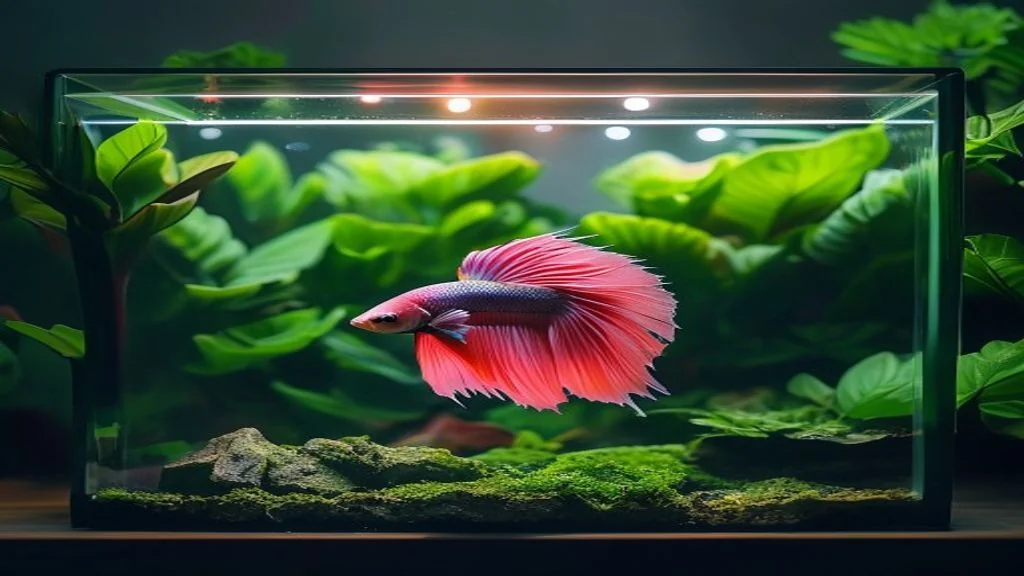
“Do betta fish need light?” sounds like a simple yes/no, but it’s really two questions in one: do they need light, and do they need darkness? The answer to both is yes. Bettas come from shallow, plant-shaded waters with a strong day–night rhythm, so the goal isn’t maximum brightness, it’s a predictable cycle. Get the schedule right and you’ll see better colour, calmer behaviour, and far less algae. Get it wrong and you’ll fight stress and green water for months.
Why Bettas Need Light (and Darkness)
Light sets a betta’s day–night rhythm: it cues activity, feeding, and, crucially, sleep. Bettas genuinely sleep and rest in darkness (see do bettas sleep); without a real “night” they don’t rest properly, which causes stress and faded colour over time. So lighting isn’t about you seeing the fish, it’s about giving it a stable, natural cycle.
The Ideal Lighting Schedule
| Setting | Recommendation |
|---|---|
| Light per day | 8–12 hours |
| Darkness per day | 12–16 hours (uninterrupted) |
| Best light type | Low-watt LED (economical, doesn’t heat water) |
| Direct sunlight | Avoid, causes temp swings & algae |
| Timer | Strongly recommended for consistency |
A cheap outlet timer is the best upgrade here, it locks in a consistent cycle so the betta isn’t at the mercy of when you remember to flip the switch.
Why LED, Not Sunlight or Strong Bulbs
- LED: low wattage, plenty of light, doesn’t warm the water, ideal. (Heat-producing bulbs can push temperature out of the ideal 78–80°F range.)
- Direct sunlight: causes temperature swings (a major stressor, see too hot) and fuels heavy algae and green water.
- Light too strong/long: stresses the betta, disrupts sleep, and turns the tank into an algae farm.
Signs Your Lighting Is Wrong
The fish and tank will tell you:
| Sign | Likely lighting issue |
|---|---|
| Hiding constantly when light is on | Too bright / no shade, add floating plants, dim it |
| Faded colour, restless, not resting | No real “night”, light on too long/24-7 |
| Heavy green algae / green water | Too much light or direct sun |
| Glass surfing under bright light | Stress, review glass surfing |
If your betta hides whenever the light is on, the answer isn’t “no light”, it’s softer light plus shade (floating plants, see floating plants for bettas) and a proper dark period.
How Many Hours of Light Does a Betta Need?
| Situation | Light per day | Notes |
|---|---|---|
| Betta only, no live plants | 8–10 hours | Low brightness is enough |
| Planted betta tank | 8–10 hours | Brighter light, same hours; more hours mainly grows algae |
| Algae problem | 6–8 hours | Cut hours first, then brightness |
| Sick or newly added betta | Shorter, dimmer days | Less light lowers stress while it recovers |
Whatever hours you pick, keep them the same every day. A cheap plug-in timer does this for you: for example, lights on at 9 a.m. and off at 7 p.m. If your betta lives in a bright room, the tank light can stay off on some days, but the room should still go dark at night.
Do Betta Fish Need Light at Night?
No, and it’s important they don’t have it. A small amount of ambient room light is fine, but a dedicated tank/night light running through the night prevents proper rest. Lights off, room calm, consistent schedule. Healthy rhythm is part of overall wellbeing, see signs of a happy betta.
How to Choose a Betta Tank Light: Buying Criteria
You don’t need an expensive reef light for a betta. You need the right kind of light, at the right intensity, on a timer. Use these criteria:
- Type: LED, every time. It runs cool, sips power, lasts for years, and won’t push your water temperature out of the 78–80°F range the way old incandescent hoods did.
- Intensity / dimmability: for a fish-only tank, low-to-medium brightness is plenty. If you keep live plants, you’ll want a stronger light, but a dimmable model lets you serve both the betta and the plants.
- Colour temperature: roughly 6500K (daylight white) looks natural and grows plants well. RGB lights are fine if you can dial them down, neon-bright colour settings stress some bettas.
- Fit: match the fixture to your tank’s footprint. A clip light suits small 3–5 gallon tanks; a full hood or extendable bar suits 5–10 gallon tanks.
- Timer/controller: built-in scheduling is a genuine upgrade. If the light lacks it, a $10 outlet timer does the same job.
- Splash safety: choose a fixture rated for aquarium use with a moisture-resistant design, it sits directly over open water.
Recommended Betta Lights & Timers
These are real, commonly recommended aquarium LEDs and timers suited to a 3–10 gallon betta tank. Pick by tank size and whether you keep live plants.
| Product | Best for | Key spec | Notes |
|---|---|---|---|
| NICREW ClassicLED | Best overall value LED | ~6500K white+blue, low watt | Cheap, reliable, fits 5–10 gal; pair with a timer; ample for fish + easy plants |
| Fluval Plant 3.0 (Nano) | Best for live-planted tanks | Full-spectrum, app-scheduled, dimmable | Premium; built-in sunrise/sunset; overkill for fish-only but excellent for plants |
| NICREW Single-Channel / Clip LED | Best for small tanks (3–5 gal) | Low-watt clip-on | Tidy clip mount, gentle output, ideal for a nano betta tank |
| Hygger Clip-On Aquarium Light | Best budget clip light | Adjustable brightness | Inexpensive, dimmable, good for shy bettas that want softer light |
| Finnex Stingray | Best slim low-tech planted light | Daylight LED, low profile | Grows low-light plants without algae blooms; sleek over rimless tanks |
| BN-LINK / Century Outlet Timer | Best add-on (any light) | 24-hr mechanical/digital timer | Turns any non-smart light into a consistent cycle, the highest-value cheap upgrade |
Editorial picks: Best overall, NICREW ClassicLED on a BN-LINK timer. Best for a planted betta tank, Fluval Plant 3.0. Best for a small 3–5 gallon tank, NICREW clip LED or Hygger Clip-On. Best budget combo, any Hygger clip light plus a mechanical outlet timer.
The Real Question Is Not Light vs No Light — It’s Rhythm
Almost every lighting mistake owners make comes from framing this as “should the light be on or off.” That is the wrong axis. A betta does not primarily need a certain amount of light; it needs a predictable daily cycle of light and darkness. Reframing the question from brightness to rhythm makes every recommendation in this guide fall into place.
Bettas evolved in shallow, plant-shaded tropical water with a strong, regular day–night pattern. Their biology is built around that cycle. Light is the external cue (the technical term is a zeitgeber) that sets their internal clock, it tells the fish when to be active, when to expect food, and, critically, when to rest. Darkness is not merely “the light being absent”; it is an active, necessary phase during which the fish genuinely sleeps and recovers. Bettas rest in the dark, and without a real, consistent night they do not get that recovery, which over time produces stress, washed-out colour, and restless behaviour. So the dark hours are not wasted hours when you cannot see the fish, they are doing physiological work just as the lit hours are.
This is why both extremes fail and why the guide keeps returning to consistency. A tank left lit around the clock denies the fish its rest phase entirely; a tank kept in permanent gloom denies the cue that organises its day. Even a “correct” number of light hours delivered erratically, on whenever someone remembers, off whenever they forget, fails, because the value is in the regularity, not the dose. The single most useful sentence in this whole topic is that the betta responds to a stable cycle, not to a particular brightness. Once that is understood, “how many hours” and “what light” become implementation details of one goal: a dependable, repeating day and night.
What a Disrupted Light Cycle Actually Does to the Fish
“Too much light stresses the betta” is repeated everywhere, but knowing the mechanism is what makes owners actually fix it instead of treating it as optional.
The most direct effect is on sleep and stress. A betta with no genuine dark period cannot enter its proper rest state. Chronic rest deprivation in fish manifests the same way it does broadly in animals, elevated baseline stress. That stress is not abstract; it suppresses the immune system, which is the common gateway into opportunistic disease, and it expresses behaviourally as the exact symptoms owners later ask about separately: restlessness, glass-surfing, and a fish that never seems to settle. A persistently lit tank is therefore not a neutral convenience for the owner; it is a low-grade, continuous stressor on the fish.
Colour is the visible casualty. Bettas often display their best colour when they are well-rested and unstressed; a fish denied a proper night frequently fades over weeks, and owners misread this as a diet or water issue when the cause is the lighting. There is also a hiding response: a betta that bolts for cover the instant the light comes on, or stays hidden while it is on, is usually telling you the light is too bright or the tank has no shaded refuge, not that it wants total darkness. The correct interpretation of “he hides under the light” is “soften and shade the light and give a real night,” not “remove light entirely.”
Finally there is the environmental consequence, which loops back onto the fish. Light is the energy source for algae. Excess photoperiod or any direct sun turns the tank into an algae farm and can cause green water, which degrades the environment and the viewing experience and competes with the system’s balance. So a bad light regime damages the betta through two routes at once, directly via stress and rest deprivation, and indirectly by fouling its environment with algae. Both routes are eliminated by the same fix: a moderate, consistent, timer-locked cycle out of direct sun.
Designing the Schedule Around Your Life, Not Against It
The recommended target is roughly 8–12 hours of light and a continuous 12–16 hours of true darkness. The practical art is fitting that to a real household so the cycle stays consistent without depending on memory.
The key realisations are that the lit period should overlap when you are actually around to enjoy the tank (the legitimate reason people want light in the first place), and that the dark period must be one long unbroken block, not darkness chopped up by the light flicking on and off through the evening. A workable pattern for most people is to have the light come on in the late afternoon and run through the evening for nine to ten hours, then a single uninterrupted dark stretch of fourteen to fifteen hours overnight and through the part of the day nobody is home. This gives the owner prime viewing time, gives the fish a generous, unbroken night, and keeps total light moderate enough to limit algae.
Crucially, this schedule should be handed to a timer rather than to a human. Manual switching fails not because owners are careless but because consistency over months is exactly what people are bad at and machines are good at, the inevitable forgotten nights and accidental all-nighters are precisely the irregularity the fish is harmed by. A timer converts intention into a reliable cycle automatically, which is why it is repeatedly called the single highest-value, lowest-cost upgrade in betta lighting. Set the on/off blocks once, then leave the schedule alone for several weeks; the fish responds to stability over time, and constant tweaking is itself a mild form of the irregularity you are trying to remove.

Choosing and Positioning the Light: The Reasoning
The buying criteria above are best understood as consequences of two priorities a betta keeper actually has: do not destabilise the water temperature, and serve the fish (and any plants) without overdoing intensity.
Why LED specifically
The dominant reason is heat. A betta needs a stable 78–80°F, and old incandescent-style hoods dump significant heat into the water, which can push the temperature out of range and, worse, create swings. An LED produces ample light while running cool, sips power, and lasts for years. The cool-running property is not a minor efficiency note, for a small tank it is a temperature-stability decision, which is why “LED, every time” is the rule.
Intensity and the plant question
For a fish-only betta tank, low-to-medium brightness is plenty; the fish does not need a powerful light and a too-bright one tends to make it hide. The complication is live plants, which do need more intensity. The clean solution is a dimmable or appropriately specced planted LED, so a single fixture can serve a moderate level for the fish or be turned up for the plants, rather than blasting a fish-only tank with reef-grade light it does not want or starving plants under a fixture that is too weak.
Colour temperature and fit
Around 6500K daylight-white looks natural to the eye and grows plants well, which is why it is the default suggestion; bright RGB on a harsh neon setting can stress some bettas, so RGB is fine only if it can be dialled down. Fixture choice is just matching the form to the tank footprint, a clip light for small 3–5 gallon tanks, a hood or bar for 5–10 gallon tanks.
Position: control the only light source
Placement is the most underrated decision. The entire schedule strategy assumes you control the light, so the tank must be away from a window. Direct or strong indirect sun acts as a powerful, uncontrollable second “sun” that both fuels algae and drives temperature swings, defeating the timer-locked cycle and the temperature stability you chose an LED to protect. Siting the tank out of sunlight is what makes the rest of the lighting plan actually work.
Lighting and Algae: Why the Fix Is Almost Always Less Light
Algae is the most common lighting side-effect, and owners reliably respond to it backwards, by scrubbing harder while changing nothing about the light. Since light is literally the fuel source for algae, the durable fix is almost always on the light side, not the cleaning side.
Work it in order of likelihood. First, suspect the photoperiod: trim the lit hours by an hour or two before doing anything drastic, because excess light duration is the most common driver. Second, hunt down any sunlight reaching the tank and eliminate it; uncontrolled sun is a frequent hidden cause that no amount of glass-wiping will solve while it continues. Third, check the timer is actually firing, a stuck or mis-set timer silently leaving the light on around the clock is a classic, easily-missed reason for a sudden algae explosion, and it also means the fish has lost its night. Only alongside these does mechanical cleaning belong: wipe the glass during routine water changes, and lean on live or floating plants, which outcompete algae for the same nutrients and are one of the most effective long-term suppressants.
The unifying point connects straight back to the rhythm principle: a tank with an algae problem very often also has a fish with a rest problem, because both are usually symptoms of the same root cause, too much light, delivered too long, or never properly switched off. Fixing the photoperiod typically improves the algae and the fish’s wellbeing at the same time, which is why “less light, not more scrubbing” is the rule.
Common Betta Lighting Mistakes (and the Correct Response)
Most lighting problems reduce to a short list of recurring errors, each tied to a principle above.
- Leaving the light on 24/7 “to watch the fish.” The single biggest mistake, it denies rest, fades colour, stresses the fish, and grows algae. Fix: a timer-locked cycle with a real 12+ hour night.
- Switching the light manually on whim. Produces the irregularity the fish is actually harmed by. Fix: hand the schedule to a timer and stop relying on memory.
- Tank on or near a windowsill. Sunlight is an uncontrollable second sun causing temperature swings and algae. Fix: relocate out of all direct and strong indirect sun.
- Reading “hides under the light” as “wants darkness.” It usually means too bright or no shade. Fix: dim or raise the light, add floating-plant cover, keep a proper night.
- Blasting a fish-only tank with a bright RGB light at full intensity. Over-intense, sometimes neon light stresses some bettas. Fix: dim it or use a moderate daylight-white setting.
- Adding more light hoping plants grow faster when algae appears. Feeds the algae further. Fix: reduce the photoperiod and let plants outcompete the algae.
- Using a heat-producing bulb on a small tank. Pushes temperature out of the 78–80°F range and causes swings. Fix: switch to a cool-running LED.
- Constantly tweaking the schedule. Undermines the consistency the fish responds to. Fix: set a sensible cycle and leave it alone for weeks.
Every entry is the same lesson in a different costume: a betta needs a moderate, consistent, machine-enforced day–night cycle from a cool LED, out of the sun, and almost every problem here is a departure from that one rule.
Lighting is one piece of a complete setup, see the full betta starter kit checklist, choose the right betta tank, and add live plants that thrive under a basic LED.
Sources & Further Reading
Hepper, Do Betta Fish Need Light?; FishkeepingWisdom, betta light schedule; Bettaboxx, lighting; PetMD-style guides, betta lighting.
Frequently Asked Questions
Do betta fish need light?
Yes, but on a schedule, about 8–12 hours of light and 12–16 hours of darkness daily, ideally from a low-heat LED on a timer.
How many hours of light do bettas need?
8–12 hours per day, followed by a long, uninterrupted dark period for proper rest.
Do betta fish need light at night?
No. They need darkness to sleep. Avoid a dedicated tank/night light running overnight; a real “night” is essential.
Is sunlight good for a betta tank?
No, direct sunlight causes temperature swings and heavy algae. Use artificial LED light and keep the tank out of direct sun.
What kind of light is best for a betta?
A low-wattage LED, it provides ample light without heating the water and is energy-efficient.
Can too much light hurt a betta?
Yes, it causes stress, disrupts sleep, fades colour, and promotes algae. Stick to the 8–12 hour schedule.
Can betta fish see in the dark?
Not well. Bettas are daytime fish that rely on light to see. In darkness they rest and sense movement through their lateral line, which is why they need a calm, dark night.
Should I turn my betta light off at night?
Yes. Turn the tank light off at night so your betta gets 12 or more hours of darkness to rest. A timer makes this automatic.