Choosing the best substrate for a betta tank is one of those decisions new keepers rush through in the store, grab the colour they like, dump it in, done. Then a week later the betta’s flowing fins are split and ragged, or the water turns cloudy and never clears. The substrate is the single biggest surface in the tank and it touches your fish, your plants, and your beneficial bacteria all at once. This guide walks through sand vs gravel vs bare-bottom the way an experienced keeper actually thinks about it: fin safety first, then biology, then looks.
The Quick Verdict
| Substrate | Best for | Watch out for |
|---|---|---|
| Fine sand | Natural look, fin safety, waste sits on top | Must stir gently to prevent anaerobic gas pockets |
| Smooth/rounded gravel | Easy cleaning, rooted plants, bacteria surface area | Buy smooth only, sharp gravel cuts fins |
| Sharp/jagged gravel | Nothing, avoid | Tears delicate betta fins → fin rot |
| Bare bottom | Hospital / breeding tanks | Not ideal for a display tank (no bacteria bed, stressful) |
How Much Substrate & Setup
- Depth: ~1 inch for a fish-only tank; ~2 inches if you have rooted live plants.
- Rinse thoroughly before adding, unrinsed substrate clouds the water for days.
- Add it before water and fish, during initial tank setup.
- Vacuum weekly with a siphon during water changes (how to clean a betta tank), trapped waste under substrate becomes ammonia.
How to Choose Substrate: The Buying Criteria
When you stand in the aquarium aisle, run every bag through this mental checklist before it goes in the cart. These are the criteria that actually matter for a long-finned fish:
- Fin safety (non-negotiable): grain edges must be smooth or fine. This single factor outranks colour, price, and brand. A betta drags its fins across the bottom constantly while resting and exploring.
- Grain size: too fine and it compacts into airless layers; too large and uneaten food and waste fall into the gaps and rot out of reach of your siphon. Fine sand or 2–3 mm rounded gravel is the sweet spot.
- Inertness: for a standard betta tank you want a pH-neutral, non-dissolving substrate. Crushed coral or aragonite raise hardness and pH and are the wrong choice for a soft-water fish like a betta.
- Plant compatibility: if you want rooted plants (swords, crypts), you need a substrate that holds roots, gravel or an aquasoil, not a thin layer of slick sand.
- Maintenance reality: be honest about how often you’ll vacuum. Sand shows every speck (good, you’ll clean it); deep gravel hides waste (bad if you skip vacuuming).
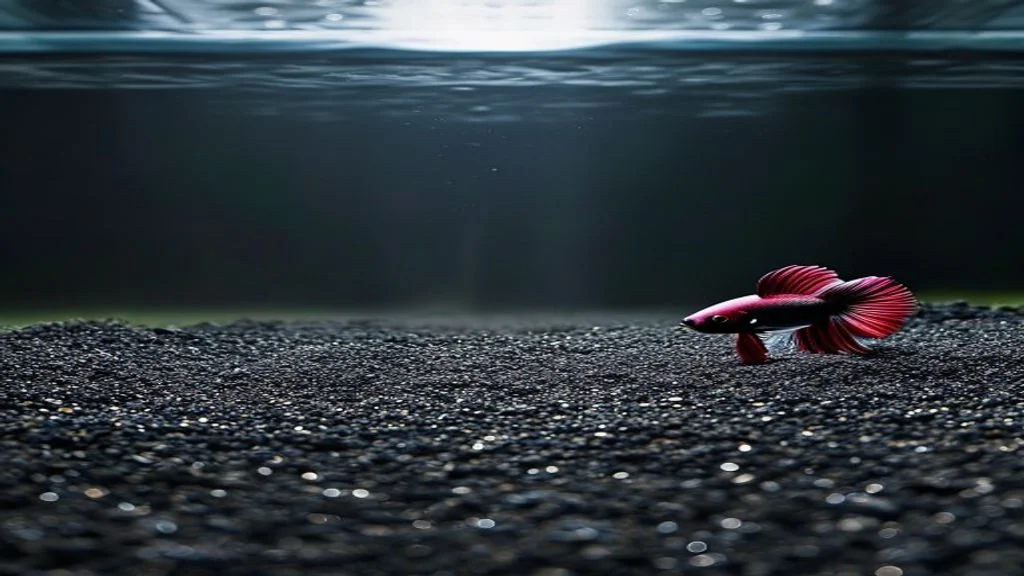
- Colour: last on the list. Very bright or white substrate can wash out a betta’s colour and show algae fast; natural tan/brown/black tends to look best and make the fish “pop”.
Choosing the Best Substrate for a Betta Tank: Recommended Products
These are real, widely stocked aquarium substrates that betta keepers reliably recommend. No brand here has sharp grains when used as directed. Choose based on whether you want a planted tank, an easy-clean tank, or the most natural look.
| Product | Type | Best for | Notes |
|---|---|---|---|
| CaribSea Super Naturals (Moonlight Sand / Sunset Gold) | Fine inert sand | Best overall: natural look + fin safety | Pre-rinsed, pH-neutral, soft rounded grains; rinse lightly and stir weekly |
| Imagitarium / Aqua One Smooth Aquarium Gravel | Smooth rounded gravel | Best for easy cleaning | 2–4 mm rounded; great bacteria bed; vacuums in seconds; choose natural tones |
| Fluval Stratum | Aquasoil (planted) | Best for live-planted betta tanks | Lightweight, root-feeding, slightly lowers pH (betta-friendly); cap with sand if it clouds |
| Seachem Flourite Black (or Flourite Sand) | Porous clay gravel | Best long-term planted look | Never needs replacing; rinse very well (it runs dirty); black makes colours vivid |
| CaribSea Eco-Complete | Planted substrate | Best low-effort planted base | Comes packed with beneficial bacteria; good for first-time plant keepers |
| Pool filter sand (food-grade) | Inert sand | Best budget | Cheap by the bag, fin-safe, uniform grain; rinse thoroughly, it starts very dusty |
Editorial picks at a glance: Best overall, CaribSea Super Naturals sand. Best budget, food-grade pool filter sand. Best for a planted betta tank, Fluval Stratum. Best for someone who hates cleaning, smooth rounded gravel (waste sits where the siphon can reach the top layer easily).
Setup Step-by-Step
- Rinse substrate in a clean bucket (no soap, ever) until the runoff is mostly clear.
- Add the rinsed substrate to the empty tank and shape your slope.
- Place a plate or bowl on the substrate and pour water onto it slowly so you don’t dig craters or cloud the tank.
- Plant any rooted plants now while you can still see the substrate clearly.
- Start your nitrogen cycle, the substrate will become a major home for beneficial bacteria over the next few weeks.
- Only add the betta once the tank is cycled and parameters are stable.
Common Substrate Mistakes
- Buying sharp/jagged gravel for a long-finned betta.
- Too-deep sand with no stirring (toxic gas pockets).
- Not rinsing substrate (cloudy water for days, see cloudy water).
- Never vacuuming under decor/substrate (hidden waste, ammonia).
- Using a bare bowl/tank as a permanent home (stressful, see can bettas live in bowls).
- Choosing a brilliant-white substrate, then wondering why algae and the betta’s washed-out colour are so obvious.
- Picking aquasoil for a fish-only tank and fighting cloudiness you didn’t need to deal with.
Why Substrate Is Three Decisions Pretending to Be One
New keepers treat substrate as a single cosmetic choice, pick a colour, pour it in. In reality the substrate is the largest single surface in the tank and it is quietly doing three different jobs at once, and a good choice is one that does not fail any of them. Understanding the three jobs is what turns “which colour” into the decision an experienced keeper actually makes.
The first job is physical contact with the fish. A betta is not a mid-water fish that ignores the floor; it rests on the bottom, props itself on the substrate, and drags its long, delicate fins across it constantly while exploring. That means the substrate is in repeated direct contact with the most fragile part of the fish. This is why fin safety is not one consideration among several, it is the gate every other consideration has to pass through, because a substrate that fails here injures the fish no matter how good it is at everything else.
The second job is biological. The substrate is one of the largest homes in the tank for the beneficial bacteria that drive the nitrogen cycle, converting toxic ammonia and nitrite into far less toxic nitrate. The choice and depth of substrate affect how much bacterial surface area you have and how stable the cycle is. It is also where uneaten food and waste collect, which means substrate choice directly determines whether that waste sits visibly on top where a siphon can reach it or falls into gaps and rots out of reach, feeding ammonia.
The third job is botanical and aesthetic. If you want rooted plants, the substrate has to physically anchor roots and, ideally, feed them, a thin layer of slick sand will not do what an aquasoil does. And colour, the thing beginners lead with, genuinely affects how the fish looks and how visible algae is, which is why it belongs on the list but at the bottom of it.
Every recommendation in this guide is just the result of refusing to let any of these three jobs fail. Fin safety first because it is contact with the fish; biology and maintenance second because that is water quality; plants and colour last because they matter but never at the expense of the first two. “Which substrate” is really “which one does all three jobs without failing the fish on any of them.”
Sand vs Gravel vs Bare Bottom: The Decision Reasoned Out
The quick verdict table gives the answer; this is the reasoning, so you can adapt it to your own tank instead of memorising a rule.
Fine sand: the natural, fin-safe default
Sand wins on the first job decisively: the grains are too fine to have any edge that can catch a fin, so it is inherently fin-safe, and it suits a bottom-resting fish well. It also has a maintenance advantage that is easy to miss, waste sits visibly on the surface rather than disappearing into gaps, so it is easy to siphon and you can actually see when the tank needs attention. Its one real weakness is biological/physical: if piled too deep, the lower layer goes anaerobic and can generate hydrogen sulfide (a rotten-egg gas) that is released harmfully if the bed is suddenly disturbed. That weakness is fully managed by keeping sand shallow and stirring it gently and regularly, which is why sand is a default rather than a problem.
Smooth, rounded gravel: the easy-clean, plant-friendly option
Gravel’s strengths are biological and botanical: it offers large surface area for beneficial bacteria, it anchors rooted plants well, it vacuums easily, and it is far too large for a betta to swallow. Its single critical weakness is the first job, much aquarium gravel has sharp, jagged edges that snag and tear a betta’s fins, which opens the door to fin rot. This is why the rule is not “gravel is bad” but “smooth, rounded gravel only.” Gravel is an excellent betta substrate precisely and only when it passes the fin-safety gate.
Bare bottom: a tool, not a home
A bare-bottom tank maximises one thing: cleanliness and the ability to sterilise, which is exactly what a hospital or breeding tank needs. But it fails the biological job (little surface for a bacterial bed) and is generally a less enriched, more stressful environment for a display fish with no natural floor to interact with. That trade-off is right for a treatment or breeding context and wrong for a permanent home, which is the entire reason bare-bottom is filed as a special-purpose option, not a recommendation.
Read together, the three options are simply different balances of the same three jobs, and the “best” one is whichever balance fits your specific tank, with the fin-safety job acting as a non-negotiable filter on all of them.
The Pantyhose Test for Substrate, and Why It’s Non-Negotiable
Because fin safety is the gate every substrate must pass, you need an objective way to check it that does not rely on how the bag looks or what the label claims. The same nylon test used for fake plants and décor is the answer, and it is worth doing properly.
The method: before buying, take a handful of the gravel and draw a piece of sheer pantyhose or nylon stocking firmly through and across it, and rub the grains against the nylon the way fin tissue will move across them in the tank. If the nylon snags, pulls, catches, or tears, the grains have edges sharp enough to do the same to a betta’s fins, and the substrate fails, regardless of price, colour, or branding. If the nylon slides through cleanly, the grains are smooth enough to be fin-safe. Fine sand passes this automatically; the test exists mainly to catch sharp gravel before it ever reaches the fish.
Two points make it reliable. First, it is a ten-second check that prevents one of the single most common preventable injuries in the hobby, torn fins leading to fin rot, so the time-to-value ratio is enormous. Second, it must override assumptions: substrate marketed for aquariums, or in attractive natural colours, can still fail badly, so the nylon is the authority and the packaging is not. Anything that fails the test goes back on the shelf; there is no colour or price that compensates for grains that catch fins.
The Anaerobic Pocket Problem: Sand’s One Real Risk, Solved
Sand’s only genuine danger is widely repeated but rarely explained, so owners either ignore it or over-fear it. Understanding the mechanism lets you use sand confidently.
In a deep, undisturbed sand bed, oxygen does not penetrate to the lower layers. In that oxygen-free zone, certain bacteria metabolise differently and produce hydrogen sulfide, the gas responsible for a rotten-egg smell. Left alone, small pockets are not necessarily catastrophic, but the real hazard is a sudden large release: if a deep, gas-laden bed is abruptly dug up or heavily disturbed, a slug of hydrogen sulfide can enter the water column at once, which is harmful to the fish in a small tank.
The fix follows directly from the cause and is simple. Keep sand shallow, roughly an inch, up to about 1.5 inches, and below the depth where large anaerobic zones establish; do not pile it 2-plus inches deep. Then gently disturb the bed on a routine basis: lightly run a finger or a chopstick through the deeper areas every week or two during maintenance so any accumulating gas is released gradually and harmlessly before it can build into a dangerous pocket. That is the whole solution. Shallow plus regular gentle stirring converts sand’s one serious weakness into a non-issue, which is precisely why sand remains a recommended default rather than a substrate to avoid.
Matching Substrate to the Specific Tank
There is no single universally best substrate; the right answer shifts with what the tank is for. Reasoning from the three jobs beats copying someone else’s setup.
- Fish-only display tank. Fin safety and easy maintenance dominate; plant-root support is irrelevant. Fine inert sand or smooth rounded gravel in a shallow layer is ideal, choose by whether you prefer waste sitting visibly on sand or the quick vacuuming of gravel.
- Live-planted tank with rooted species. Now the botanical job matters: you need a substrate that anchors and feeds roots, so an aquasoil or porous clay planted substrate beats plain sand for swords and crypts. Expect to prioritise the plants’ needs while still keeping the surface fin-safe.
- Low-tech tank with only rhizome/floating plants. Anubias, Java fern, and floating plants do not root in substrate, so plant-root support is unnecessary; pick purely on fin safety and maintenance, typically shallow sand or smooth gravel.
- Hospital or quarantine tank. The ability to sterilise and observe the fish completely outweighs biology and aesthetics; bare bottom is correct here precisely because it sacrifices the bacterial bed for cleanliness and control.
- Breeding tank. Like a hospital tank, bare or minimal bottom is usual so eggs and fry are visible and the tank is easy to keep pristine; this is a deliberate, temporary trade-off, not a model for a permanent home.
- Soft-water betta in any setup. Across all of the above, keep the substrate inert and pH-neutral. Crushed coral or aragonite raise hardness and pH and are the wrong choice for a soft-water fish like a betta, regardless of how the tank is otherwise configured.
The unifying logic is to weight the three jobs according to the tank’s purpose, but never to let the fin-safety job be outvoted, because that one is a hard requirement in every case.
Substrate Over the Long Term: A One-Time Decision Done Right
The encouraging conclusion is that substrate, chosen correctly, is close to a permanent decision rather than a recurring cost or chore. Quality inert substrate, clean sand, porous clay gravel, established planted substrates, essentially never needs wholesale replacement; it just needs cleaning. There is no replacement schedule the way there is for, say, a heater. This is why it is worth getting right once: the choice you make at setup is one you live with for the life of the tank.
The ongoing work is modest and follows from the three jobs. For the contact-with-fish job, the requirement was satisfied at purchase by passing the nylon test, and only needs re-checking if you ever add new material. For the biological/maintenance job, the routine is a weekly siphon during the water change, pushing the siphon into gravel to lift trapped debris, or hovering it just above sand to pull waste without removing the sand, plus, for sand specifically, the gentle periodic stir that prevents gas pockets. For the botanical job, planted setups simply benefit from a root tab pushed near heavy root-feeders every month or two. None of this is heavy maintenance; it is a few minutes folded into the water change you are already doing.
Framed across the whole life of the tank, substrate is a high-leverage, low-recurring-cost decision: get the fin-safety gate and the depth right at the start, do a couple of minutes of routine vacuuming and (for sand) stirring, and it will quietly support the fish, the bacteria, and the plants for years without ever needing to be redone. The mistakes that haunt people, sharp gravel, too-deep unstirred sand, unrinsed cloudiness, never vacuuming, are all front-loaded decisions or skipped two-minute habits, which is exactly why a little care at setup pays off for the entire duration of the tank.
Substrate is just one line on the full betta starter kit checklist, pair the right substrate with the correct betta tank, fin-safe decorations, and the right live or silk plants for a complete, low-stress setup.
Sources & Further Reading
Hepper, Best Substrate for Betta Tanks; Betta Care Fish Guide, substrate guide; BRS, sand vs gravel vs soil; Bettaboxx, betta gravel/substrates.
Frequently Asked Questions
What is the best substrate for a betta tank?
Fine sand or smooth, rounded gravel. Both are fin-safe and support beneficial bacteria. Avoid sharp/jagged gravel, which tears betta fins.
Is sand or gravel better for bettas?
Both work. Sand is fin-safe and natural with waste on top (stir to avoid gas pockets); gravel is easiest to clean and best for rooted plants, just choose smooth gravel.
Is gravel bad for betta fish?
Only sharp gravel is, it snags and tears their delicate fins, risking fin rot. Smooth, rounded gravel is perfectly safe.
Can a betta live in a bare-bottom tank?
It’s fine for hospital or breeding tanks but not ideal as a permanent home, substrate hosts beneficial bacteria and a bare display tank can be more stressful.
How deep should betta tank substrate be?
About 1 inch for a fish-only tank, ~2 inches if you keep rooted live plants.
What is the best substrate for a planted betta tank?
An aquasoil like Fluval Stratum or a porous clay gravel like Seachem Flourite. Both feed roots and hold plants; Stratum also gently lowers pH, which suits bettas.
Is sand or rocks better for betta fish?
Fine sand or smooth, rounded gravel are both safe. Avoid sharp rocks and jagged gravel, which tear betta fins. Sand looks natural; smooth gravel is easier to vacuum and better for rooted plants.
Do bettas need substrate?
Not strictly, but a display tank does better with it. Substrate holds beneficial bacteria, anchors plants and reduces reflections that stress bettas. Bare bottoms are best kept for hospital and breeding tanks.