
The best betta water test kit is the single most important piece of equipment most owners do not buy, and “my betta died for no reason” very often turns out to be an untested water problem. Ammonia, nitrite, and pH crashes are invisible; a test kit is literally the only way to see the most common killers before they act. This guide compares the well-known kits side by side, explains exactly what to test and how often, and shows the beginner mistakes that make testing useless even when you own a kit.
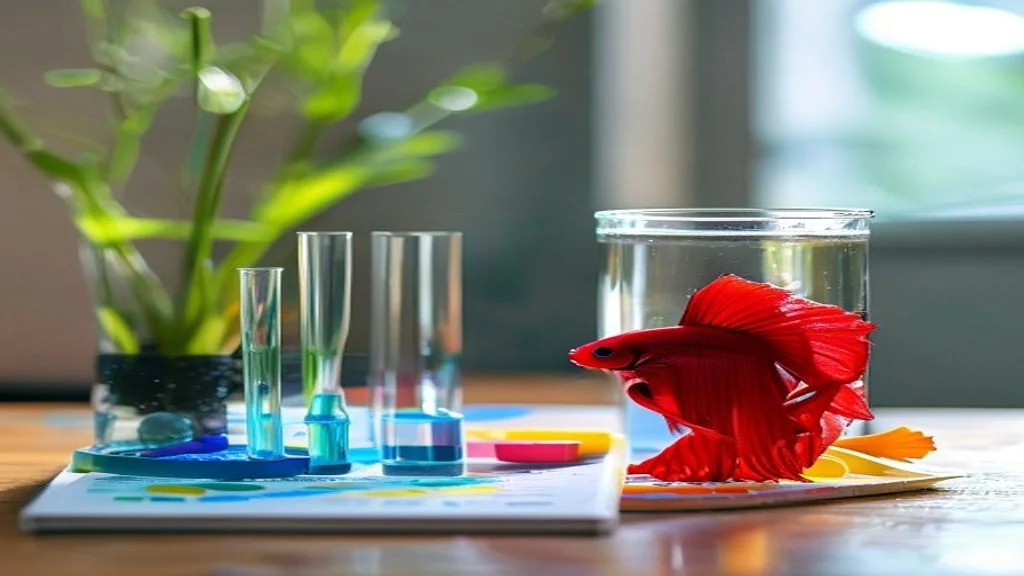
Why Testing Is Non-Negotiable
The three most common water killers, ammonia, nitrite, and a pH crash, are all invisible. The water looks perfectly clear while it’s killing the fish. A test kit is literally the only way to see them coming. “My betta died for no reason” very often means “I never tested the water”.
What You Must Test (and target values)
| Parameter | Target | Guide |
|---|---|---|
| Ammonia | 0 ppm | Ammonia poisoning |
| Nitrite | 0 ppm | Nitrite poisoning |
| Nitrate | <20 ppm | Nitrate levels |
| pH | 6.5–7.8 and stable (around 7.0 is typical) | Ideal pH |
| KH (bonus) | Enough to hold pH steady | pH crash |
| Temperature | 78–80°F | Water temperature |
Full target sheet: betta water parameters chart.
How Often to Test
| Situation | Testing frequency |
|---|---|
| New tank / cycling | Every 1–2 days (ammonia & nitrite especially) |
| Established stable tank | Weekly, around water-change day |
| Fish looks unwell | Immediately, water first, before medicating |
| After adding fish/plants/changes | Next day, then monitor |
Common Testing Mistakes
- Not owning a kit at all, the biggest mistake of all.
- Relying only on strips for critical readings (ammonia/nitrite).
- Not testing during cycling, when it matters most.
- Medicating a “sick” fish without testing water first.
- Reading results in poor light or after expiry of reagents.
The Best Betta Water Test Kit: Top Options Compared
You do not need every product on the shelf, you need one accurate liquid master kit, and optionally a few add-ons. The well-known options below all do the job they are designed for; the differences are scope, accuracy, and running cost. (No affiliate links, buy whatever reputable kit is available in your region.)
| Test kit | Tests | Accuracy | Cost per test | Best for |
|---|---|---|---|---|
| API Freshwater Master Test Kit | pH, high-range pH, ammonia, nitrite, nitrate | High & reliable | Very low (≈800 tests/kit) | The standard all-rounder, recommended for every betta keeper |
| API GH & KH Test Kit | General hardness, carbonate hardness (buffering) | High | Very low | Essential add-on for diagnosing/preventing pH crashes |
| Salifert / Sera liquid kits | Individual parameters (ammonia, nitrate, etc.) | High | Low–moderate | Buying single tests rather than a full master kit |
| Tetra EasyStrips / API 5-in-1 Strips | pH, KH, GH, nitrite, nitrate (ammonia usually needs a separate strip or liquid test) | Approximate | Higher per test | Quick spot checks and travel only, not for critical readings |
| Seachem Ammonia Alert | Continuous ammonia (free ammonia) badge | Rough, ongoing | Replaced ~1 year | A passive backup early-warning, not a primary tool |
| Digital pH meter | pH only (very precise) | Very high (needs calibration) | Calibration fluid cost | Frequent precise pH work; pair with a liquid kit for the rest |
Practical recommendation: a liquid master kit (the API Freshwater Master Test Kit type) plus a separate GH & KH kit covers everything a betta keeper realistically needs, ammonia, nitrite, nitrate, pH, and the KH that predicts pH crashes, for the lowest long-term cost. Strips are acceptable only as a fast convenience check, never for confirming an ammonia or nitrite emergency.
Why Liquid Beats Strips for the Readings That Matter
The reason experienced keepers are almost unanimous on this is accuracy where it counts. Test strips read by eye against broad colour bands and degrade quickly if the bottle is exposed to humidity; for nitrate or a rough pH that is tolerable, but for ammonia and nitrite, the two readings that determine whether your fish lives through the night, “approximately zero” is not good enough. Many strip kits do not test ammonia reliably at all. A liquid reagent kit measures a defined water volume with a precise drop count and a longer colour-development time, giving a result you can actually act on. The few extra minutes a liquid test takes are the cheapest insurance in the hobby.
Step-by-Step: Reading Results Accurately
- Test at a consistent time: ideally the same time of day, since pH in particular varies between day and night.
- Use the exact drop count and shake/wait times. Reagent tests are chemistry; rushing the wait or mis-counting drops produces a wrong number that can lead to the wrong action.
- Read against white in natural light. Hold the vial against the white card the kit provides, in daylight, not under coloured artificial light that distorts the colour.
- Compare immediately at the stated time. Some colours keep developing; reading too early or too late shifts the result.
- Log every result with the date. A single number is a snapshot; a logged series reveals a trend, a slowly rising nitrate or a falling KH warns you days before it becomes a crisis.
- Check reagent expiry. Old reagents (especially the nitrate bottles) drift and read falsely low, replace them rather than trust a stale result.
Building a Simple Testing Log
The difference between owning a kit and actually benefiting from it is the log. A basic notebook or phone note with columns for date, ammonia, nitrite, nitrate, pH, KH, and temperature turns isolated readings into an early-warning system. Trends are what protect the fish: ammonia ticking up from 0 to 0.25 means the cycle is struggling before any symptom appears; KH drifting from 4 to 2 dKH means a pH crash is approaching; nitrate climbing week over week means water changes are not keeping pace. None of these are visible in a single test or in the tank itself, only the logged pattern reveals them in time to act. This habit, more than any specific product, is what separates keepers whose bettas thrive for years from those who are blindsided.
| Date | Temp | pH | NH₃ | NO₂ | NO₃ | KH | Note |
|---|---|---|---|---|---|---|---|
| e.g. 1 May | 79°F | 7.2 | 0 | 0 | 10 | 5 | All normal; 25% change |
| e.g. 8 May | 79°F | 7.0 | 0 | 0 | 20 | 4 | NO₃ rising as expected |
| e.g. 15 May | 78°F | 6.8 | 0 | 0 | 30 | 2 | KH dropping, watch pH |
In that example log, nothing looks alarming on any single day, but the pattern across three weeks shows KH falling from 5 to 2 dKH and pH starting to drift down with it, a textbook early warning of an approaching pH crash that a one-off test would completely miss.
Liquid Kit vs. Test Strips vs. Digital Meter: Which One, When
The three formats are not really competitors so much as tools for different jobs, and understanding the role of each stops you from either overspending or under-protecting the fish. The liquid reagent master kit is the backbone: it is what you use for every routine weekly test and every emergency, because it is accurate for the two readings that decide life or death (ammonia and nitrite) and cheap per test over hundreds of uses. Test strips are a convenience layer, genuinely useful for a thirty-second “is anything wildly off?” glance, for travelling, or for a quick check between proper tests, but they should never be the tool you rely on to confirm an ammonia or nitrite emergency, because their accuracy and shelf stability are not good enough for a zero-tolerance parameter. A digital pH meter is a specialist instrument: extremely precise for pH alone, worth it only if you do frequent fine pH work and are willing to calibrate it regularly with fresh calibration fluid, since an uncalibrated meter is often less reliable than a liquid drop test. For the overwhelming majority of betta keepers, the correct answer is simple: own a liquid master kit and a GH/KH kit, and treat strips as an optional convenience rather than the primary safeguard.
| Job | Best tool | Why |
|---|---|---|
| Routine weekly testing | Liquid master kit | Accurate, lowest cost per test, covers the core parameters |
| Suspected ammonia/nitrite emergency | Liquid master kit | Zero-tolerance readings need real accuracy, not a colour band |
| Predicting/preventing a pH crash | Separate GH & KH kit | Master kits omit KH, the number that warns of crashes |
| Quick glance / travel / between tests | Test strips | Fast and convenient, accuracy adequate only for a rough check |
| Frequent precise pH work | Digital pH meter (calibrated) | Most precise for pH only; useless if not calibrated |
| Passive ammonia early warning | Ammonia alert badge | Continuous rough backup, never the primary test |
How to Store a Test Kit So It Stays Accurate
A test kit only protects the fish if its results are trustworthy, and the most common reason a kit gives a dangerously wrong reading is degraded reagents, usually from poor storage rather than genuine age. Keep reagent bottles tightly capped and stored upright at room temperature, away from direct sunlight and away from anywhere that freezes; heat and light accelerate reagent breakdown. Keep the colour comparison cards clean and unstained, because a chart with a dried reagent splash on it leads to misreading every future test. Note the purchase date on the box: liquid reagents are generally good for a couple of years, but the nitrate reagents in particular are notorious for drifting and reading falsely low as they age, which can lull an owner into skipping water changes while nitrate is actually high. Test strips are far more fragile, humidity ruins them, so keep the tube tightly sealed, never touch the pads with wet fingers, and replace the tube once it has been open a long time. When a reading seems implausible (for example, nitrate stubbornly reading near zero in a long-established, rarely-changed tank), suspect the reagent before you trust the number, and confirm with fresh reagent or a second method.
Sources & Further Reading
FishLab, aquarium test kits; Aquarium Co-Op, water testing guide; Bettafish.org, testing & parameters; API product references.
Frequently Asked Questions
What is the best water test kit for a betta tank?
A liquid reagent master kit, it accurately tests ammonia, nitrite, nitrate, and pH and is the cheapest per test over time.
Are test strips good enough for a betta?
They’re convenient for quick checks but less accurate. For critical parameters like ammonia and nitrite, use a liquid kit.
What should I test in a betta tank?
Ammonia (0), nitrite (0), nitrate (<20 ppm), and pH (6.5–7.8 and stable). KH and temperature are valuable extras.
How often should I test betta water?
Every 1–2 days while cycling, weekly for an established tank, and immediately whenever the fish looks unwell.
My betta looks sick: should I test or medicate first?
Test first. Most “illness” is a water problem; medicating without testing wastes time and can make things worse.
Is the API Freshwater Master Test Kit good for a betta?
Yes, the API Freshwater Master Test Kit type is the standard recommendation. It accurately tests pH, ammonia, nitrite, and nitrate, lasts hundreds of tests, and has the lowest cost per test. Pair it with a separate GH & KH kit for full coverage.
How do I test for ammonia in a betta tank?
Fill the tube to the line with tank water, add the drops the kit asks for, shake for the stated time, then wait the full colour time (about five minutes for most liquid ammonia tests) and compare against the card in daylight. Any reading above 0 ppm means a water change.
Can a pet store test my betta water?
Many fish stores will test a sample for free, which helps in an emergency. Bring water from the tank, not the tap, and ask for the actual numbers rather than just a pass or fail.