A betta pH crash is the single most common explanation behind the heartbreaking “he was completely fine yesterday and dead this morning” story. It is not bad luck and it is almost never a disease — it is chemistry, and specifically it is low KH (the water’s pH buffer) running out. The good news is that pH crashes are one of the most preventable disasters in fishkeeping once you understand the one number nobody tells beginners to test. This guide explains swings versus crashes, the KH science in plain English, the warning signs, the emergency response, and bulletproof prevention.
Swing vs. Crash — Definitions
| Term | What it is | Danger |
|---|---|---|
| pH swing | A noticeable up/down change over hours/days | Chronic stress, weakened immunity |
| pH crash | A sudden steep drop (often overnight) | Acute — can be rapidly fatal |
Both are far more dangerous than a stable “wrong” pH — the lesson from ideal pH for betta fish: stability beats the perfect number.

The Real Cause: Low KH (Buffering)
This is the part almost every beginner misses. KH (carbonate hardness) is the water’s “shock absorber” for pH. Fish waste, leftover food, and CO₂ constantly produce acids. With healthy KH, those acids are neutralised and pH stays steady. With low KH, there’s nothing to absorb them — acids build until the pH suddenly collapses, often overnight when CO₂ peaks. So a “mysterious” pH crash is almost always a KH problem, not a pH problem.
What Causes Low KH / pH Crashes
- Soft source water or pure RO/distilled with no buffering (see best water for betta fish).
- Skipping water changes — waste acids accumulate, KH gets used up (see nitrate & water changes).
- Overstocking / overfeeding — more waste = more acid.
- Driftwood/peat/almond leaves overused — they acidify; fine in moderation, risky with low KH.
- Chemical “pH down” products — force pH down with no lasting buffer, then it rebounds/crashes.

Warning Signs of a pH Swing/Crash
- Sudden lethargy, lying at the bottom, gasping (compare lethargy).
- Clamped fins, fading colour, stress stripes appearing quickly.
- “Fine yesterday, sick today” — the classic overnight-crash story.
- Multiple fish affected at once (it’s the water, not a disease).
Emergency: If Your Betta pH Has Crashed
- Test pH and KH to confirm (test kit).
- Gradual partial water changes with stable, properly buffered, temperature-matched water — bring pH back slowly (a fast correction is another swing). See adjust betta pH safely.
- Add buffering (e.g., crushed coral) to raise and hold KH so it doesn’t recrash.
- Reduce the acid load — stop overfeeding, remove waste.
- Support the fish — calm, warm, dim; if it’s crashing, see how to revive a dying betta.
Prevention (the whole point)
- Maintain KH — don’t run pure soft/RO water unbuffered; crushed coral in the filter provides a self-regulating buffer.
- Routine water changes — the simplest defence; fresh water restores buffering and removes acids.
- Don’t overstock/overfeed — less waste, less acid.
- Use natural pH methods in moderation, with KH in mind.
- Test KH periodically, not just pH — KH is the early-warning parameter.

The Day/Night pH Cycle: Why Crashes Happen at Night
One detail explains why crashes so often strike overnight: carbon dioxide. During the day, if the tank has plants, they consume CO₂ via photosynthesis and pH tends to rise slightly. At night, photosynthesis stops, every living thing in the tank (fish, plants, bacteria) keeps respiring and releasing CO₂, and CO₂ dissolved in water forms a mild acid. In a well-buffered tank this nightly acid pulse is harmless — KH absorbs it and pH barely moves. But in a low-KH tank there is nothing to soak it up, so pH falls steadily through the night and is at its lowest in the early morning hours. That is precisely the window in which under-buffered bettas are found dead “for no reason”. Understanding this rhythm tells you exactly when to be suspicious and why a one-off daytime pH reading can look perfectly fine while a crash is brewing every night.
What a Healthy KH Looks Like (target numbers)
| KH | pH stability | Crash risk | Action |
|---|---|---|---|
| 0–1 dKH (≈0–18 ppm) | Very unstable | High — crashes likely | Raise KH now (crushed coral / buffer) |
| 2 dKH (≈36 ppm) | Marginal | Moderate — fragile | Increase buffering; test often |
| 3–8 dKH (≈54–143 ppm) | Stable | Low | Ideal — maintain with water changes |
| >8 dKH | Very stable (pH tends higher) | Very low | Fine for bettas if steady |
The practical takeaway: keep KH at roughly 3 dKH or above and the great majority of pH crashes simply cannot happen. KH, not pH, is the parameter that protects the fish.
Step-by-Step: Recovering a Crashed Betta
If you find a betta listless or gasping and a test confirms a crashed (very low) pH, the instinct to “fix it fast” is itself dangerous — a rapid upward correction is just another swing. Work calmly through this:
- Confirm with pH and KH tests. Expect pH low and KH at or near zero — that combination is the signature of a crash.
- Begin gradual, buffered water changes. Use stable, properly buffered, temperature-matched water. Change modest amounts so pH rises slowly, not in one jump. Aim to nudge it up gently over hours, not minutes.
- Restore KH. Add crushed coral (in the filter or substrate) so buffering is rebuilt and the tank cannot immediately re-crash. This is the step that actually fixes the cause.
- Cut the acid load. Stop feeding for a day or two, remove any waste and uneaten food, and reduce anything acidifying (excess driftwood, peat, almond leaves).
- Support the fish. Keep the tank calm, dim, and correctly warm while it recovers. If the betta is collapsing, follow how to revive a dying betta.
- Re-test over the following days to confirm pH is now holding steady because KH is doing its job.
Why Chemical pH Adjusters Cause Crashes
It is worth stating plainly because it is such a common trap: bottled “pH down” and “pH up” products are a leading manufactured cause of crashes. They force the pH number to move without supplying lasting buffering, so the water’s natural chemistry drags it back, and the keeper doses again, producing a violent daily see-saw. The fish does not experience “the right pH” — it experiences relentless swings, which are far more harmful than the original stable value would ever have been. The durable answer is always buffering-based and slow: support KH, do routine water changes, and let the chemistry stabilise itself, exactly as covered in how to safely adjust betta pH.
A Simple Monitoring Routine That Prevents Crashes
Prevention does not require obsessive testing — just the right test on a sensible cadence. Check KH (alongside pH) every week or two, and always before and after introducing anything acidifying or changing your water source. If KH is trending down toward 2 dKH, act before it reaches zero rather than after. Pair that with consistent partial water changes, which continually replenish buffering and remove the waste acids that consume it, and you have effectively eliminated the overnight-crash scenario. The whole strategy reduces to one sentence: watch KH, keep it above ~3 dKH, change water regularly, and never chase pH with chemicals. A betta pH crash is one failure mode on the full betta water parameters chart; pair this with the ideal pH for betta fish targets and a best betta water test kit that reads KH, and crashes become a non-event.
The KH Analogy That Makes It Click
If the chemistry still feels abstract, here is the mental model experienced keepers use. Think of KH as a jar of antacid tablets and the acids in your tank (from fish waste, leftover food and night-time CO₂) as a steady drip of stomach acid. As long as there are tablets in the jar, every drop of acid is neutralised the instant it appears and your “stomach” (the pH) feels perfectly fine — stable, no symptoms. Crucially, you cannot tell from how you feel how many tablets are left. The jar can be down to its last one or two while everything still feels normal. Then one more drop of acid arrives, the final tablet is used, and the very next drop is not neutralised at all — the acid hits full force and the pain (the crash) is sudden and severe. This is exactly why a pH crash looks like it came from nowhere: pH, the symptom, stays normal right up until the buffer is exhausted, then collapses all at once. Testing pH tells you how you feel; testing KH tells you how many tablets are left in the jar. Only one of those warns you before the crash, which is the entire reason this guide keeps insisting you test KH and not just pH.
Real Scenario: The Classic Overnight Crash
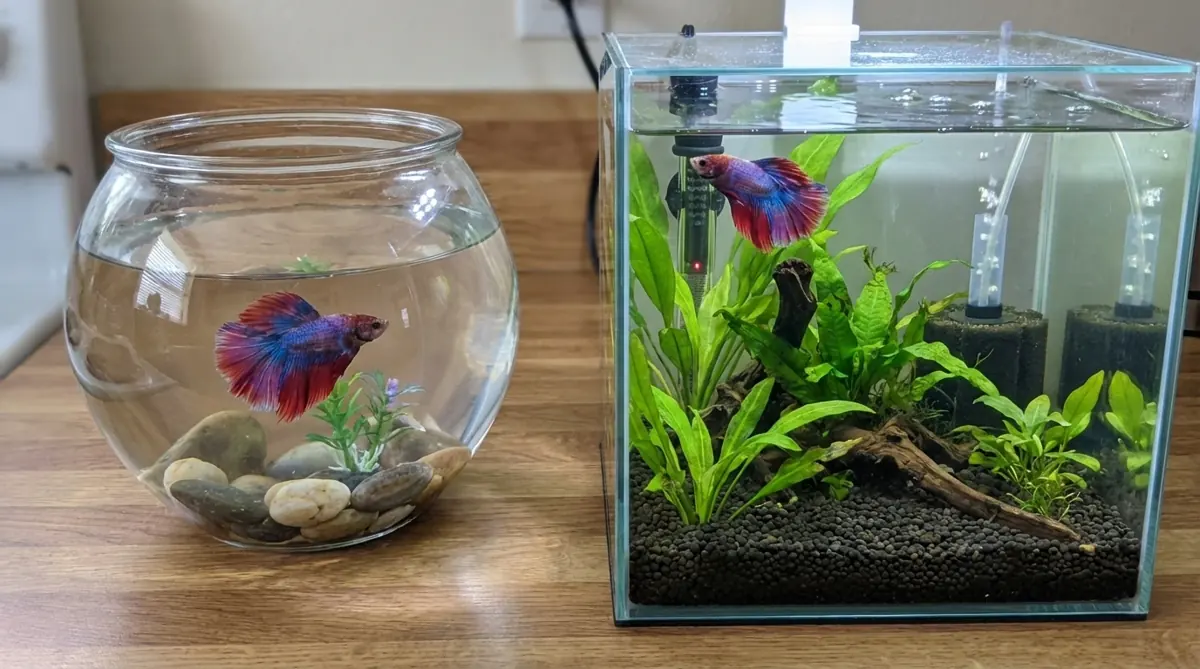
This is the case the article exists to prevent, told as it usually unfolds. A keeper sets up a 5-gallon tank using soft tap water (naturally low KH) or, trying to do the “best” thing, pure RO or distilled water with nothing added back. The betta is healthy and active for weeks. Because the pH always reads a normal-looking value whenever it is tested in the daytime, the owner sees no reason to worry and never tests KH — most beginners do not even know it exists. Quietly, with every passing day, the small KH reserve is being consumed by waste acids and the nightly CO₂ pulse, and water changes (if infrequent or with the same low-KH water) are not replenishing it fast enough. One ordinary evening the buffer finally hits zero. Overnight, with photosynthesis off and respiration releasing CO₂, the acid pulse arrives with nothing to absorb it, and pH plummets several points in a few hours. The owner comes downstairs to a fish that was “completely fine yesterday” lying on the bottom or already dead, water crystal clear, and concludes it must have been a sudden disease or “just one of those things”. It was none of those — it was a textbook KH-driven pH crash, 100% preventable by a $10 KH test and a small amount of crushed coral. The emotional weight of this scenario is exactly why the single most useful sentence in betta water chemistry is: test KH, not just pH.
Crash vs. Disease vs. Poisoning: Reading the Pattern
Because a crash kills fast and clean water hides it, owners often misattribute it. Use this differential to recognise the real cause and avoid wasting time medicating a chemistry problem:
| Pattern | Most likely cause | Confirming test |
|---|---|---|
| “Fine yesterday, dead/dying this morning”, clear water, soft or RO water history | Overnight pH crash (low KH) | pH very low + KH at or near 0 |
| Multiple fish affected at once, same timing | Water chemistry (a crash or toxin), not contagious disease | pH/KH and ammonia/nitrite tests |
| Gradual decline with red or dark gills, newer tank | Ammonia poisoning | Ammonia > 0 — see ammonia |
| Gasping with brownish gills after an ammonia phase | Nitrite poisoning | Nitrite > 0 — see nitrite |
| Visible spots, cotton growth, or fin erosion over days | Actual disease (often secondary to stress) | Visual diagnosis; water tests usually clean |
The clinching clue for a crash is the combination of a sudden, dramatic event in clear water with a history of soft, RO, distilled, or rarely-changed water — and a test showing very low pH alongside near-zero KH. If multiple fish go down together, it is almost certainly the water, not a germ.
Common pH-Crash Mistakes
- Only ever testing pH. The defining mistake. pH looks fine until the instant it crashes; KH is the only parameter that warns you in advance.
- Running pure RO or distilled water unbuffered. Zero KH means there is no shock absorber at all — crashes become almost inevitable.
- Skipping or rarely doing water changes. Fresh, buffered water is what replenishes KH and removes the acids that consume it. Neglecting changes slowly drains the buffer.
- Using chemical pH-down/up bottles. They move pH without lasting buffer, causing the see-saw and eventual crash they appear to fix.
- Overusing driftwood, peat or almond leaves in low-KH water. Their acidifying effect is fine with a healthy buffer but accelerates a crash when KH is already low.
- “Fixing” a crash too fast. A rapid upward pH correction is just another swing. Recovery must be gradual and paired with restoring KH.
- Treating a crash as a disease. Medicating a chemistry collapse wastes critical time; the cure is buffered water and restored KH, not medication.
- Overstocking or overfeeding. More waste means more acid consuming the buffer faster — a hidden accelerant of crashes.
Sources & Further Reading
FishLab — pH stability & KH; Aquarium Co-Op — KH/buffering basics; Bettafish.org — water chemistry; Merck Veterinary Manual — Alkalinity & pH instability in fish systems.
Frequently Asked Questions
What causes a pH crash in a betta tank?
Almost always low KH (carbonate buffering). Without enough buffer, acids from waste and CO₂ build up until pH suddenly drops, often overnight.
What is the difference between a pH swing and a pH crash?
A swing is a noticeable change over hours/days (chronic stress); a crash is a sudden steep drop (often overnight) that can be rapidly fatal.
How do I prevent betta pH crashes?
Maintain KH (e.g., crushed coral), do routine water changes, avoid overstocking/overfeeding, use acidifying additives in moderation, and test KH — not just pH.
Why was my betta fine yesterday and dead today?
A classic overnight pH crash from low KH. pH alone looked okay until the buffer ran out and it collapsed. Testing KH would have warned you.
Does RO or distilled water cause pH crashes?
Yes, if used unbuffered. They have no KH, so pH is unstable and crashes easily. They must be remineralised and buffered.
How do I fix a crashed pH safely?
Gradual partial water changes with stable buffered water, add KH buffering (crushed coral), reduce the waste load, and bring pH back slowly — never fast.
Should I test KH or just pH?
Test both. KH is the early-warning parameter — it tells you whether your pH is protected or about to crash.
Why do pH crashes usually happen overnight?
At night photosynthesis stops but everything keeps respiring, releasing CO₂ that forms a mild acid. In a low-KH tank there is no buffer to absorb it, so pH falls through the night and is lowest in the early morning — exactly when under-buffered bettas are found dead.
What KH level prevents a pH crash?
Keep KH at roughly 3 dKH (about 54 ppm) or above and the vast majority of crashes cannot happen. Below 2 dKH the tank is fragile; at 0–1 dKH crashes are likely.
How fast should I bring a crashed pH back up?
Slowly — gentle, modest buffered water changes over hours, not one big jump. A rapid upward correction is just another swing. Restoring KH (crushed coral) is what actually stops it re-crashing.
Why do pH up/down bottles cause crashes?
They move the pH number without adding lasting buffer, so the water drags it back and the keeper re-doses, creating a violent daily see-saw. The fish suffers constant swings, which are far more harmful than a stable value.