Betta ammonia poisoning is one of the most common killers of pet bettas, and it is invisible, the water looks crystal clear while it chemically burns the fish’s gills from the inside. If your betta is gasping at the surface, has red or dark gills, and lives in a new or unfiltered tank, treat it as an ammonia emergency until a test proves otherwise. This guide gives you the exact safe levels, the symptoms in order of severity, the step-by-step emergency response, and the root-cause fix so it never happens again.
What Betta Ammonia Poisoning Actually Is
Bettas constantly excrete ammonia through waste and gills. In a healthy cycled tank, beneficial bacteria convert ammonia → nitrite → relatively harmless nitrate. In a new, uncycled, unfiltered, or overstocked tank, ammonia accumulates and chemically burns the gills and skin. It’s called the “silent killer” because the water looks perfectly clear while it’s happening, you cannot see ammonia.
Safe Levels (memorise this)
| Ammonia (ppm) | Meaning | Action |
|---|---|---|
| 0 | Safe, the only acceptable level | Maintain |
| 0.25–0.5 | Already harmful, gill damage starting | Act now: water change |
| 1.0 | Serious poisoning | Emergency response |
| 2.0+ | Often lethal | Aggressive emergency action |
There is no “a little is okay” with ammonia, any reading above 0 is doing damage. You can only know your level with a water test kit.
Symptoms of Ammonia Poisoning
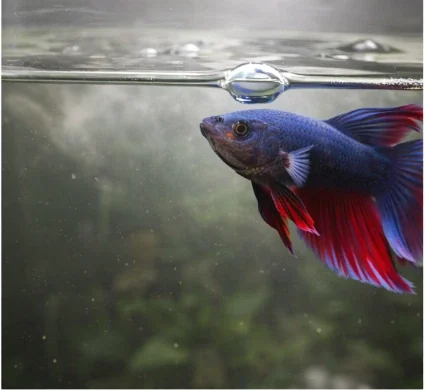
- Gasping at the surface, rapid gill movement (gills are burned).
- Red, purple, or dark gills; gills not closing properly.
- Red streaks on the body/fins, inflamed eyes or vent.
- Lethargy: lying at the bottom (see why is my betta lethargic).
- Clamped fins, loss of appetite, sometimes flashing/rubbing.
- Severe cases: gulping at the surface, then collapse.
Ammonia Burn on a Betta: What It Looks Like
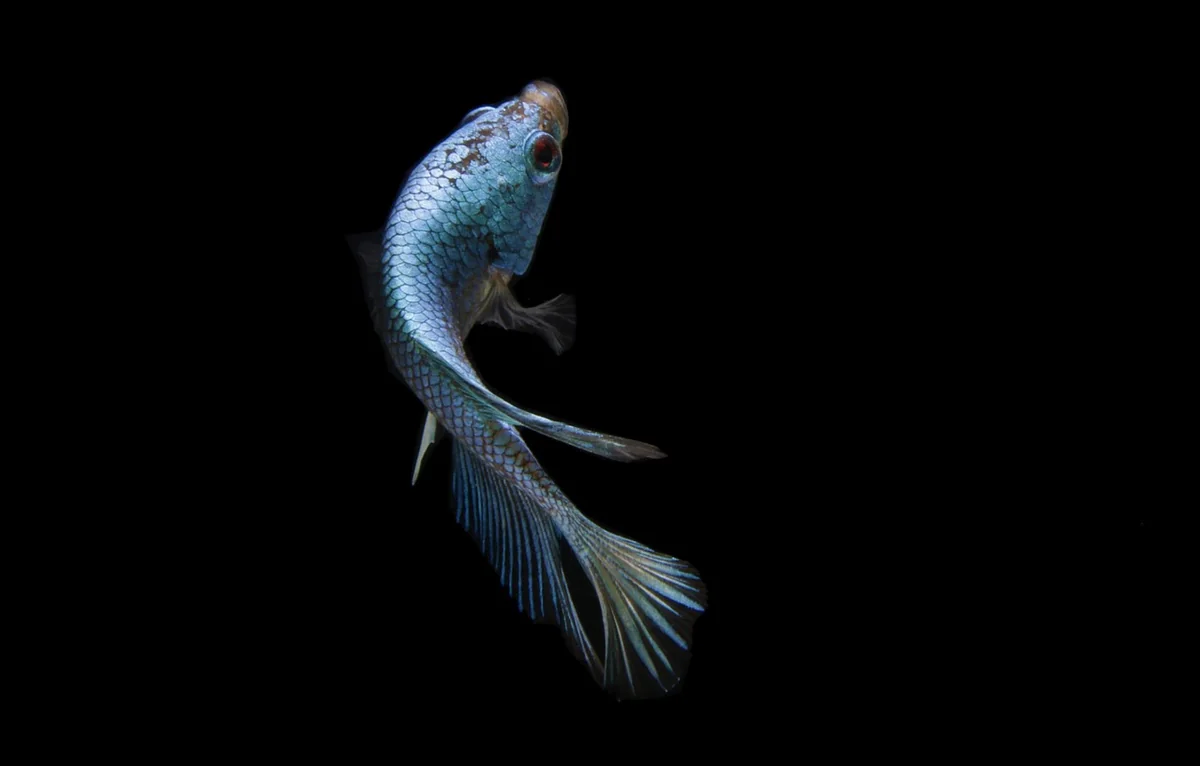
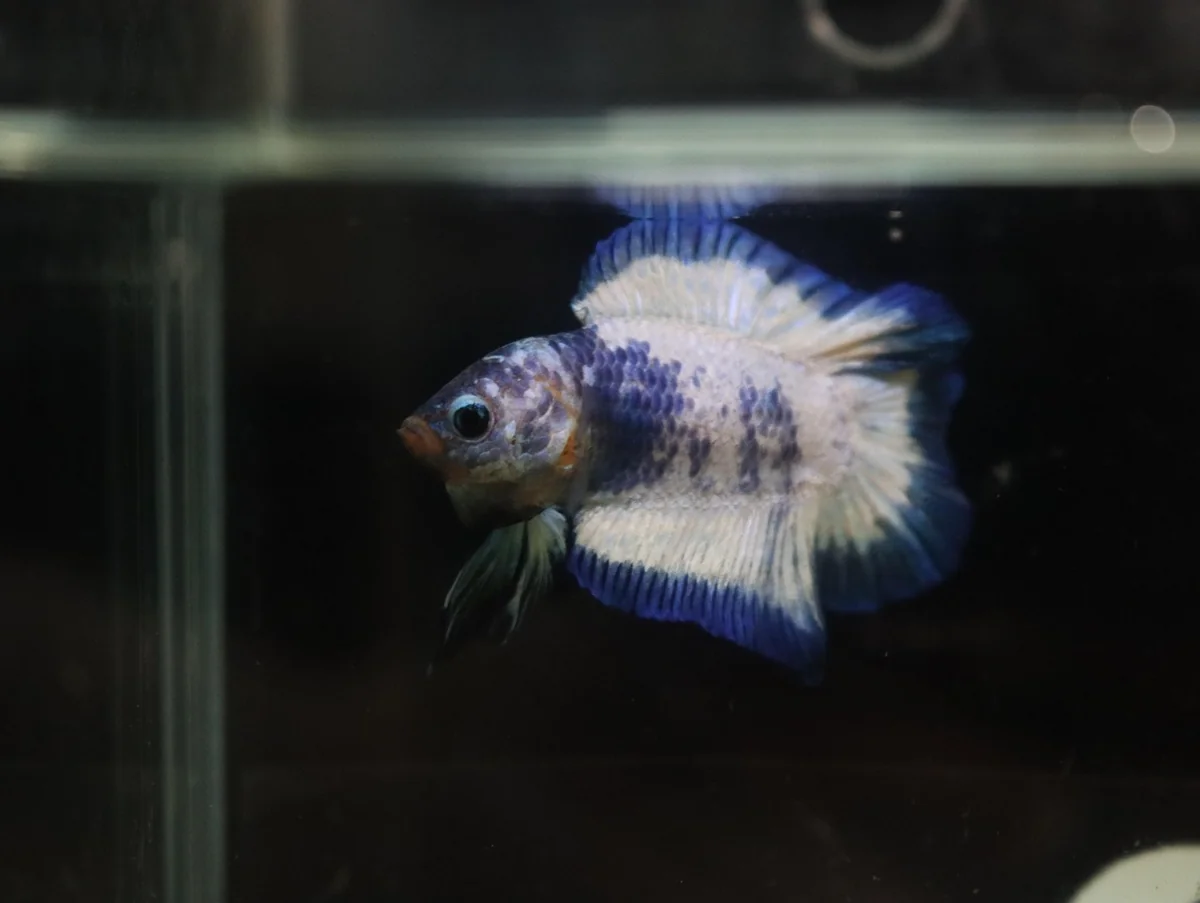
“Ammonia burn” is the visible damage ammonia leaves on the skin, fins and gills. It often appears a day or two after a spike, sometimes after the water has already been fixed, so knowing the signs helps you match the damage to its cause.
| Where | What ammonia burn looks like |
|---|---|
| Gills | Red, purple or dark gills; gills that look swollen or stay slightly open |
| Fins | Black or dark brown edges, as if singed, often on the tips |
| Body | Red or purple patches and streaks; dull, greyish areas where the slime coat is damaged |
| Eyes and vent | Red or inflamed tissue |
Ammonia burn, fin rot or injury?
| Ammonia burn | Fin rot | Torn fin (injury) | |
|---|---|---|---|
| Fin edges | Blackened tips across several fins | Ragged edges that shrink over days, sometimes white or red margins | One clean split or tear |
| Other signs | Red gills, gasping, recent ammonia reading | Often follows poor water; spreads if untreated | Sharp decor nearby; fish otherwise normal |
| First step | Water change and ammonia detoxifier | Clean water, then see fin rot treatment | Remove the sharp item; keep water clean |
With clean, warm, stable water, mild ammonia burn usually starts to look better within a week or two. Blackened fin tips often fall away and the fins regrow over the following weeks. Keep the water at 0 ppm ammonia while it heals, because damaged tissue is open to infection.
Long-Term Damage & Recovery
Ammonia burns can heal if caught early and the water is corrected, fins and gills regenerate over weeks in clean, warm, stable water. But repeated or severe exposure causes permanent gill scarring and shortens lifespan. The takeaway: ammonia is not a “treat once” problem, it’s a husbandry problem you must prevent from recurring.
The Science: Why Ammonia Burns (and why pH and temperature change the danger)
Ammonia in water exists in two forms that constantly trade back and forth: free ammonia (NH₃), which is highly toxic and passes straight across the gill membrane, and ammonium (NH₄⁺), which is far less harmful. A standard test kit reads “total ammonia”, the sum of both, but the fish only really suffers from the NH₃ portion. What decides the split is pH and temperature.
This is the part most beginners never learn, and it explains confusing situations: the higher the pH and temperature, the more of your total ammonia is the toxic NH₃ form. A reading of 0.5 ppm total ammonia at pH 6.5 is far less dangerous than the same 0.5 ppm at pH 8.0, because at high pH a much larger fraction is the deadly free form. This is also why you must never chase down a high pH quickly during an ammonia spike, a sudden pH drop can briefly buy time, but an unstable pH swing creates a second emergency. The only safe answer is to physically remove the ammonia with water changes and detoxify the rest.
| Conditions | Effect on ammonia toxicity |
|---|---|
| Higher pH (alkaline) + warm | More toxic free NH₃ same test number is more dangerous |
| Lower pH (acidic) + cooler | More harmless NH₄⁺ same test number is less dangerous (still not safe) |
Ammonia vs. Other Causes: How to Tell Them Apart
Surface-gasping and lethargy have several causes. Use this differential so you treat the right thing:
| Likely cause | Distinguishing signs | Confirm with |
|---|---|---|
| Ammonia poisoning | Red/dark/inflamed gills, red streaks, clear water, new or unfiltered tank | Ammonia test >0 ppm |
| Nitrite poisoning | Similar gasping but often brownish gills, tank slightly older (post-ammonia stage) | Nitrite test >0 ppm |
| Too hot / low oxygen | Thermometer >84°F or stagnant surface; gills not discoloured | Thermometer + surface check |
| Gill flukes/parasites | One gill stuck open, scratching/flashing, normal water tests | Close inspection; tests clean |
The single fastest way to distinguish ammonia from temperature or parasite issues is a liquid test kit, see best betta water test kit.
Step-by-Step: The First 60 Minutes of an Ammonia Emergency
- Minute 0–5: Test ammonia and nitrite to confirm and gauge severity. Note the pH too, high pH means higher real danger.
- Minute 5–20: Perform a 25–50% water change with dechlorinated, temperature-matched water. This is the single most effective action, it physically removes the toxin.
- Minute 20–30: Dose a conditioner that detoxifies ammonia for the whole tank volume. This temporarily converts residual ammonia to a safer form for ~24–48 hours.
- Minute 30–45: Increase surface agitation/oxygen. Burned gills transport oxygen poorly, so more dissolved oxygen directly improves survival.
- Minute 45–60: Stop feeding, dim the lights, keep the tank calm, and re-test in a few hours. Plan daily water changes until the source of ammonia (uncycled filter, overstocking, overfeeding) is fixed.
Preventing It Permanently: The Cycling Connection
Every ammonia emergency traces back to the same root: there are not enough beneficial bacteria to keep up with the fish’s waste. A fully cycled tank converts ammonia to nitrite to nitrate continuously, so a healthy reading is a permanent 0 ppm with no intervention. The reliable prevention formula is: an adequately sized tank, a working filter with established bio-media that you never deep-clean in tap water, sensible stocking, controlled feeding (uneaten food is a major hidden ammonia source), and routine partial water changes. Test weekly while the tank is young so you catch any rise before the fish shows symptoms, by the time gills are red, significant damage has already occurred. Ammonia is one row on the full betta water parameters chart; it leads straight into nitrite poisoning and then nitrate, all of which you track with the best betta water test kit.
The Hidden Sources of Ammonia Most Owners Miss
When ammonia keeps appearing despite “doing everything right”, it is almost always because of a source the owner has not connected to ammonia. Identifying and removing these is what turns a recurring problem into a solved one:
- Overfeeding. The single biggest avoidable source. Every flake or pellet the betta does not eat decomposes directly into ammonia. A betta’s stomach is roughly the size of its eye; it needs far less food than owners instinctively give.
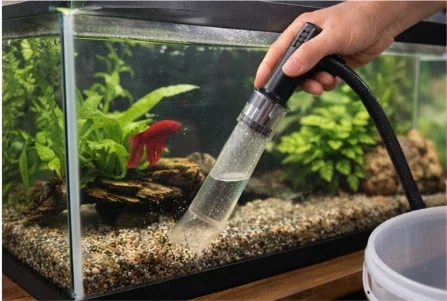
- Uneaten food rotting in the substrate. Food that sinks into gravel and is never removed is a continuous ammonia factory. Gentle substrate vacuuming during water changes removes it.
- Decaying plant matter. Dying leaves and rotting plant trimmings break down into ammonia just like food. Trim and remove them promptly.
- An over-cleaned or replaced filter. Washing bio-media in tap water (chlorine kills the bacteria) or replacing the whole filter cartridge wipes out the colony that was processing ammonia, triggering a fresh spike in an otherwise “established” tank.
- A dead, hidden tankmate or snail. A decomposing animal behind decor produces a large, sudden ammonia load that baffles owners until they find it.
- Overstocking. More animals means more waste than the bacterial colony can process. A betta is best kept singly or very modestly stocked.
- Source water containing chloramine. Chloramine is chlorine bonded to ammonia; a chlorine-only conditioner can free that ammonia. Use a conditioner that handles chloramine and detoxifies ammonia.
The pattern to notice: a “mystery” ammonia reading in a tank that was previously fine is almost always a disturbed filter, a dead animal, or a feeding habit, not bad luck.
Chronic Low-Level Ammonia: The Slow Version of the Silent Killer
Most articles focus on the dramatic spike, but the more insidious form is chronic low-level ammonia, a tank that hovers at 0.25–0.5 ppm for weeks because it is permanently slightly under-cycled or overstocked. This rarely kills outright, so the owner never sees a single dramatic event. Instead the betta is subjected to a constant low-grade gill burn that suppresses its immune system and slowly damages tissue. The visible result is a fish that is “always a bit off”: frequently clamped, prone to recurring fin rot or ich that keeps coming back despite treatment, faded in colour, and slow to heal. This is one of the most common reasons a betta seems to catch every disease no matter how much medication is used, the real problem is not the disease, it is the chronic ammonia keeping the immune system shut down. The fix is never another medication; it is finding why ammonia never reaches a true 0 (usually an undersized or uncycled tank, overstocking, or overfeeding) and correcting that. A betta that “keeps getting sick” should always be tested for chronic ammonia before anything else.
Real Scenario: New Tank Syndrome, Step by Step
Here is the classic case this article exists to prevent. An owner buys a betta and a small unfiltered bowl the same day, fills it with conditioned tap water, and adds the fish immediately, no cycling, because nobody told them about it. For the first few days everything looks perfect: clear water, active fish. Around day four to seven the betta starts spending more time near the surface, breathing rapidly. By day ten the gills look red and inflamed and the fish is lethargic and refusing food, yet the water is still crystal clear, so the owner assumes a disease and considers medication. What actually happened is textbook new tank syndrome: with no beneficial bacteria, the ammonia from the fish’s own waste climbed steadily and invisibly until it reached a gill-burning level. The correct response is not medication. It is an immediate ammonia and nitrite test (which reveals elevated ammonia), a 25–50% dechlorinated, temperature-matched water change, an ammonia-detoxifying conditioner dosed for the whole volume, no feeding for a day or two, added surface agitation, and then daily water changes while a proper cycle is established (ideally moving the fish to an adequately sized, filtered, cycled tank). The betta, caught before permanent gill scarring, recovers over the following weeks in clean, stable water. The single lesson: clear water is not safe water, and the time to learn about cycling is before the fish goes in, not on day ten.
Common Ammonia Mistakes Quick Table
| Mistake | Why it is dangerous | Do this instead |
|---|---|---|
| Trusting clear water | Ammonia is invisible and odourless; the tank can be lethal while looking pristine | Test with a liquid kit, especially in a young tank |
| Medicating the “disease” while ignoring ammonia | Medication cannot fix a chemical gill burn; the fish keeps deteriorating | Test and fix water first; treat disease only after water is confirmed safe |
| One water change then stopping | An uncycled tank simply re-accumulates ammonia within a day | Daily changes until 0 ppm holds, plus fix the cycle |
| Crashing pH to “make ammonia safe” | The pH swing is a second emergency that can kill faster | Remove ammonia with water changes; keep pH stable |
| Deep-cleaning the filter in tap water | Chlorine kills the bacteria, causing a fresh spike | Rinse media gently in old tank water only |
| Overfeeding “to be safe” | Uneaten food is the biggest hidden ammonia source | Tiny portions the fish finishes in ~2 minutes; remove leftovers |
Sources & Further Reading
BMC Zoology, Acute toxicity of ammonia and nitrite to Betta splendens; Betta Care Fish Guide, ammonia poisoning; sera, new tank syndrome; Merck Veterinary Manual, Ammonia toxicity in fish.
Frequently Asked Questions
What are the symptoms of ammonia poisoning in betta fish?
Gasping at the surface, red or dark gills, red streaks, inflamed eyes, lethargy, clamped fins, and loss of appetite, in clear-looking water.
What is a safe ammonia level for a betta?
0 ppm. Anything above 0.25 ppm is already harmful, and 2 ppm or higher is often lethal.
How do I treat betta ammonia poisoning?
Do an immediate 25–50% dechlorinated water change, add an ammonia detoxifier, stop feeding briefly, add surface oxygen, repeat changes until 0 ppm, then fix the tank’s cycle.
Can a betta recover from ammonia poisoning?
Yes, if caught early and the water is corrected, gills and fins heal over weeks. Severe or repeated exposure causes permanent damage.
Why does my betta keep getting ammonia poisoning?
The tank is uncycled, too small, unfiltered, overstocked, or overfed. Permanent fix: a cycled, adequately sized, filtered, well-maintained tank.
How is ammonia poisoning different from nitrite poisoning?
Both cause gasping and lethargy, but ammonia typically reddens or darkens the gills in a newer tank, while nitrite poisoning often follows later (post-ammonia stage) and shows brownish gills. A test kit confirms which toxin is elevated.
What does ammonia burn look like on a betta?
Red or purple gills, blackened fin tips, and red or purple patches or streaks on the body. It often shows a day or two after an ammonia spike.
How long does ammonia burn take to heal on a betta?
Mild burns usually start to improve within one to two weeks of clean, warm, stable water. Blackened fin tips often fall away and regrow over the following weeks.