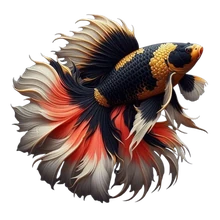
The ideal pH for betta fish is around 7.0, with anything from 6.5 to 7.5 being perfectly healthy, but the single most important thing to understand is that a stable pH matters far more than a “perfect” one. Many bettas are harmed by owners chasing the magic number 7.0 with chemical adjusters than by an off-ideal but steady pH. This guide gives you the exact ranges, explains the chemistry simply (including the KH buffering that quietly controls everything), shows how to test correctly, and clarifies the one question that matters most: should you adjust at all?
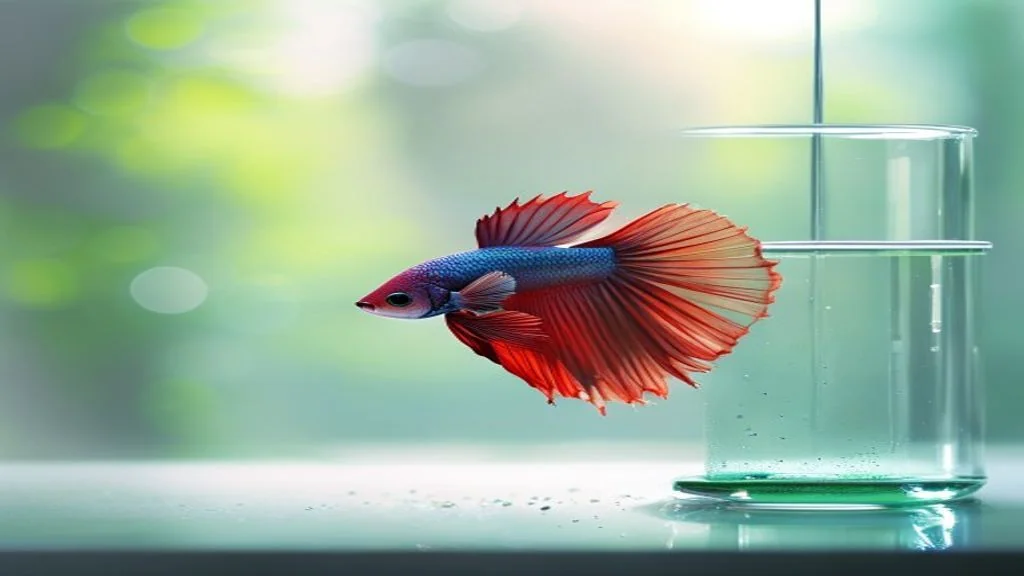
The Ideal pH for Betta Fish: The Numbers
| pH | Status |
|---|---|
| ~7.0 | Ideal (neutral) |
| 6.5–7.5 | Healthy range, bettas thrive here |
| 6.0–6.5 / 7.5–8.0 | Tolerable if stable, not ideal |
| <6.0 or >8.0 | Stressful; address gradually |

What Affects pH in a Betta Tank
- Source water: tap/spring water varies; see best water for betta fish.
- KH (carbonate hardness / buffering): low KH = unstable pH that crashes easily.
- Driftwood, leaves, peat: release tannins that gently lower pH.
- Crushed coral, rocks, substrate: can raise/buffer pH.
- CO₂ / waste buildup: can drift pH down over time between water changes.
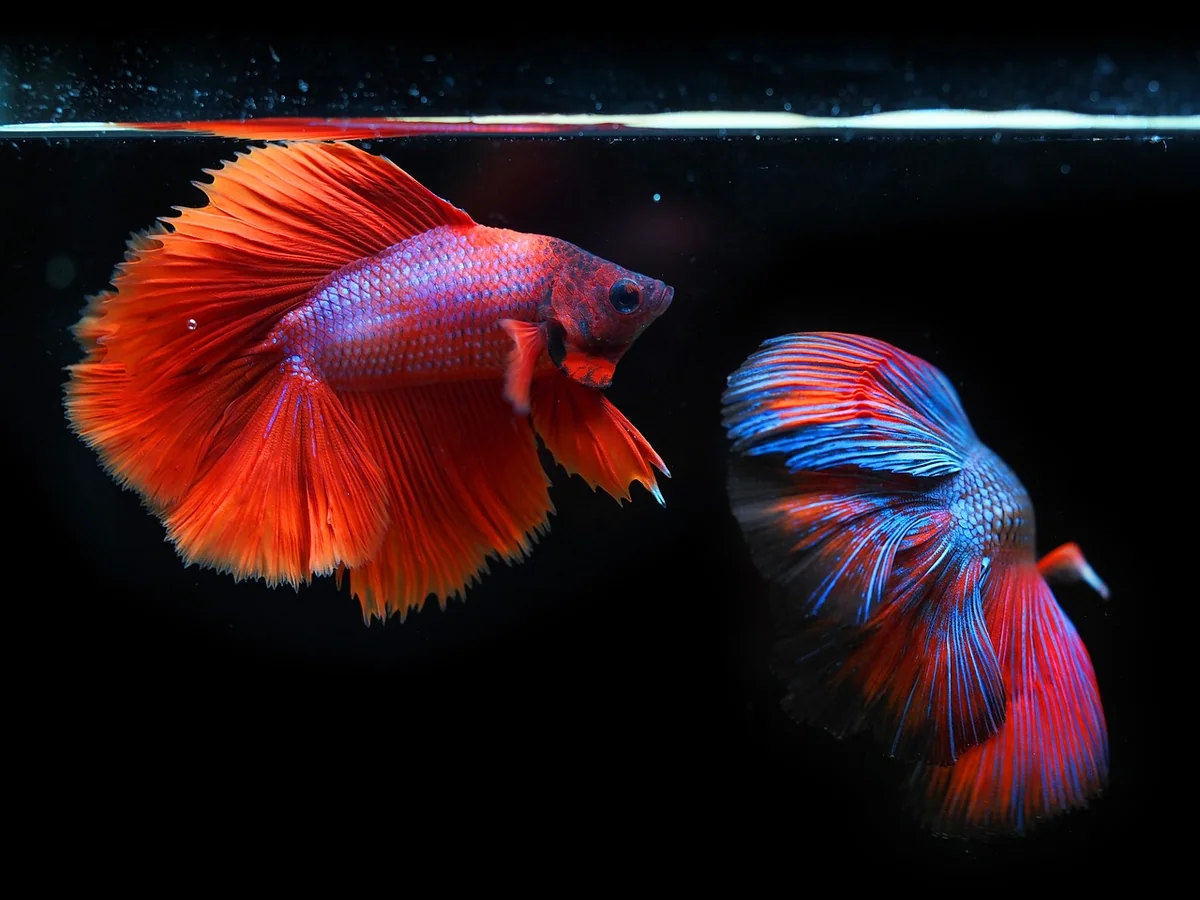
Symptoms of pH Problems
- After a swing: clamped fins, lethargy, gasping, faded colour, stress stripes.
- Sudden distress right after adding chemicals or new water (a swing, not the absolute value).
- Chronic stress/illness when pH is extreme and unstable.
These overlap with general stress, cross-check signs of stress in betta fish and the water parameters chart.
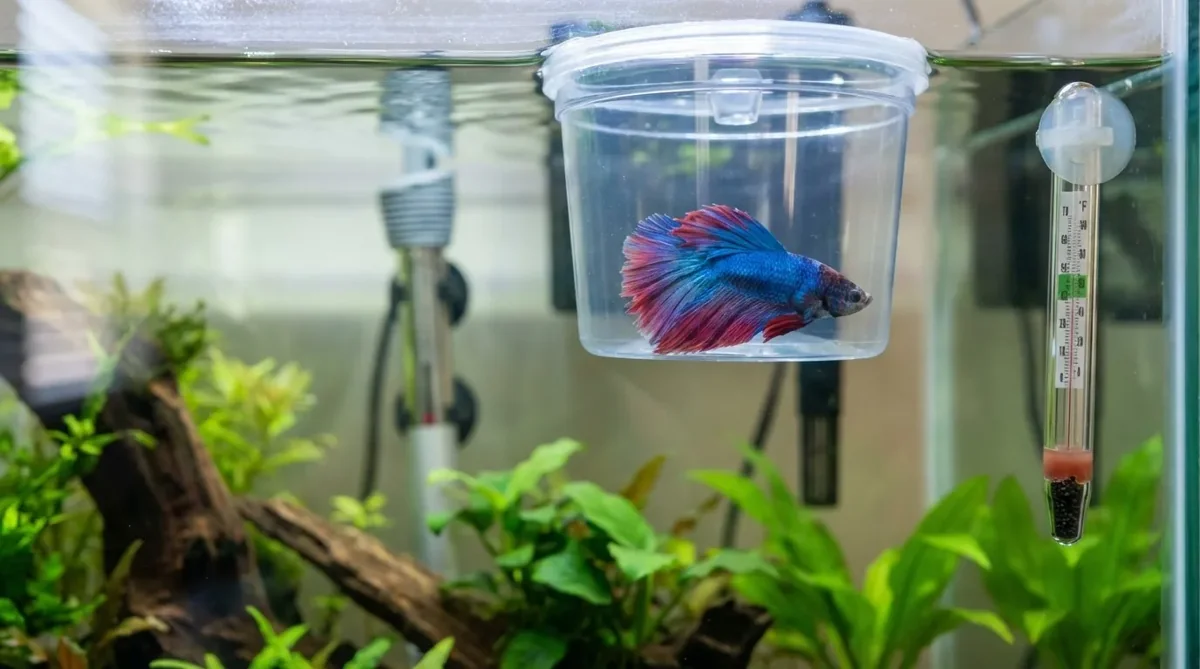
Common pH Mistakes
- Chasing “exactly 7.0” with chemicals and causing swings.
- Changing pH quickly instead of over days.
- Ignoring KH/buffering, so pH crashes unexpectedly.
- Switching water source/brand and shifting pH suddenly.
- Not testing at all, then guessing.
The pH Scale Explained Simply
pH measures how acidic or alkaline water is on a scale of 0 to 14, where 7.0 is neutral, below 7.0 is acidic, and above 7.0 is alkaline. The crucial detail beginners miss is that the scale is logarithmic: each whole number is a tenfold change. pH 6.0 is ten times more acidic than 7.0, and pH 5.0 is a hundred times more acidic. This is exactly why a “small” pH swing of one full point is biologically enormous to a fish and why gradual change matters so much, moving from 7.5 to 6.5 is not a minor nudge, it is a tenfold shift in acidity that the betta’s body must re-balance against.
KH: The Hidden Number That Actually Controls pH
You cannot understand betta pH without understanding KH (carbonate hardness, also called alkalinity or buffering capacity). KH is the water’s reservoir of carbonates that neutralise incoming acids. Think of KH as a shock absorber: as long as it has capacity, it soaks up the acids produced by fish waste and biological processes, and pH stays steady. When KH is used up or naturally very low (as in soft tap water, RO, or distilled water), there is nothing left to absorb acid and pH crashes suddenly and dangerously.
This single concept explains most “mystery” pH problems: a tank with healthy KH holds a rock-steady pH for weeks, while a low-KH tank drifts down between water changes and can crash hard. It is also why the right fix for unstable pH is usually to support KH (stable buffering), not to keep dosing pH-up or pH-down chemicals that fight a losing battle against the chemistry.
| KH level | Effect on pH | What to do |
|---|---|---|
| Very low (0–2 dKH) | Unstable, pH drifts down and can crash | Raise KH gently (stable buffering) for safety |
| Moderate (3–8 dKH) | Stable, pH holds well between changes | Ideal, maintain with routine water changes |
| High (>8 dKH) | Very stable, pH tends higher | Usually fine for bettas if steady; don’t fight it |

Why a Stable “Wrong” pH Beats an Unstable “Perfect” One
A betta’s body continuously works to maintain its internal chemistry against the surrounding water, a process called acid–base regulation. When pH is stable, even if it is 7.6 instead of the textbook 7.0, the fish establishes a steady equilibrium and lives comfortably; bettas are genuinely adaptable across the 6.5–7.8 range. When pH swings, the fish must repeatedly re-balance its physiology, and each swing is a stress event that suppresses immunity and can be acutely dangerous. This is the core reason experienced keepers preach “don’t chase the number”: the act of chasing creates the swings that do the real harm. The skill is not hitting 7.0, it is keeping whatever stable value your water naturally holds.
How pH, Temperature, and Ammonia Interact
pH does not act alone, and knowing the links prevents dangerous mistakes. The most important interaction: pH controls how toxic ammonia is. At higher pH, more of any ammonia present exists as the highly toxic free form, so the same ammonia reading is far more dangerous in alkaline water than acidic water. This is precisely why you must never crash the pH down to “make ammonia safer”, the pH swing is its own emergency, and the correct response to ammonia is always water changes and detoxifier, with pH kept stable. Temperature also nudges pH and shifts the same ammonia balance, which is one more reason a stable, well-buffered, correctly heated tank keeps every parameter cooperating instead of cascading.
Where the “7.0 Myth” Comes From, and Why Wild Bettas Don’t Care
It is worth addressing directly why so many owners fixate on hitting exactly 7.0. The number gets repeated because it is neutral, easy to remember, and sits comfortably in the middle of the betta’s healthy band, it makes a tidy headline. But the idea that a betta needs precisely 7.0 is a myth, and the wild origins of the fish prove it. Betta splendens evolved in the shallow waters, rice paddies, ditches and slow streams of Southeast Asia, and the pH of those habitats is anything but a constant 7.0. Depending on season, rainfall, vegetation and decaying leaf litter, wild betta water ranges widely on the acidic-to-neutral side and shifts with the weather. A fish whose ancestors thrived across that natural variability is not a delicate instrument that fails at 7.3. What it is not adapted to is a tank that lurches up and down every few days because an anxious owner keeps dosing adjusters. The takeaway: the betta’s biology is built for a range, not a point. Aim your effort at keeping whatever stable value your water holds, and let the mythical 7.0 go.

Step-by-Step: Reading a Liquid pH Test Correctly
Most pH “problems” people report are partly testing errors, because the popular liquid pH test is easy to misread. Done properly it is reliable and cheap. Here is the correct method:
- Use a clean tube and the right test. Standard liquid pH kits read roughly 6.0–7.6; if your water is more alkaline you may need the high-range pH test, or the standard test will simply max out and look “very high”.
- Fill to the exact line with tank water. Take the sample from mid-tank, not the surface film and not right at the substrate.
- Add the precise number of drops stated. One extra drop noticeably shifts the colour; hold the bottle vertically so drop size is consistent.
- Cap and invert to mix, do not shake violently. Gentle inversion fully mixes the reagent without creating bubbles that distort the read.
- Read immediately against the white card in natural light. pH colour can drift if you wait too long, and artificial light skews the green-blue scale badly.
- Test at the same time of day. pH naturally fluctuates slightly over 24 hours (a day–night CO₂ rhythm, more pronounced in planted tanks), so comparing readings only makes sense at a consistent time.
If your readings seem to “jump around”, before assuming a real swing, rule out the boring explanations first: inconsistent drop count, reading under a lamp, testing at different times of day, or a maxed-out standard kit on alkaline water. A genuine swing shows up consistently across careful, like-for-like tests.
The Natural, Stable Way to Gently Influence pH
If your water is genuinely and stably outside the comfortable range and you decide influence is warranted, the safest tools are natural and gradual, never bottled “pH down/up”. The principle is to nudge slowly and let KH stay in control, not to force a number. On the soft, acidic side, botanicals are the classic approach: aquarium driftwood and dried Indian almond (catappa) leaves release tannins that gently lower pH over time while also giving a betta the tinted, shaded “blackwater” conditions it instinctively likes. On the harder, more alkaline-buffered side, a small amount of crushed coral or aragonite in the filter slowly raises and stabilises KH and pH. The reason these are preferred over chemical adjusters is rate: they act gradually as water moves through them, so the change is measured in days, not minutes, which is exactly the gentleness the fish needs. The full method and cautions are in how to safely lower or raise betta tank pH, but the headline rule remains: most tanks should not be adjusted at all, and when they are, slow and natural beats fast and chemical every time.
Quick pH Troubleshooting Table
| What you see | Likely explanation | What to do |
|---|---|---|
| pH stable but not 7.0 (e.g. steady 7.6) | Normal, your water’s natural buffered value | Leave it alone; the betta adapts and thrives |
| pH drifting down between water changes | Low KH; acids accumulating with nothing to buffer them | Support KH; keep up routine water changes, see pH crash |
| pH “jumps around” each test | Often a testing error (drop count, light, time of day) | Re-test carefully, like-for-like, before assuming a real swing |
| Fish stressed right after dosing pH adjuster | Chemical-induced swing, the harm is the change, not the value | Stop using adjusters; restore stability gradually |
| pH reads very high on a standard kit | Standard test maxed out on alkaline water | Use the high-range pH test to get the true number |
| pH shifted after changing water brand/source | New source has different pH/KH | Switch sources gradually; match parameters, see best water for betta fish |
How to Lower or Raise pH Safely (Only When You Must)
Most bettas never need their pH adjusted. A steady pH anywhere from about 6.5 to 7.8 is fine. Adjust only when the water sits well outside that range, and do it slowly: aim for no more than about 0.2 pH change per day. Always adjust the new water in a bucket before it goes in, not the tank itself.
| Your situation | What to do |
|---|---|
| pH stable, roughly 6.5–7.8 | Nothing. Adjusting would only add swings. |
| pH steady above about 8.0 | Pre-soaked driftwood or Indian almond leaves in the change water; blend in remineralised RO water if KH is high |
| pH below about 6.0, or keeps crashing | Crushed coral or aragonite to rebuild KH (buffer) |
| pH bounces back after every water change | Treat the new water in a bucket first; expect a change over weeks, not days |
| pH swinging every day | Stop all chemical adjusters and let it settle |
Why “pH up” and “pH down” bottles cause problems
Chemical adjusters change the number fast, but the water’s KH pulls it back within hours. The result is a daily up-and-down swing that stresses a betta far more than a steady, slightly-off pH. Fix the buffer (KH) and the source water instead.
Sources & Further Reading
FishLab, pH Levels for Betta Fish; FishkeepingWisdom, optimal betta pH; Bettafish.org, water parameters; Merck Veterinary Manual, Water quality (pH) for fish; FishLab / FishkeepingWisdom, adjusting betta pH; Aquarium Co-Op, natural pH methods; Bettafish.org, water chemistry; Merck Veterinary Manual, Managing water chemistry for fish.
Frequently Asked Questions
What is the ideal pH for a betta fish?
Around 7.0 (neutral), with a healthy range of 6.5–7.5. A stable pH matters more than hitting an exact value.
Is a stable pH more important than a perfect pH?
Yes. A steady 7.6 is healthier than a tank swinging between 6.8 and 7.4. pH swings cause most pH-related betta stress and deaths.
Should I adjust my betta tank’s pH?
Usually not. If it’s stable and roughly 6.5–7.8, leave it, the betta adapts. Only adjust if it’s well outside the range, and do it gradually with stable methods.
How do I test betta tank pH?
A liquid test kit is the reliable choice; test strips are rough; digital meters are precise but need calibration. Test at a consistent time and around water changes.
What pH is too high or too low for a betta?
Below ~6.0 or above ~8.0 is stressful and should be corrected gradually. Within 6.5–7.5 is ideal.
What is KH and why does it control betta pH?
KH (carbonate hardness/buffering) is the water’s reservoir of carbonates that neutralise incoming acids. While KH has capacity, pH stays steady; when KH runs out or is very low, pH crashes. Supporting KH is usually the real fix for unstable pH.
How do I lower the pH in my betta tank safely?
Only lower it if it is steady above about 8.0. Use pre-soaked driftwood or Indian almond leaves in the change water, change it by no more than about 0.2 a day, and adjust new water in a bucket, not in the tank.
Should I use pH up or pH down products for my betta?
It is better not to. They change pH quickly, then the water buffer pulls it back, which causes daily swings. Stable water is safer than a perfect number.
Is a pH of 7.6 good for a betta?
Yes, if it stays stable. 7.6 is slightly alkaline but well within what bettas tolerate. Do not try to force it down to 7.0.
Is a pH of 7.8 too high for a betta?
Not if it is stable. Bettas cope with 7.8 well. Only consider gentle adjustment if pH sits above about 8.0, and never change it by more than about 0.2 a day.