How long do betta fish live? Longer than most people think, but only when the basics are right. The number on the box at the pet store means very little, because the single biggest factor is not genetics or luck. It is the water the fish lives in every day. This guide gives you the honest numbers, a lifespan chart by setup, the life stages from fry to senior, and the specific habits that add years to a betta’s life.
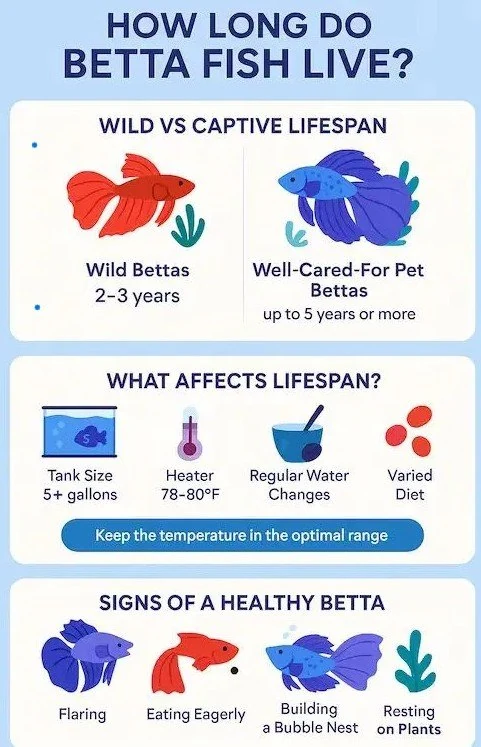
Betta Fish Lifespan at a Glance
| Situation | Typical lifespan |
|---|---|
| Total lifespan with good care | 3–5 years |
| Time at home after buying from a store | About 2–4 years |
| Small unheated bowl or vase | Often 1–2 years |
| Exceptional cases | Past 5 years is rare; around 10 years has been reported but is very unusual |
Why do sources disagree, with some saying 2 years and others 5? Most of the difference comes from one detail: whether they count the fish’s total age or only the time after purchase. A betta bought at 9 months old that lives to 4 has given its owner a little over 3 years.
How Long Do Betta Fish Live in Different Setups?
The tank decides more about a betta’s lifespan than anything else. Here is how common setups compare and why:
| Setup | What happens to the water | Lifespan outlook |
|---|---|---|
| Vase or bowl under 1 gallon, no heater | Temperature follows the room; ammonia builds in hours | Short, often 1–2 years |
| 1–2.5 gallons, heated | Warm but swings fast; needs very frequent water changes | Below average |
| 5 gallons, heated, filtered, cycled | Stable temperature and water quality | Good: the setup most long-lived bettas have |
| 10 gallons or more, planted, heated, filtered | Very stable; mistakes are diluted | Best chance at 4–5 years and beyond |
See the betta tank size guide and why 5 gallons is the practical minimum for the details.
The Betta Life Stages
| Stage | Age | What you see |
|---|---|---|
| Fry | 0–2 months | Tiny, clear to pale; living on microfoods |
| Juvenile | 2–4 months | Colour appears; males start to show longer fins |
| Young adult | 4–12 months | Full colour and fins; the age most bettas are sold |
| Prime adult | 1–2 years | Most active, brightest colour, regular bubble nests in males |
| Mature | 2–3 years | Still healthy; may rest a little more |
| Senior | 3 years and older | Slower, more resting, colour and fins may fade or curl |
Why Pet-Store Bettas Often Die Young
Many bettas start life at a disadvantage. In stores they are often kept in small cups of unheated water that is changed rarely, and they may have travelled a long way from the breeding farm. A betta that has spent weeks in a cold, dirty cup arrives with a weakened immune system. That is why the first month at home matters so much: a properly cycled tank, stable warmth and a calm introduction to the new tank give a stressed fish the chance to recover.
When choosing a betta, pick one that is active, responds to movement, has no white spots, torn or clamped fins, and is not lying at the bottom of the cup. Compare it with the signs of a healthy betta.
The 6 Things That Shorten a Betta’s Life Most
- Ammonia from an uncycled tank. It burns the gills and fins and is the root of many diseases. Ammonia and nitrite should always read 0 ppm.
- Cold or swinging water. Bettas are tropical. Below about 76°F their immune system slows down; see the ideal betta water temperature.
- Overfeeding. It causes bloating, constipation and dirty water. A betta’s stomach is about the size of its eye; see how much to feed a betta.
- Tiny containers. Small volumes swing in temperature and pollute fast.
- Fin damage. Sharp decor and strong currents tear long fins, which opens the door to fin rot.
- Long-term stress. Bright light all day, aggressive tank mates or constant disturbance; see the signs of stress in bettas.
9 Ways to Help Your Betta Live Longer
- Keep it in a heated tank of at least 5 gallons.
- Cycle the tank before the betta goes in, and test the water weekly.
- Hold the temperature steady at 78–80°F with an adjustable heater.
- Use a gentle filter; see do bettas need a filter.
- Change 20–30% of the water every week with dechlorinated water; see how often to clean a betta tank.
- Feed a quality, protein-rich pellet in small portions, with frozen foods for variety; see the best betta fish food.
- Use soft decor and live or silk plants so fins stay intact.
- Keep a regular day and night light cycle; see how much light a betta needs.
- Spend 30 seconds a day looking at your fish, so you notice problems early.
Old Age or Illness? How to Tell
| Sign | Normal ageing | Likely illness or water problem |
|---|---|---|
| Activity | Gradually slower over months; rests more | Sudden lethargy, lying on the bottom |
| Appetite | Eats a little less, but still eats | Stops eating for several days |
| Fins | Thinner, edges may curl slightly | Ragged, shrinking or dark edges (fin rot) |
| Colour | Slowly fades | Fast fading, stress stripes, spots or patches |
| Body | A little thinner, slight curve of the spine in some old fish | Bloating, scales sticking out, bulging eyes |
If you see anything in the right-hand column, test the water first and then check the betta fish diseases symptom checker. A senior betta also does better with a slightly lower water level and a leaf or hammock near the surface to rest on.
Caring for an Older Betta
Older bettas tire more easily. Lower the filter flow, add resting spots near the surface, keep the temperature at the steady upper end of the ideal range, and offer smaller meals of easy-to-eat food. Keep up the weekly water changes: older fish handle poor water worse than young ones. If an old betta is struggling, see how to help a betta that is declining.
Sources & Further Reading
PetMD, betta fish facts (lifespan and care); WebMD Pets, how long do betta fish live; Chewy Education, how long do betta fish live; bettafishh.com care guides linked above.
Frequently Asked Questions
How long do betta fish live?
Most betta fish live 3-5 years in total with good care. Because pet-store bettas are usually 6-12 months old when sold, most owners can expect about 2-4 years at home.
How long do betta fish live in a bowl or 1 gallon tank?
Usually much shorter, often only 1-2 years. Small, unheated, unfiltered containers swing in temperature and build up ammonia quickly, which weakens the fish and invites disease.
What is the oldest a betta fish can live?
Anything past 5 years is exceptional. PetMD notes that some bettas have reached around 10 years with excellent care, but that is rare and not something to expect.
How can I tell how old my betta is?
You can only estimate. A male with full, long fins is usually at least 4-6 months old, and store bettas are typically 6-12 months old. Signs of a senior betta (3 years or more) include slower swimming, more resting, faded colour and fins that look thinner or curl at the edges.
Do male or female bettas live longer?
There is no reliable evidence that one sex lives longer. Males with very long fins are more prone to fin damage and fin rot, so good water and fin-safe decor matter more for them.
Is my betta dying of old age or sick?
Old age comes on slowly over months. Sudden changes such as not eating for days, clamped fins, spots, bloating or gasping point to illness or water problems, so test the water first.
Does a bigger tank make a betta live longer?
Usually yes. A heated, filtered tank of 5 gallons or more keeps temperature and water quality stable, which is the biggest factor in how long a betta lives.
Can a betta live 10 years?
It is very rare. A few reports exist, but most well-kept bettas live 3-5 years. Aim for excellent care rather than a record.