Betta fin rot is one of the most common — and most treatable — illnesses a betta owner will ever face, but only if you catch it early and fix the real cause instead of just dosing medication. In this guide you’ll learn exactly how to identify the three stages of betta fin rot, the precise water-change, salt, and antibiotic protocol that stops it, a day-by-day recovery timeline so you know it’s working, and the husbandry fixes that stop it from ever returning. Everything below is written from real fin-rot rehabilitations, not theory.
What Fin Rot Actually Is
Fin rot is not one single disease. It is what happens when opportunistic bacteria (commonly Aeromonas and Pseudomonas) or fungus attack fin tissue that has already been weakened. The trigger is almost always the environment — not bad luck. Ammonia, old water, cold water, or stress lowers your betta’s immune defence, and the bacteria that live in every tank do the rest.
This is why fixing the water is not “step one of the treatment” — it is most of the treatment. If you only add medication and leave the tank dirty, the rot keeps coming back. Many beginners learn this the hard way; if you are new, our guide on beginner betta care mistakes to avoid covers the habits that cause it.
The 3 Stages of Fin Rot (with what to look for)
| Stage | What you see | Urgency |
|---|---|---|
| Mild (early) | Slightly ragged, transparent, or brown/white tips. Tiny notches on the fin edge. Behaviour normal. | Low — usually fixable with clean water alone |
| Moderate | Fins visibly receding, black or bloody edges, fuzzy patches, fins look “melted”. | High — needs salt + antibiotic |
| Severe (body rot) | Rot reaches the fin base or body, open sores, red streaks, fins almost gone, lethargy, not eating. | Critical — aggressive treatment, prognosis guarded |
A useful trick: take a clear photo every day in the same spot. Fin rot moves slowly, so a daily photo tells you whether you are winning faster than your eyes can. Compare against a normal fish using our signs of a healthy betta fish guide — if the only problem is the fins, you caught it early.
Fin Rot vs. Normal Fin Damage (don’t treat the wrong thing)
Bettas tear their fins on sharp decor and rough filter flow all the time. Torn fins are clean splits with no discolouration and they regrow without any treatment. Fin rot is progressive: the edge looks dirty, frayed, and gets worse day by day. If a fin gets shorter over a week, it is rot. If it looks the same after a week, it was a tear. Sharp ornaments are a top cause of the original injury — see how to set up a betta tank step by step for safe decor.
Step-by-Step Treatment Plan
Step 1 — Fix the environment (do this no matter the stage)
- Test the water. Ammonia and nitrite must read 0 ppm; nitrate under 20 ppm. High ammonia is the #1 cause — follow how to lower ammonia in a betta tank.
- Do a 25–50% water change daily during treatment with dechlorinated, temperature-matched water.
- Confirm a stable heater at 78–80°F (25–27°C). Cold water cripples healing — see do bettas need a heater.
- If the tank was never cycled, that is the root cause: how to cycle a betta tank safely.
Step 2 — Aquarium salt (moderate cases)
Aquarium salt (not table salt, not Epsom) helps mild–moderate fin rot by reducing osmotic stress and slowing bacteria. Dose: 1 teaspoon of aquarium salt per 1 gallon, dissolved in a cup of tank water first, for up to 10 days. Do not exceed 10 days continuously and never use salt long-term in a planted tank.
Step 3 — Antibiotic (moderate to severe)
| Situation | Common medication type | Notes |
|---|---|---|
| Moderate, slow progression | Erythromycin-based or API-type fin/tissue treatment | Follow the bottle exactly; finish the full course |
| Severe / body rot / red streaks | Kanamycin or a broad-spectrum gram-negative antibiotic | Treat in a hospital container; remove carbon from filter |
Step 4 — Recovery and regrowth
New fin growth looks clear/transparent and slightly raggedy — that is healthy, not more rot. Keep water pristine and feed a high-quality varied diet to fuel regrowth; our pages on what betta fish eat and best live foods for bettas help here. Full regrowth of a long-finned betta can take several weeks to a few months.
Recovery Timeline (what “working” looks like)
| Day | Expected sign |
|---|---|
| Day 1–3 | Rot stops spreading; fin edges stop getting worse |
| Day 4–7 | Edges look “cleaner”, less black/fuzzy |
| Week 2–3 | Clear new growth appears at fin edges |
| Week 4–8+ | Visible length returns; colour fills in gradually |
What NOT To Do
- Don’t trim or “cut” the rotted fin — that is surgery and usually makes it worse.
- Don’t dump in medication without fixing water first — it will relapse.
- Don’t treat in a tiny cup long-term; the betta still needs warm, stable water (betta tank size guide).
- Don’t combine random medications “to be safe” — overdosing stresses the fish more than the disease.
How to Prevent Fin Rot Coming Back
Prevention is just good husbandry: a cycled, heated, filtered tank of adequate size, weekly partial water changes, no overfeeding, and reducing stress. Chronic stress is a silent driver — learn the early warning signs in signs of stress in betta fish. Most bettas that “keep getting fin rot” are living in an uncycled or unheated tank, not unlucky.
Fin Rot vs. Look-Alikes: A Quick Diagnostic Checklist
Half of “fin rot panic” cases aren’t fin rot at all. Mistreating the wrong thing wastes time and stresses the fish. Run through this before you medicate:
| What you see | Likely | Action |
|---|---|---|
| Clean split/tear, no discolouration, not spreading | Physical fin damage (decor/nipping) | Clean water; it regrows on its own |
| Edges going black/brown/white, receding daily | True fin rot | Follow the treatment plan above |
| Fluffy 3-D white tufts on the fin | Fungus | See betta fungal infection |
| Flat grey film spreading fast | Columnaris (emergency) | See columnaris |
| Pinholes/clear thin patches in the fin web | Early rot or biting | Test water; watch 48 hrs with photos |
The single most reliable test is the daily photo: true fin rot visibly progresses over a few days; damage and biting hold steady.
Why Fin Rot Keeps Coming Back (Root-Cause Audit)
If a betta gets fin rot more than once, the disease isn’t the problem — the environment is. Recurring fin rot is almost always one of these unfixed root causes. Work down the list honestly:
- Uncycled tank. No beneficial bacteria means chronic low-level ammonia constantly weakening fins. Confirm with a test kit and fix via cycling.
- No or unstable heater. Cold, swinging temperatures suppress immunity. A betta at 72°F is a fin-rot magnet — see do bettas need a heater.
- Tank too small. Toxins concentrate fast in under-5-gallon setups; the fish is never truly in clean water.
- Sharp decor / fin-nipping tank mates. The injury that starts the rot keeps recurring — review beginner mistakes.
- Overfeeding. Uneaten food rots, spikes ammonia, fouls water between changes.
- Skipped water changes. The most common single cause — without routine partial changes, water quality silently degrades.
Fix the root and fin rot simply stops happening. Keep treating the fin while ignoring the cause and you’ll be back here in a month — this is the core lesson of how to prevent betta diseases.
What Causes Betta Fin Rot in the First Place?
Understanding the cause is what separates owners whose betta recovers once from owners who fight fin rot every month. Fin rot is an opportunistic infection — the bacteria are always present in the water, harmlessly, until something lowers the fish’s immune defence or physically breaks the fin’s protective slime coat. Once that barrier is down, the bacteria colonise the damaged edge and digest the soft fin tissue from the outside in.
1. Poor Water Quality (the number-one cause)
Ammonia and nitrite are toxic to bettas even at low concentrations. In an uncycled or overstocked tank, ammonia chronically irritates the gills and fins, strips the slime coat, and keeps the immune system in a constant state of suppression. A betta living in 0.25 ppm ammonia looks “fine” for weeks, then suddenly the fins start dissolving. If you take only one thing from this article: a digital or liquid test kit that confirms 0 ammonia, 0 nitrite, under 20 ppm nitrate is more valuable than any medication on the shelf.
2. Cold Water
Bettas are tropical fish from the warm shallows of Southeast Asia. Below about 76°F their metabolism and immune response slow dramatically, and the bacteria that cause fin rot continue multiplying. An unheated room-temperature tank that swings from 70°F at night to 76°F in the afternoon is a textbook fin-rot generator. A reliable adjustable heater holding a steady 78–80°F is non-negotiable for long-term fin health.
3. Physical Injury
Sharp plastic plants, rough decorations with hard edges, jagged ornaments, and even an overly strong filter outflow tear delicate fin tissue. That fresh tear is an open door for bacteria. Long-finned and halfmoon bettas are especially prone because the sheer surface area of their fins catches on everything. Replace plastic plants with silk or live plants and run the “pantyhose test” — drag a piece of nylon over every ornament; if it snags, it will shred a betta’s fins.
4. Fin Biting and Tank-Mate Nipping
Some bettas bite their own tails out of boredom, stress, or because the fins have grown so heavy they’re uncomfortable. Self-biting creates clean, often U-shaped chunks missing — and those wounds frequently get secondary fin rot. Incompatible tank mates such as tiger barbs, fin-nipping tetras, or another aggressive fish will also shred fins and seed infection.
5. Chronic Stress
Stress is invisible but devastating. Constant tapping on the glass, a tank in a high-traffic noisy area, aggressive tank mates, no plants or hides, sudden lighting, and frequent rough handling all elevate cortisol and suppress immunity. A stressed betta gets fin rot in conditions a relaxed betta would shrug off. Learn to read the early warning signals in our guide on signs of stress in betta fish.
How to Diagnose Fin Rot Correctly (Step-by-Step)
Misdiagnosis is the most common reason treatment fails. Before you dose anything, work through this short diagnostic process so you treat the right problem.
- Photograph the fish today. Use the same angle, same lighting, against a plain background. This is your baseline.
- Test the water. Record ammonia, nitrite, nitrate, pH and temperature. Almost every genuine fin-rot case shows a water-quality problem.
- Look at the fin edge under good light. Fin rot edges are ragged, discoloured (black, brown, white, or milky), and often look “melted”. Clean splits with normal-coloured edges are mechanical damage, not rot.
- Wait 24–48 hours and re-photograph. Progression is the deciding test. If the fin is visibly shorter or the discolouration has advanced, it is active fin rot. If it looks identical, it was an injury that will heal on its own.
- Check for red flags. Red streaks in the fins or body, open sores, a fast-spreading grey film, or the fish refusing food signals a severe or different infection (such as columnaris or septicemia) needing immediate aggressive treatment.
This five-step check takes two days and saves weeks of mistreating the wrong condition.
Setting Up a Proper Hospital Tank
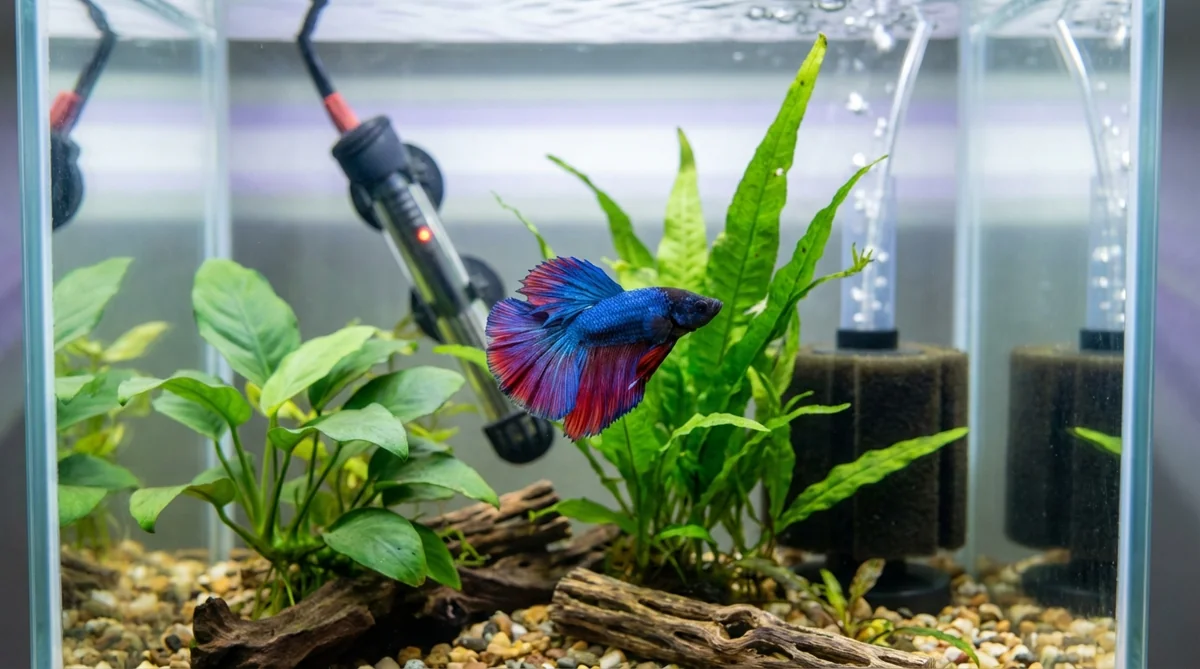
Moderate and severe cases heal far better in a dedicated hospital (quarantine) container, and it protects any tank mates and your biological filter from medication. Here is how to do it correctly:
- Size: at least 1–2 gallons — small enough to dose medication economically, large enough to stay thermally stable. Never use a tiny cup.
- Heater: a small adjustable heater set to 78–80°F. Stable warmth is part of the cure, not optional.
- Gentle aeration: an air stone on low or a sponge filter (without carbon) keeps oxygen up, especially important when medicating or running warm.
- No substrate or porous decor: bare bottom is easiest to keep spotless and lets you see waste. Add one silk plant or a small hide so the fish feels secure.
- Cover it: sick and stressed bettas jump. A lid prevents a tragic, avoidable death.
- Water source: use dechlorinated, temperature-matched water. Match the temperature within 1°F when transferring to avoid shock.
Perform daily 25–50% water changes in the hospital tank. Because there is no established biological filter, frequent changes are what keep the water safe during treatment.
Aquarium Salt vs. Epsom Salt vs. API Stress Coat: What to Use
| Product type | What it does for fin rot | How to use |
|---|---|---|
| Aquarium salt | Reduces osmotic stress, mildly inhibits bacteria, supports slime-coat recovery. Best general support for mild–moderate cases. | 1 tsp per gallon, pre-dissolved, up to 10 days; replace proportionally on water changes. |
| Epsom salt (magnesium sulfate) | Not for fin rot — it’s used for bloating/constipation and swelling, not bacterial fin infections. | Do not use for fin rot unless there is also internal swelling and you understand the dosing. |
| Slime-coat conditioner | Helps rebuild the protective slime layer after injury; supportive, not curative. | Per bottle, alongside water changes; useful for injury-driven cases. |
| Aquarium antibiotic | The actual cure for moderate–severe bacterial rot. | Per label, full course, carbon removed from filter. |
Key point: aquarium salt and table salt are not the same. Table salt often contains iodine and anti-caking agents that harm fish. Always use plain aquarium salt and never exceed roughly 10 continuous days.
Caring for Your Betta While It Heals
Treatment isn’t only medication — supportive care speeds recovery and prevents relapse.
- Feed for healing. A varied, protein-rich diet fuels tissue regrowth. High-quality betta pellets plus occasional bloodworms or brine shrimp. Do not overfeed — uneaten food fouls the very water you’re trying to keep pristine.
- Dim the lights and reduce traffic. Lower stress accelerates immune recovery. Move the tank away from noise and don’t tap the glass.
- Keep the temperature rock-steady. Swings undo progress. Check the thermometer daily.
- Be patient with regrowth. New fin tissue is clear, thin, and slightly raggedy — this is healthy regrowth, not new rot. Colour and full length return slowly over weeks to months.
- Don’t stop treatment early. Finish the full antibiotic course even if the fin looks better, or the infection can rebound resistant.
When to Call an Aquatic Veterinarian
Most fin rot is handled at home, but some situations need a professional:
- Rot has reached the body with open sores or red streaks (possible septicemia).
- The fish has stopped eating for several days and is lethargic or lying on the bottom.
- You’ve completed a full, correct treatment course and the rot is still advancing.
- Multiple fish are affected rapidly, suggesting an aggressive pathogen like columnaris.
An aquatic vet can prescribe targeted antibiotics and, in severe cases, provide care that over-the-counter products cannot. There is no shame in escalating — early professional help saves fish.
The Complete Fin Rot Treatment Timeline (Day 0 to Full Recovery)
One of the most common reasons owners panic mid-treatment is not knowing what normal progress looks like, so they either give up too early or keep changing the plan. Fin rot recovery follows a predictable arc when the cause is genuinely fixed. Use this as your reference for “is this working?”.
| Stage | What you should see | What to do |
|---|---|---|
| Day 0 (start) | Ragged, discoloured, possibly receding fin edges; you have just tested water and started treatment | Confirm water parameters, begin daily changes, start salt/antibiotic as the stage requires |
| Day 1–3 | The single most important sign: the rot stops spreading. Edges look no worse than yesterday | Hold the protocol exactly; daily 25–50% water changes; do not change anything if spread has stopped |
| Day 4–7 | Edges look “cleaner” — less black, less fuzzy, less melted. No new tissue loss | Continue treatment; finish any antibiotic course in full even though it looks better |
| Week 2–3 | Clear, thin, slightly raggedy new growth appears at the fin edges — this is healthy regrowth, not new rot | Stop salt by day 10; keep water pristine; feed for healing |
| Week 4–8+ | Visible length returns; colour fills in gradually from the base outward | Maintain normal good husbandry; patience — long fins regrow slowly |
| Month 2–3+ | Full or near-full regrowth on long-finned bettas; colour and shape mostly restored | Resume routine prevention; the episode is over |
The decisive checkpoint is Day 1–3: if the rot has stopped advancing, your plan is working and the priority is consistency, not adding more medication. If it is still visibly spreading after 3–4 days of a correct, full protocol with confirmed clean warm water, that is your signal to escalate — re-examine the diagnosis (it may be columnaris, not fin rot) and consider an aquatic vet.
Exact Dosing Reference: Salt and Common Medications
Vague dosing is where home fin-rot treatment most often goes wrong — either too little to help or enough to harm. Keep these specifics in front of you and always defer to the product label where it differs.
| Treatment | Dose | Duration | Critical rules |
|---|---|---|---|
| Aquarium salt (mild–moderate) | 1 teaspoon of aquarium salt per 1 gallon, pre-dissolved in a cup of tank water | Up to 10 continuous days maximum | Never table salt; replace salt proportionally to water removed on each change; never long-term in a planted tank |
| Erythromycin-type / fin-and-tissue treatment (moderate) | Per product label, by tank volume | The full labelled course — typically several days, even if it looks better sooner | Remove activated carbon first; do not stop early; do not double-dose to “speed it up” |
| Kanamycin / broad-spectrum gram-negative (severe / body rot) | Per product label, by tank volume | Full labelled course; treat in a hospital container | Remove carbon; never combine antibiotics unless a product is formulated for it; availability varies by country — ask your fish store for the equivalent |
| Slime-coat conditioner (supportive) | Per product label | Alongside water changes during recovery | Supportive only — it does not cure bacterial rot, it aids injury-driven cases |
The Biggest Fin Rot Mistakes (and What to Do Instead)
After enough fin-rot rehabilitations, the same handful of avoidable errors account for the large majority of cases that drag on for months or end badly. Each one has a simple correct alternative.
- Mistake: medicating before fixing the water. The rot relapses the moment the course ends because the real cause never changed. Instead: treat the water first and always — it is most of the cure, not step one of it.
- Mistake: trimming or “cutting off” the rotted fin. This is amateur surgery, it traumatises the fish, and it usually accelerates the infection. Instead: leave the fin alone; correctly treated tissue regrows on its own.
- Mistake: treating long-term in a tiny cup. The fish still needs warm, stable, oxygenated water — a cold fouling cup adds stress that defeats the treatment. Instead: use a properly heated 1–2 gallon (or larger) hospital container with daily changes.
- Mistake: stopping treatment as soon as it “looks better”. The bacteria are not gone yet; the infection rebounds, sometimes resistant. Instead: finish the entire labelled course every time, no exceptions.
- Mistake: combining several medications at once. Overdosing and chemical interactions stress the fish more than the rot. Instead: one correctly chosen treatment for the stage, dosed exactly.
- Mistake: mistaking healthy new growth for more rot. Owners panic at the clear, thin, raggedy regrowth and restart aggressive treatment unnecessarily. Instead: recognise clear thin edges as recovery and let it continue.
- Mistake: treating the wrong condition entirely. Fast grey film is columnaris, fluffy tufts are fungus — neither responds to a fin-rot plan. Instead: run the daily-photo progression test and the look-alike checklist before committing to treatment.
Nearly every “I treated it for months and it kept coming back” story is one of these — almost always treating the fin while ignoring the environment. Fix the root cause and fin rot simply stops.
Long-Term Aftercare: Keeping the Fin Rot Gone for Good
Beating an active fin-rot episode is only half the job. A betta that has had fin rot once is more vulnerable while the fins regrow, and the same conditions that caused it will cause it again if nothing structural changed. Lock in the recovery with deliberate aftercare:
- Keep water pristine through the entire regrowth period. New fin tissue is fragile. Maintain the routine partial water changes and stable parameters for the full weeks-to-months of regrowth, not just until the rot stops.
- Hold the temperature rock-steady at 78–80°F. Regrowth and immunity both depend on stable warmth; a swinging heater during recovery is a common cause of relapse.
- Feed deliberately for tissue repair. A varied, high-quality, protein-rich diet fuels regrowth — quality pellets plus occasional bloodworms or brine shrimp. Do not overfeed; uneaten food fouls the very water the recovering fin depends on.
- Keep stress low while the fish is vulnerable. Dim lighting, a calm low-traffic location, no glass-tapping, and no new tank mates or rescaping until the fish is clearly stable and regrowing well.
- Remove the original physical cause. If a sharp ornament or strong filter flow started it, replace or fix it now — run the “pantyhose test” over all decor; if nylon snags, it will shred regrowing fins.
- Audit the root cause honestly and permanently. Confirm the tank is cycled, adequately sized, and reliably heated. A fish that had fin rot is telling you one of these failed — fix it for good, not just for this episode.
- Keep observing daily. A 30-second daily check through recovery catches any early sign of relapse while it is still trivial to fix.
The honest truth from real rehabilitations: a betta that recovers from fin rot and then goes back into the exact conditions that caused it will get fin rot again. The fish that stays cured is the one whose environment changed — a cycled, heated, adequately sized, well-maintained, low-stress tank. That, not the medication, is what makes a recovery permanent. The full framework is in how to prevent betta diseases.
Sources & Further Reading
Chewy / PetMD — Betta Fish Fin Rot: Symptoms, Causes, and Treatment; Bettafish.org — Fin Rot; Aquarium Co-Op — Treating Fin Rot in Aquarium Fish; Merck Veterinary Manual — Bacterial Diseases of Ornamental Fish. Always follow the medication label and local veterinary advice for severe infections.
Frequently Asked Questions
Can betta fin rot heal on its own?
Mild, early fin rot often heals on its own once water quality is corrected and you do daily partial water changes. Moderate and severe cases will not self-heal and need salt and/or antibiotics.
How long does betta fin rot take to heal?
Spreading usually stops within 1–3 days of correct treatment. Visible fin regrowth takes 2–6 weeks, and full regrowth of long fins can take a few months.
Will betta fins grow back after fin rot?
Yes. If the fin base and body are not destroyed, fins regrow. New growth looks clear and thin at first. Severe body rot can leave permanent loss.
Is fin rot contagious to other fish?
The bacteria are present in every tank, so it is less “contagious” and more a sign of poor conditions. Other stressed fish in the same bad water can develop it too.
What water temperature is best while treating fin rot?
Keep it stable at 78–80°F (25–27°C). Cold water slows the immune system and healing.
What does early-stage betta fin rot look like?
Early fin rot looks like slightly ragged, transparent, or brown/white fin tips with tiny notches on the edge, while the fish still behaves normally. It is the easiest stage to cure — usually with clean water alone — so act as soon as you notice it.
Can I use aquarium salt and antibiotics together for fin rot?
Yes, aquarium salt at 1 teaspoon per gallon can be used alongside most aquarium antibiotics and often improves results in moderate cases. Always remove activated carbon from the filter first, follow the medication label, and do not exceed about 10 continuous days of salt.
Does fin rot hurt my betta?
Fin rot itself is not believed to be acutely painful in early stages because fin tissue has limited nerve supply, but advanced rot that reaches the body causes real distress, stress, and secondary infection. Treating early prevents suffering and permanent damage.
Why does my betta keep getting fin rot?
Recurring fin rot almost always means an unfixed root cause — usually an uncycled tank, no or unstable heater, a tank that is too small, sharp decor, overfeeding, or skipped water changes. Fix the environment and fin rot stops returning.
How do I know if fin rot treatment is working?
The decisive sign appears within the first one to three days: the rot stops spreading and the fin edges look no worse than the day before. Over the following week the edges look cleaner and less discoloured, and within two to three weeks clear, thin, slightly raggedy new growth appears — that is healthy regrowth, not new rot. If the rot is still visibly advancing after three to four days of a correct, full protocol with confirmed clean, warm water, re-check the diagnosis and consider an aquatic vet.