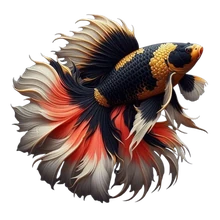
Whether betta and shrimp can share a tank comes down to two things you control, species choice and planting, and one you can’t: your betta’s predatory instinct. Done right, shrimp are a brilliant clean-up crew and a fascinating addition; done wrong, they’re an expensive snack that vanishes in a week. This guide ranks the safest shrimp (Amano, cherry colony, true ghost), explains the moulting danger that causes most shrimp deaths, and shows exactly how to stack the odds in their favour.
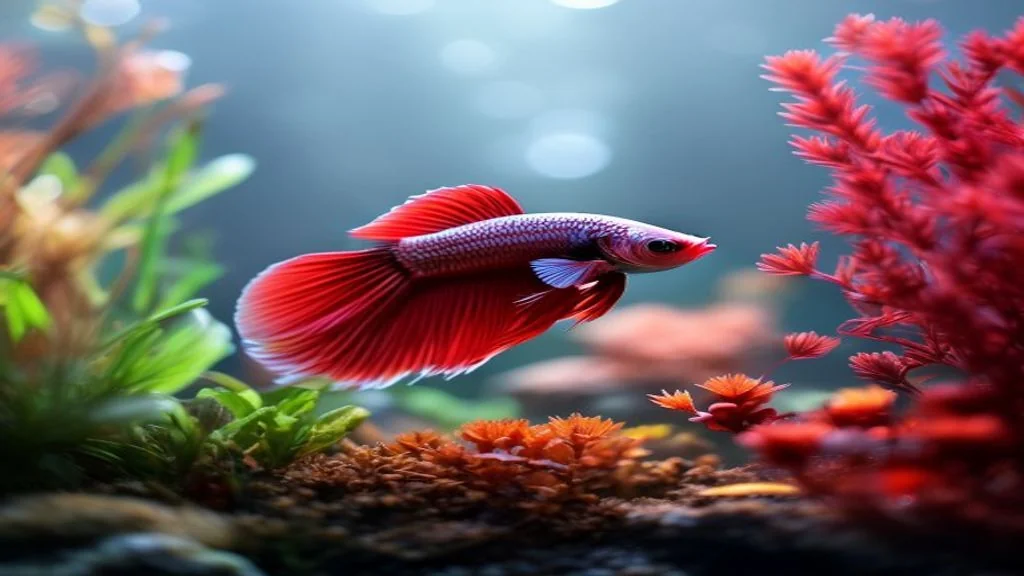
Betta and Shrimp: It Comes Down to Instinct
Whether betta and shrimp succeed comes down to predatory instinct, and reactions vary widely, some bettas completely ignore shrimp, others hunt them relentlessly. You can’t fully predict this, so you stack the odds with species choice, size, and dense planting. A backup plan matters here as much as with any pairing (see best betta tank mates). If your betta turns out to be a dedicated hunter, lower-risk options like snails or corydoras are far more forgiving.
The Setup That Keeps Shrimp Alive
- 10 gallons or larger, heavily planted (moss, dense plants), this is non-negotiable; bare tanks = dead shrimp. See tank size guide.
- Lots of hides: moss, caves, driftwood, leaf litter, shrimp need escape routes and moulting cover.
- Start with a colony, not 2–3 shrimp, so the population absorbs losses.
- Stable water: 75–80°F, gentle filter with a pre-filter sponge so shrimp aren’t sucked in (filter guide).
- Quarantine shrimp/plants first (quarantine guide), they carry parasites too.
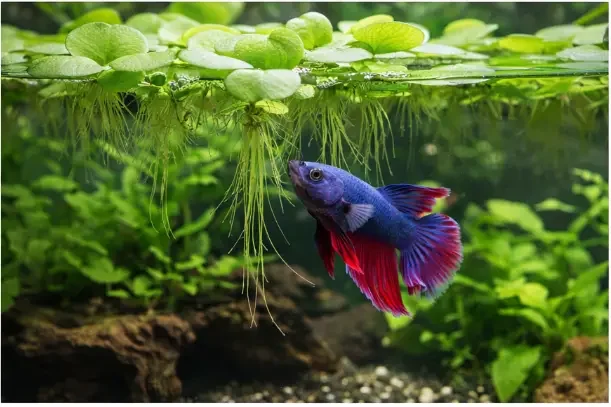
The Moulting Problem (Where Most Shrimp Deaths Happen)
Here’s the detail that decides shrimp survival and almost nobody explains: shrimp moult. For a few hours after shedding their shell they’re soft, slow, and defenceless, and that’s when an otherwise-tolerant betta picks them off.
| Moment | Shrimp risk | What protects them |
|---|---|---|
| Normal (hard shell) | Low, fast, armoured | Open swimming is okay |
| Just moulted (soft) | Highest, slow, exposed | Dense cover to hide until hardened |
| Newly added | High, disoriented, no territory yet | Heavy planting + acclimate slowly |
| Berried (carrying eggs) | Elevated, slower | Moss/caves to retreat into |
This is exactly why “heavily planted, lots of hides” isn’t optional advice, it’s the difference between a thriving colony and an expensive snack bowl. Bare tank + shrimp + betta almost always ends one way.
Shrimp Species Compatibility, Ranked
Species choice is the biggest single lever you have, because size and breeding rate decide whether a shrimp survives a curious betta. Here is the honest ranking.
| Shrimp | Adult size | Why it ranks here | Verdict with a betta |
|---|---|---|---|
| Amano shrimp | ~2 inches | Big and fast; most bettas leave them alone | Safest single choice |
| Cherry shrimp (colony) | ~1–1.5 inches | Small but breeds fast; a colony outpaces losses | Good as 15+, not 2–3 |
| True ghost shrimp | ~1.5 inches | Workable but “ghost shrimp” is a mixed catch-all | OK from a known source |
| Bamboo / wood shrimp | ~3 inches | Large filter-feeders, peaceful, mostly ignored | Workable in a mature tank |
| Tiny shrimp or lone fry | <0.5 inch | Bite-sized and defenceless | Avoid, guaranteed snack |
The pattern is consistent: bigger shrimp survive on size, small shrimp survive on numbers. The single worst approach is adding two or three small cherry shrimp to a betta tank and hoping, that almost always ends with an empty tank.
The Compatibility Scorecard
Unlike fish pairings, the limiting factor here is not water chemistry, shrimp and bettas want very similar water, but predation and the moult cycle.
| Factor | Betta + shrimp rating | Notes |
|---|---|---|
| Temperature | Match | 75–80°F suits both |
| pH / hardness | Workable | Cherries like a touch harder; manageable overlap |
| Predation risk | Variable | Entirely dependent on the individual betta |
| Moult vulnerability | High without cover | Dense planting is the fix |
| Filter intake risk | Real | Use a sponge pre-filter so shrimp aren’t sucked in |
| Overall | Works with the right setup | Species + planting decide it, not luck |
Acclimation: Shrimp Are Extra Sensitive
Shrimp are far more sensitive to water-parameter swings than most fish. A rushed drop into the tank can kill them within a day, which owners then misread as the betta hunting them.
- Quarantine shrimp and plants 4–6 weeks. Shrimp and the plants they arrive on can carry parasites and pests into the display tank (quarantine guide).
- Drip acclimate slowly, 1–2 hours. Shrimp need a much longer, gentler drip than fish to adjust to pH and hardness.
- Add into a mature, heavily planted tank. A new, sparse tank has no biofilm to graze and no cover to hide in.
- Release them near dense cover so they can retreat immediately rather than wander the open tank disoriented.
- Don’t add a single pair. Start with a colony so the population can absorb early losses while it establishes.
Reading Your Betta’s Predatory Instinct
You can’t choose your betta’s temperament, but you can read it within the first days and respond before you lose the whole colony.
- Indifferent betta: swims past shrimp, no interest even when they move. The ideal outcome; the colony will thrive with good cover.
- Curious betta: investigates and may nip antennae but doesn’t pursue. Usually survivable with heavy planting; watch moulting individuals.
- Dedicated hunter: actively stalks, chases, and picks shrimp off. This betta will never accept shrimp; move it or rehome the shrimp via the backup plan.
- Opportunist: ignores adults but eats anything small or moulting. A cherry colony can still persist; tiny shrimp or fry will not.
This is why a backup plan matters as much here as with fish. Judge the behaviour, not the hope, and compare against the safer-by-default options in best betta tank mates.
The Planted-Tank Strategy in Detail
“Heavily planted” gets repeated so often it stops meaning anything, so here is what it concretely involves and why each element earns its place. The goal is not decoration, it is to guarantee that a soft, freshly moulted shrimp is never more than a body-length from cover, because that single fact decides whether a colony survives a curious betta.
Moss Is the Single Most Important Element
Java moss, Christmas moss, or any dense aquatic moss is the backbone of a shrimp-safe tank. It creates a three-dimensional thicket that a betta physically cannot follow a shrimp into, it traps the biofilm and detritus shrimp graze on, and it gives newly hatched shrimplets a nursery a betta can never fully access. A large moss-covered area, ideally several connected clumps, does more for shrimp survival than any other intervention. A tank with one small moss ball is not a planted shrimp tank.
Layered Cover at Every Level
Shrimp use the whole water column, so cover has to exist at every level. Driftwood and rock create caves and crevices at the bottom; broad-leaf plants and stem plants break sightlines in the mid-water; floating plants with trailing roots provide a top-zone refuge and dim the light, which shrimp prefer. Leaf litter, particularly Indian almond leaves, adds both hiding space and a slow release of tannins that shrimp graze and benefit from. The principle is redundancy: many overlapping hiding options so that wherever a shrimp moults, safety is immediately adjacent.
Why a Bare or Sparse Tank Always Fails
In an open tank, every moult is a coin flip with a betta watching. There is no version of “a betta and a few shrimp in a lightly decorated tank” that reliably works, because the limiting event, a defenceless soft shrimp in open water, happens on a schedule you cannot prevent. Planting does not change the betta; it changes the geometry so the betta rarely gets the opportunity. This is why planting is described as non-negotiable rather than recommended.
Cherry Shrimp Colony Maths: Why Numbers Beat Hope
The cherry shrimp strategy is fundamentally a population game, and it is worth understanding the arithmetic because it explains why “I added five and they vanished” is the expected result, not bad luck.
- Small starts collapse. A handful of cherry shrimp cannot reproduce faster than even an occasional predation event removes them. The population trends to zero before it can establish.
- A critical mass reproduces faster than it is thinned. Start with a substantial colony, fifteen to twenty-five or more, and a healthy planted tank, and the breeding rate of a mature colony can outpace the slow attrition from a non-dedicated-hunter betta. The colony reaches a stable equilibrium rather than dying out.
- Females are the engine. A berried (egg-carrying) female releases dozens of shrimplets at a time. The more breeding females the colony sustains, the faster the recruitment, and the more resilient the population is to losses.
- Cover multiplies survivors. Shrimplets that have dense moss to hide in survive to adulthood; the same shrimplets in a bare tank do not. Planting and colony size are multiplicative, not independent.
The honest framing: a cherry colony with a betta is not “will the betta eat any shrimp”, it usually will, occasionally, but “does the colony reproduce faster than it loses members”. Set up correctly, the answer is yes, and the tank trends toward a self-sustaining population. Set up as a few shrimp in a sparse tank, the answer is no, and the outcome is an empty tank within weeks.
Amano Versus Cherry: Choosing Your Strategy
The two mainstream approaches succeed for opposite reasons, and picking the right one for your situation matters more than most keepers realise.
| Consideration | Amano shrimp | Cherry shrimp colony |
|---|---|---|
| Survival mechanism | Size, too big for most bettas to bother | Numbers, breeds faster than it is thinned |
| Best for | Keepers who want a few visible, reliable individuals | Keepers who want a self-sustaining population |
| Algae cleanup | Excellent, voracious algae eaters | Good, constant grazers in numbers |
| Breeding in tank | No, larvae need brackish water, won’t reproduce | Yes, readily breeds, replaces losses |
| Main weakness | Antennae nipping; vulnerable while moulting | Small individuals are snack-sized; needs critical mass |
| Colour appeal | Translucent, understated | Bright red, strong visual interest |
The practical guidance: if you want a small number of dependable cleaners and accept they will not multiply, Amano is the safer single choice. If you want colour and a colony that replenishes itself, commit to cherries properly, a large founding group and a genuinely planted tank, rather than a token few. The failure case is treating cherries like Amanos and adding only a handful; that ignores the very mechanism that keeps cherries alive.
Common Shrimp-Keeping Mistakes With a Betta
Most lost colonies trace back to a short list of avoidable errors. Each one is easy to fix once you know it is the cause.
- Starting with two or three shrimp. The single most common mistake. Small starts get eaten or fail to breed. Start a colony or choose Amanos.
- A bare or lightly decorated tank. Without dense cover, every moult is fatal exposure. Plant heavily before adding any shrimp.
- Adding shrimp to a brand-new tank. Shrimp need an established biofilm to graze and a stable, mature nitrogen cycle. A new tank starves and stresses them, and the deaths get misread as predation.
- Rushing acclimation. Shrimp are far more sensitive to parameter swings than fish and need a slow drip over one to two hours. A fast transfer can kill them within a day.
- No filter guard. An unguarded intake silently removes shrimp and shrimplets. A sponge pre-filter is essential, not optional.
- Copper exposure. Many fish medications and some plant fertilisers contain copper, which is lethal to invertebrates. Never dose copper-based treatments in a shrimp tank.
- Ignoring the betta’s signals. A dedicated hunter will not change. Continuing to add shrimp to a betta that stalks them just funds repeated losses; use the backup plan instead.
Sources & Further Reading
The Shrimp Farm, cherry/ghost shrimp & betta; Splashy Fish, betta & freshwater shrimp; Betta Care Fish Guide, shrimp with betta; Aquarium Co-Op, invertebrate care.
Frequently Asked Questions
Can bettas live with shrimp?
Yes, with the right setup: Amano or a cherry-shrimp colony in a 10-gallon-plus heavily planted tank with lots of hides and a betta that isn’t a dedicated hunter.
What is the safest shrimp for a betta tank?
Amano shrimp, they’re large and fast enough that most bettas ignore them, though a betta may nip at their antennae.
Will a betta eat cherry shrimp?
It can, especially small or moulting ones. Keeping a breeding colony in a heavily planted tank lets the population survive the losses.
What size tank for a betta and shrimp?
At least 10 gallons, heavily planted with moss and hiding spots so shrimp can escape and moult safely.
Why do shrimp keep disappearing in my betta tank?
Usually they’re being picked off while moulting or shortly after being added, when they’re soft and defenceless. Dense moss and hides solve most of it; a bare tank almost guarantees losses.
Can baby shrimp survive in a betta tank?
Only in a heavily planted tank with dense moss where they can hide. In an open tank a betta will eat most fry, which is why a breeding colony with cover is the strategy.