If you had to pick a single community fish for a betta, betta and corydoras would be near the top of the list. Corydoras catfish live on the bottom while the betta patrols the top, eat different food, and look nothing like a rival betta — three structural reasons the pairing almost never produces conflict. This guide explains why bettas and corydoras rarely clash, the exact tank and school size you need, the substrate detail most beginners get wrong, and how to introduce them safely.
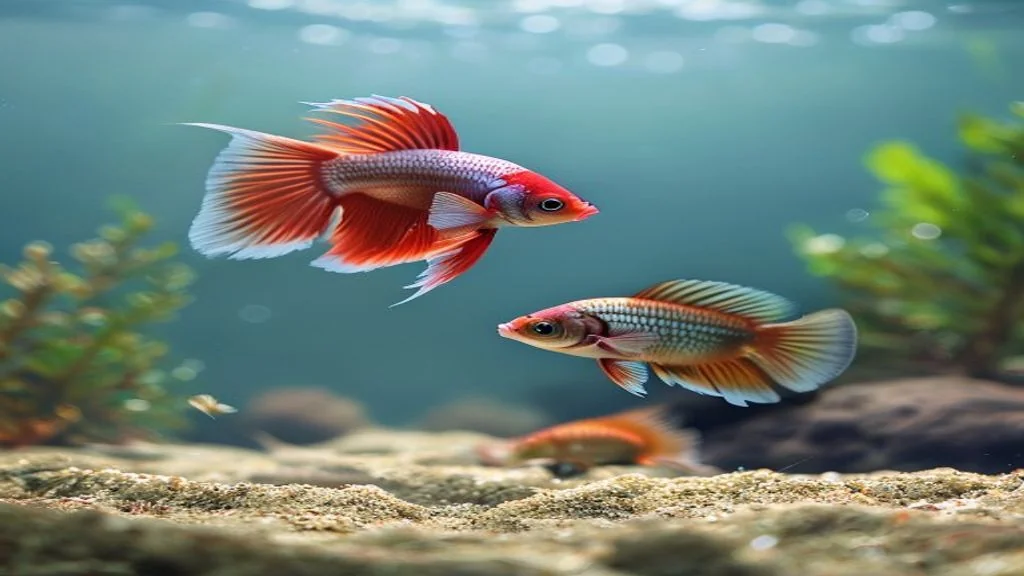
Why Betta and Corydoras Rarely Clash
- Different zone: corydoras stay on the bottom; bettas patrol the top/mid — they barely interact.
- No “betta look”: dull, armoured, short-finned — nothing that triggers fin-recognition aggression.
- Peaceful temperament: they don’t nip and won’t bother the betta.
- Different diet: corydoras scavenge the bottom; no food rivalry (still feed them properly — see betta diet for portioning logic).
The Right Setup
| Factor | Best practice |
|---|---|
| Tank size | 15–20+ gallons (bottom footprint matters) — tank size guide |
| School size | 5–6 minimum (corydoras are shoaling — lone ones get stressed) |
| Substrate | Sand or smooth gravel (protects their barbels) |
| Water | 78–80°F, gentle filter — same as betta (heater, filter) |
| Hides | Caves/plants so corydoras feel secure |
Avoid a 5-gallon: too small for a corydoras shoal, and a cramped betta is more likely to pick on them. This is a community-tank pairing, not a small-tank one — see the size logic in is 5 gallons best for bettas.
How to Introduce
- Quarantine the corydoras 4–6 weeks first (quarantine guide).
- Add the whole shoal together with plenty of bottom cover.
- Watch 48 hours; conflict is rare but a hyper-aggressive betta should still be monitored — keep a backup tank.
The Substrate Detail That Makes or Breaks This Pairing
Corydoras are one of the best betta companions — but there’s a make-or-break detail almost every beginner gets wrong: substrate. Corydoras feed by sifting the bottom with delicate sensory barbels (“whiskers”).
| Substrate | Effect on corydoras | Verdict |
|---|---|---|
| Soft sand | Barbels stay healthy; natural sifting | ✅ Ideal |
| Smooth fine gravel | Usually okay if not sharp | ⚠️ Acceptable |
| Sharp/coarse gravel | Erodes barbels → infection → can’t feed | ❌ Avoid |
Sharp substrate slowly destroys their barbels, leading to infection and an inability to find food — a slow decline owners blame on “bad luck”. Sand or smooth substrate isn’t decoration advice here; it’s a health requirement for corydoras.
Why Bettas and Corydoras Almost Never Fight
This pairing works for structural reasons, not luck — understanding them helps you replicate the success:
- Zero zone overlap. Corydoras live on the bottom; bettas patrol the top/mid. They barely occupy the same space, so there’s almost nothing to fight over.
- No “betta trigger”. Corydoras are dull, armoured, short-finned — nothing that resembles a rival betta or invites fin-nipping.
- Peaceful by nature. They don’t nip, chase, or compete; they scavenge calmly in a group.
- They’re shoaling — keep 5–6+. A lone corydoras is stressed and unhealthy; a proper group is confident and active. This isn’t optional, and it’s why the pairing needs a 15–20+ gallon tank, not a 5-gallon (tank size guide; is 5 gallons enough).
Quarantine the group first (quarantine guide), use sand, keep 5–6+, and even a fairly territorial betta usually ignores them. Conflict is rare enough that corydoras sit near the top of best betta tank mates — still keep a backup tank for the occasional exception, and watch early stress signs.
The Compatibility Scorecard
Corydoras score highly across the board. The only real requirements are a big enough tank for a shoal and the correct substrate — both fully in your control.
| Factor | Betta + corydoras rating | Notes |
|---|---|---|
| Temperature | Match | Most common cories suit 75–80°F (check species) |
| pH / hardness | Match | Soft to neutral suits both |
| Zone overlap | Minimal | Cories on the bottom, betta up top |
| Aggression trigger | None | Dull, armoured, short-finned — no rival cue |
| School requirement | Critical | 5–6+ shoaling fish, never kept alone |
| Overall | One of the very best pairings | Needs 15–20+ gal and soft substrate |
This is one of the few pairings where even a fairly territorial betta usually succeeds, because there is almost nothing for the two species to compete over.
Choosing the Right Corydoras Species
“Corydoras” covers many species, and a few practical differences matter when pairing them with a betta — mostly temperature tolerance and adult size.
- Bronze and albino cories — hardy, widely available, comfortable in the warmer end bettas need. A reliable default choice.
- Panda cories — popular and peaceful but prefer slightly cooler water, so keep the tank toward the lower end of the betta range and watch them in sustained heat.
- Pygmy and dwarf cories — tiny and charming, good for smaller (but still 15+ gallon) setups; keep larger groups of 8–10 as they shoal even more tightly.
- Sterbai cories — notably heat-tolerant, which makes them one of the better matches for a warm betta tank.
Whichever you choose, confirm its temperature range overlaps the betta’s 78–80°F and keep a single-species group rather than mixing types — cories shoal best with their own kind.
Acclimation and Introduction
Conflict is rare here, so the priority during introduction is the corydoras’ own health — clean water, the right substrate, and a stress-free transfer.
- Quarantine the shoal 4–6 weeks. Cories are sensitive to disease and can also import it; quarantine protects both them and the betta (quarantine guide).
- Set up sand or smooth substrate first. This is non-negotiable for barbel health and must be in place before they arrive.
- Add the whole group together with plenty of bottom cover — caves, driftwood, and plants so they feel secure immediately.
- Float and acclimate gently over 30–45 minutes; cories dislike sudden parameter swings.
- Watch the first 48 hours. Conflict is unlikely, but a hyper-aggressive betta should still be monitored and moved to the backup tank if it harasses them.
Warning Signs Specific to Corydoras
Because betta aggression is rare with cories, most problems show up as corydoras health issues instead — and they’re easy to miss if you don’t know what to look for.
| Sign | Likely cause | Action |
|---|---|---|
| Eroded or missing barbels | Sharp substrate or dirty sand | Switch to soft sand; keep substrate clean |
| Hiding constantly, not foraging | Group too small or no cover | Increase shoal to 6+, add hides |
| Gasping / darting to surface | Poor water quality or low oxygen | Test water, increase aeration |
| Betta chasing a cory | Rare hyper-aggressive individual | Separate using the backup tank |
Most “bad luck” cory deaths in betta tanks trace back to sharp gravel destroying barbels, which leads to infection and an inability to feed — see why it makes the list in beginner betta care mistakes.
Why the “Different Zone” Advantage Is So Powerful
Most betta-pairing failures come from competition over the same resource: the same water column, the same territory, the same surface, the same food. The betta-and-corydoras pairing succeeds precisely because it removes that competition almost entirely, and it is worth understanding the mechanism so you can recognise why this is structurally safer than even the good schooling-fish options.
A betta is a surface and upper-water fish. It breathes atmospheric air at the surface through its labyrinth organ, builds bubble nests at the top, and patrols the upper third of the tank as its territory. A corydoras is the opposite animal: it is a bottom-dwelling scavenger that spends almost its entire life on the substrate, sifting sand for food and darting to the surface only for a quick gulp of air before returning to the bottom. The two species are, in effect, living in two different tanks stacked on top of each other. There is no shared territory to defend, no shared food to fight over, and no overlapping patrol route to trigger a confrontation.
This is why even a moderately territorial betta — one that might harass a mid-water tetra — usually ignores corydoras completely. The betta does not perceive the bottom as its territory, so a fish that stays there is not a rival or an intruder. Compare this to mid-water schooling fish like neon tetras or rasboras, which share the betta’s zone and can still trip its territorial response under stress. The corydoras pairing is safer not because corydoras are tougher, but because the geometry of the tank keeps the two species apart by default. When you hear that corydoras are “one of the best” betta companions, this spatial separation is the single biggest reason.
Substrate, Barbels, and the Slow Decline Owners Miss
The most common way this otherwise bulletproof pairing fails has nothing to do with the betta — it is the substrate slowly disabling the corydoras. This deserves a deeper explanation than “use sand”, because the failure is gradual and easy to misattribute to disease or bad luck.
Corydoras feed by burying their mouths and barbels into the substrate and sifting it for food particles. The barbels are delicate sensory organs, essentially the corydoras’ equivalent of fingertips for finding food. On soft sand, this behaviour is natural and harmless — the fish sifts, the sand passes harmlessly over the gills, and the barbels stay intact. On sharp or coarse gravel, every feeding motion abrades those barbels. Over weeks, they wear down, become infected, and eventually erode away entirely. A corydoras with damaged barbels cannot locate food efficiently, so it slowly starves even in a well-fed tank, all while the owner sees a fish that “just faded for no reason”.
The fix is specific and non-negotiable: smooth, fine sand is ideal; rounded fine gravel is tolerable only if it is genuinely smooth; sharp, coarse, or jagged gravel is disqualifying for corydoras regardless of how good it looks. Equally important is keeping that substrate clean — even soft sand becomes a problem if trapped waste makes it a bacterial hazard for the barbels. A gentle weekly surface siphon of the sand keeps it safe. This single detail decides whether a corydoras shoal thrives for years or quietly declines, and it is entirely within the keeper’s control.
Shoaling Behaviour: Why Five Is the Floor, Not the Goal
Corydoras are obligate shoaling fish, and the instruction to keep “at least five or six” is a minimum rather than a target. Understanding their social biology explains why an under-stocked group is the second most common failure after substrate.
- Confidence comes from numbers. A corydoras in an adequate group forages boldly in the open, even with a betta cruising above. A lone or near-lone corydoras hides constantly, stops foraging properly, and declines from chronic stress — behaviour owners often misread as the betta bullying it.
- Bigger groups behave better. Six is a working minimum, but groups of eight to ten or more display the natural, active, social behaviour the species is loved for, including coordinated foraging and the characteristic “shoal sweeps” across the substrate.
- Keep one species per group. Corydoras shoal most tightly with their own species. A mixed bag of two of this and three of that does not form a cohesive shoal as reliably as a single-species group of the same total number.
- The group is also their safety signal. Like other shoaling fish, a corydoras reads its group as protection. With the group present, the betta above is irrelevant scenery; without it, the corydoras stays stressed regardless of how peaceful the betta is.
The practical takeaway is that “the betta is stressing my corydoras” is, far more often, “my corydoras group is too small to feel safe”. Fix the shoal size before suspecting the betta — in the large majority of cases, that is the entire problem.
Feeding So the Corydoras Actually Eat
Because corydoras occupy a different zone, a subtle problem can develop that has nothing to do with aggression: the betta intercepting their food before it ever reaches the bottom. A corydoras shoal can slowly starve in a tank that appears well-fed simply because the betta eats everything on the way down.
- Use dense sinking food. Sinking pellets or wafers formulated for bottom feeders drop fast and are less appealing for a betta to chase mid-water than floating flake.
- Feed after lights-out or at dusk. Corydoras are comfortable foraging in low light, and a settled betta is less likely to patrol aggressively for sinking food then.
- Target-feed the bottom. Drop the corydoras’ portion in a consistent spot away from where the betta feeds, so the shoal learns where to find it quickly.
- Confirm they are actually eating. Watch occasionally to verify the corydoras reach and consume their food rather than assuming it. A round-bellied, actively foraging shoal is the sign you have it right.
- Do not rely on “leftovers”. Corydoras are not a clean-up crew that survives on a betta’s scraps. They need their own complete, deliberately delivered diet — feeding them properly also protects water quality (the portioning logic in betta diet applies to total tank input too).
Realistic Long-Term Scenarios
To make the guidance concrete, here is how this pairing typically plays out over months in the setups people actually run.
Scenario 1: A shoal of six bronze cories on sand in a planted 20-gallon
The textbook success. Adequate group, correct substrate, ample volume, and a temperature both species share. The betta patrols the top and ignores the bottom entirely; the cories forage confidently in a tight group. This setup routinely runs for years with no aggression issues and is exactly why corydoras rank near the top of the safe list.
Scenario 2: Three cories on fine gravel in a 10-gallon
The slow-failure version. The betta is rarely the problem; the corydoras are. The group is too small to feel secure, so they hide and forage poorly, and the gravel gradually wears their barbels. The decline is gradual and gets blamed on “weak fish” when the real causes were under-stocking and substrate — both fixable, both avoidable.
Scenario 3: A correct cory setup but with a genuinely hyper-aggressive betta
The rare exception. A small minority of bettas are aggressive enough to pursue even bottom dwellers. With a correct shoal, substrate, and tank size already in place, you have ruled out the common causes, so this is one of the few cases where the individual betta is genuinely the issue. The solution is the standing backup tank — separate the betta and keep it solo rather than subjecting the shoal to constant harassment.
Sources & Further Reading
Betta Care Fish Guide — Corydoras and Bettas; Bettafish.org — safe tank mates; Keeping Catfish — cory & betta; Aquarium Co-Op — corydoras care.
Frequently Asked Questions
Can bettas live with corydoras?
Yes — it’s one of the best pairings. Corydoras are peaceful bottom-dwellers that don’t trigger betta aggression. Keep 5–6+ in a 15–20+ gallon tank.
How many corydoras should I keep with a betta?
At least 5–6. Corydoras are shoaling fish and become stressed and unhealthy kept alone or in tiny groups.
What size tank for a betta and corydoras?
15–20 gallons or more, with a sand or smooth substrate to protect the corydoras’ barbels.
Will a betta bother corydoras?
Rarely — they occupy different zones and corydoras don’t look like a rival betta. A very aggressive betta should still be monitored.
Can a betta and cory catfish live in a 5-gallon tank?
No. 5 gallons is too small for a corydoras shoal and makes the betta more likely to pick on them. Use 15+ gallons.
What substrate is best for corydoras with a betta?
Soft sand is ideal. Corydoras sift the substrate with delicate barbels, and sharp or coarse gravel erodes them, leading to infection and an inability to feed. Smooth fine gravel is acceptable; sharp gravel is not.
Which corydoras species do best with a betta?
Heat-tolerant species like sterbai, plus hardy bronze and albino cories, suit the warm 78–80°F a betta needs. Panda cories prefer slightly cooler water, so keep them at the lower end of the range.
Do corydoras and bettas compete for food?
No. Corydoras scavenge the bottom while the betta feeds at the surface. Just ensure sinking food actually reaches the cories rather than being eaten on the way down.
Will a betta eat baby corydoras?
It can — fry of any species are vulnerable. Adult corydoras are armoured and safe, but if you want fry to survive you’ll need a separate grow-out tank.
Why are my corydoras hiding all the time?
Usually the shoal is too small or there isn’t enough cover. Corydoras are social; keep 5–6+ and provide caves and plants so they forage confidently in the open.