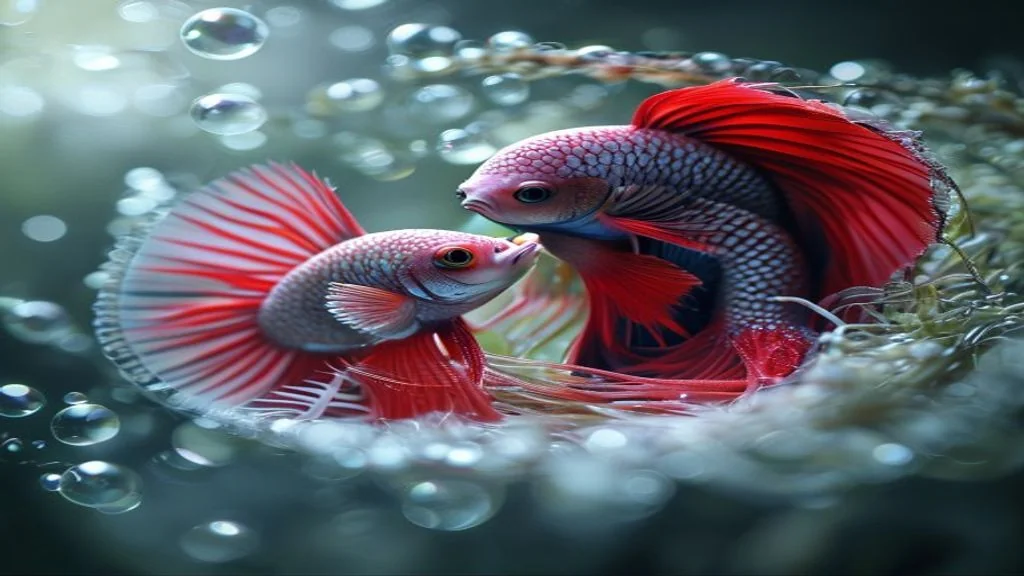
If you have ever wondered exactly how do betta fish mate, the short version is a dramatic, almost violent-looking ritual that ends with the male curled around the female beneath a raft of bubbles. This guide breaks the entire spawning sequence down stage by stage — the courtship, the famous “embrace”, egg release and fertilisation, what is perfectly normal versus genuinely dangerous, and the exact moment you must intervene — so you can watch it unfold without panicking at the rough parts.
How Do Betta Fish Mate? The Sequence Stage by Stage
| Stage | What you see |
|---|---|
| 1. Nest building | Male blows a bubble nest at the surface |
| 2. Display/courtship | Male flares, spreads fins, “dances”; female shows vertical breeding bars |
| 3. Approach | Receptive female swims to the male near the nest, head-down posture |
| 4. The embrace | Male wraps around the female; she’s momentarily still (“stunned”) |
| 5. Egg release + fertilisation | Eggs drop as the male fertilises them in the same moment |
| 6. Egg collection | Male (sometimes female) mouths fallen eggs into the nest |
| 7. Repeat & finish | Cycle repeats for hours; then the male guards the nest and drives the female off |
Reading the Signs of Readiness
Mating only works if both fish are ready — forcing it causes injury. Look for:
- Male: actively building a bubble nest, flaring and displaying, not hiding.
- Female: vertical breeding bars (top-to-bottom — not horizontal stress stripes), a rounder belly with eggs, sometimes a visible white “egg spot” (ovipositor).
- Both: conditioned and healthy — see conditioning bettas for breeding and confirm sex via male vs female bettas.
What’s Normal vs. What’s Dangerous
Spawning looks violent — this is the part that scares first-time breeders into intervening at the wrong moment:
| Normal (don’t panic) | Dangerous (intervene) |
|---|---|
| Chasing, flaring, a few torn fins | Relentless attacking with no spawning attempts after 24–48 hrs |
| Female briefly motionless during the embrace | Female trapped, battered, hiding constantly, refusing to spawn |
| Male driving the female away after spawning | Either fish badly injured or exhausted/listless |
If it’s clearly turned into one-sided aggression rather than courtship, separate them and re-condition before trying again. Minor torn fins should be watched so they don’t become fin rot — keep water pristine.
After the Embrace: The Critical Removal
Once the female stops producing eggs and the male is fully focused on the nest, the female must be removed — she’s exhausted and the male will now attack her as an intruder near his eggs. Move her to a clean, warm recovery jar with rich food and watch her recover. The male stays to tend the nest until the eggs hatch (see betta fish eggs), then he too is removed once fry are free-swimming (fry care). Mating is just one stage of the bigger picture covered in the complete betta breeding guide.
Stage 1 in Detail: Nest Building
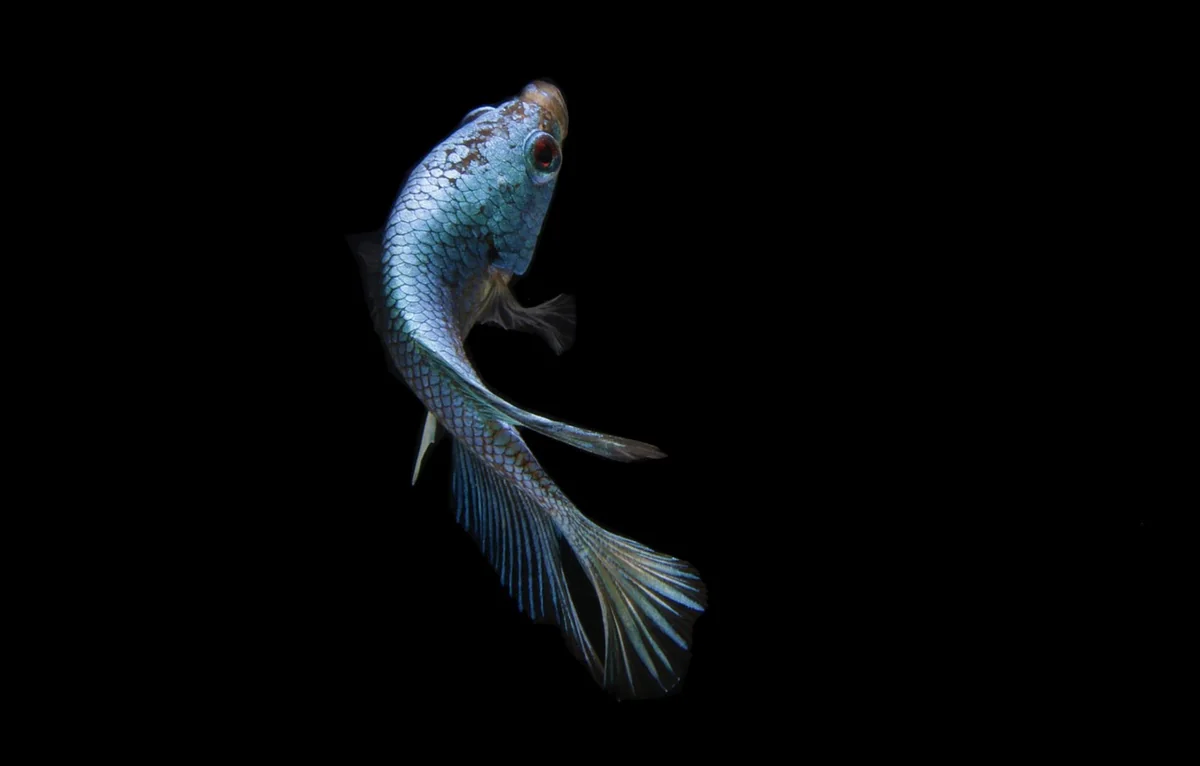
Everything starts with the male and the surface. A conditioned, ready male will gulp air and blow a raft of saliva-coated bubbles, usually under a floating anchor — a foam cup, a leaf, a film of surface scum. He fusses over it constantly, adding bubbles, repositioning, defending the spot. A robust, well-built nest is the clearest single sign the male is in spawning condition and the water parameters are right. A male that refuses to build is telling you something is off: water too cold, current too strong, the fish not conditioned, or he is stressed. The meaning and triggers of nest-building are explored further in betta bubble nest meaning. Do not “fix” or move the nest — handling it almost always ends the spawn.
Stage 2 in Detail: Courtship and Display
Once the female is released near the nest, the male shifts into full display: fins fully spread, gill covers flared, body colour at its most intense, swimming in a stiff, showy “S” or sideways shimmer. He may flare directly at her, then dart back toward the nest as if leading her to it. A receptive female responds rather than flees — she darkens, shows strong vertical breeding bars, sometimes flares back in a smaller way, and orients toward the nest with a slightly head-down posture. An unready female does the opposite: she clamps her fins, hugs the bottom or corners, shows horizontal stress stripes instead of vertical bars, and tries to escape. Courtship can run several hours, and it is normal for it to look like harassment in places. The key distinction is direction — a willing female keeps returning to the nest area; an unwilling one only ever tries to get away.
Stage 3 in Detail: The Embrace, Egg Release and Fertilisation
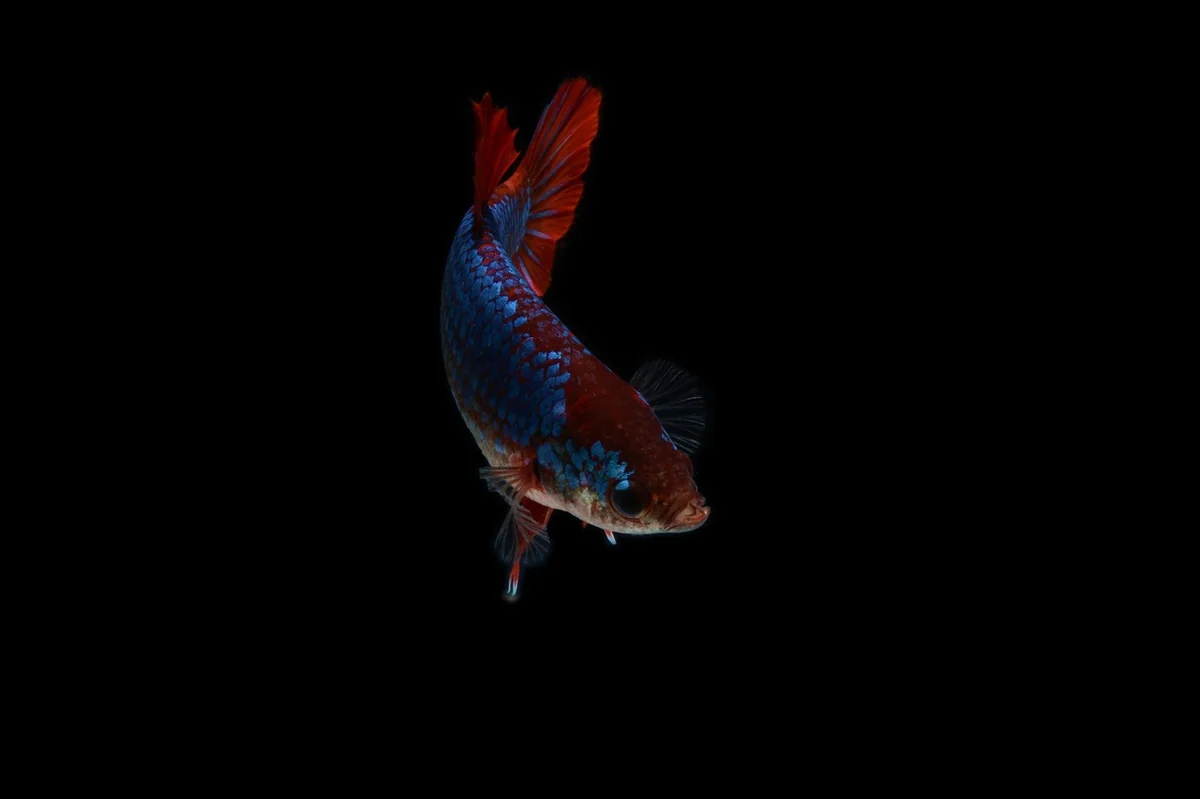
The embrace is the heart of betta mating and the part that alarms first-time keepers. The pair meet directly beneath the nest. The male curves his entire body around the female, often bending her into a “U” with her belly facing upward. For a few seconds she appears completely motionless or “stunned” — this is normal and is the moment of egg release. As she releases a batch of eggs, the male fertilises them in the same instant by releasing milt. The eggs, being slightly heavier than water at this stage, drift downward. The pair separates; the female may sink and rest briefly while the male — and frequently the female too once she recovers — darts down to catch the falling eggs in their mouths and spit them up into the bubble nest. Then the pair re-positions and embraces again. This full cycle repeats many times over several hours, with each embrace producing another small batch of eggs until the female is spent. A single spawn commonly yields 30–40 eggs and sometimes far more; what those eggs should look like is covered in betta fish eggs.
Stage 4 in Detail: Egg Collection and the Shift to Guarding
Between embraces, egg retrieval is constant and frantic-looking. Eggs that are missed and reach the bare bottom can still be recovered by the male, which is precisely why the breeding tank has no gravel and shallow water — the logic is laid out in betta breeding tank setup. As the female runs out of eggs, the dynamic flips. The male stops courting and starts guarding. He positions himself under the nest, becomes intensely territorial, and begins treating the female not as a mate but as an intruder near his eggs. This behavioural switch is your single most important visual cue, and it is covered in its own section below.
How Long Does the Whole Process Take?
| Phase | Typical duration |
|---|---|
| Nest building | Hours to ~1–2 days after the male is introduced |
| Courtship/display after female release | Several hours, sometimes up to 1–2 days |
| Active embracing/egg-laying session | 2–6 hours in one continuous session |
| Female removal | Immediately once spawning ends and guarding begins |
| Egg incubation (male tending) | 24–72 hours to hatch |
| Yolk-sac stage (fry hang in nest) | 2–3 days after hatching |
If 24–48 hours pass after the female is released with no nest, no courtship, and no spawning attempt — only hiding or one-sided attacking — the pair is not ready. Separate them, re-condition, and try again rather than leaving them to injure each other.
Reading the Signs of Readiness
Mating only works if both fish are ready — forcing it causes injury. Look for:
- Male: actively building a bubble nest, flaring and displaying, not hiding.
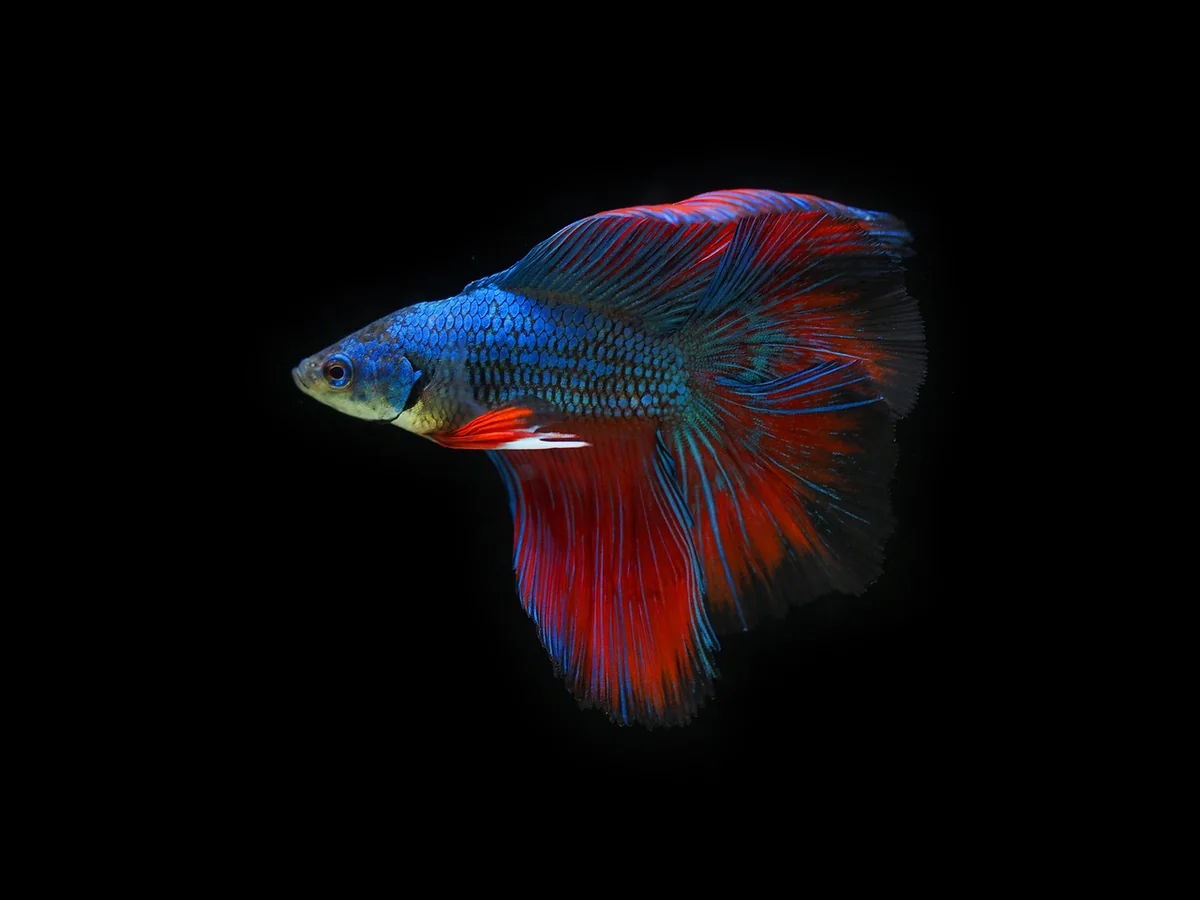
- Female: vertical breeding bars (top-to-bottom — not horizontal stress stripes), a rounder belly with eggs, sometimes a visible white “egg spot” (ovipositor).
- Both: conditioned and healthy — see conditioning bettas for breeding and confirm sex via male vs female bettas.
Why Bettas Mate This Way (the Biology)
Bettas are bubble-nest builders from shallow, still, warm waters (think Thai rice paddies and slow ditches). In that habitat, water can be low in oxygen, so a surface bubble nest in warm, humid air keeps developing eggs better oxygenated than the water column would. The shallow spawn tank and surface nest deliberately mimic that environment — which is why breeding tank setup uses very low water and a tight, warm lid. The embrace itself is an efficient adaptation: wrapping the female both triggers egg release and positions the male to fertilise the eggs in the same instant, minimising waste in still water where eggs and milt would otherwise disperse. The male’s intense post-spawn aggression is paternal instinct: in the wild he alone guards eggs and fry from predators — including the female, who would otherwise eat the eggs. Understanding this makes the “violent” behaviour read as biology working exactly as designed, not as a malfunction or a cruel fish.
Failed Spawns: Why Bettas Sometimes Won’t Mate
- Not conditioned: the most common cause — see conditioning bettas for breeding.
- Wrong temperature: below ~80°F many pairs simply will not spawn; the tank must hold a steady 80–82°F.
- Stress and disturbance: bright light, tapping the glass, foot traffic, or a strong filter current can stall a pair indefinitely.
- Mis-sexed fish: two of the same sex will never spawn — confirm via male vs female bettas.
- Inexperience: first-time pairs sometimes fumble the first one or two attempts and succeed later after re-conditioning.
- Incompatibility: occasionally a specific pair simply refuses each other even when both are ready; swapping a partner can solve it.
Sources & Further Reading
Hepper (vet-approved) — betta breeding; NippyFish — spawning behaviour; Aquarium Store Depot — breeding guide; Fishkeeping World — breeding betta fish.
Frequently Asked Questions
How do betta fish mate?
The male builds a bubble nest and courts the female; under the nest he wraps around her in an “embrace” as she releases eggs and he fertilises them. He then collects the eggs into the nest, repeating for hours.
What is the betta “embrace”?
The moment the male wraps his body around the female to trigger and fertilise egg release. She goes momentarily still, then eggs drop and the male gathers them.
Is it normal for bettas to fight while mating?
Some chasing, flaring, and minor torn fins are normal courtship. Relentless one-sided attacking with no spawning, or serious injury, means you should separate them.
How do I know if my female betta is ready to mate?
Vertical breeding bars (not horizontal stress stripes), a rounder egg-filled belly, a visible white egg spot, and approaching the male’s nest.
How long does betta spawning take?
The embrace cycle repeats over several hours in one session. Afterward the female is removed and the male tends the eggs.
When do I remove the female after mating?
As soon as spawning ends and the male starts guarding the nest and driving her away — leaving her in risks serious injury.
Why does the male attack the female after mating?
Paternal instinct — he now sees anything near the eggs, including the female, as a threat and guards the nest alone.
Do betta fish need a bubble nest to mate?
Yes, in normal breeding the male builds a bubble nest first. The eggs are placed in it and the male tends them there. A male that won’t build a nest usually isn’t conditioned or the water is too cold or turbulent.
Why won’t my betta fish mate?
Usually the pair isn’t conditioned, the temperature is below 80°F, there’s too much disturbance or current, the fish are mis-sexed, or it’s an inexperienced or incompatible pair. Re-condition, stabilise the tank, and try again.
Do female bettas help look after the eggs?
Briefly — a female may help catch falling eggs during spawning, but the male quickly drives her off and tends the nest alone. That’s why she’s removed as soon as spawning ends.