“How long can a betta go without food” is one question with three very different real-world answers, and confusing them is where keepers go wrong. A planned fast, a week-long vacation, and a fish that flat-out refuses food are not the same situation even though all three involve an empty stomach. This guide gives the honest survival timeframes, explains why short fasts are genuinely good for a betta, and shows when an empty stomach is actually a red flag.
The Real Timeframes
| Duration | Status |
|---|---|
| 1–2 days | Completely fine, even beneficial (digestive rest) |
| 3–7 days | Safe for a healthy adult (e.g., a short vacation) |
| ~10–14 days | Emergency maximum, survivable but stressful, not advisable |
| Beyond ~2 weeks | Serious risk, weakness, organ stress, decline |
This applies to healthy adult bettas in good water. Sick, very young, or stressed fish have far less reserve and should not be fasted by choice.
Why This Question Has 3 Different Answers
- “I want to fast my betta on purpose.” A planned 1–2 day fast (often weekly) is healthy, it clears the gut and prevents constipation. See the weekly fast day in our feeding guide.
- “I’m going on vacation.” Up to ~5–7 days, a healthy betta is genuinely better left unfed than risking an unreliable feeder block fouling the water. Longer trips need a plan; see the vacation plan by trip length below.
- “My betta won’t eat.” This is not voluntary fasting, it’s a symptom. The clock matters less than the cause: test water, check temperature, and read why is my betta not eating.
Why Short Fasts Are Good (Not Cruel)
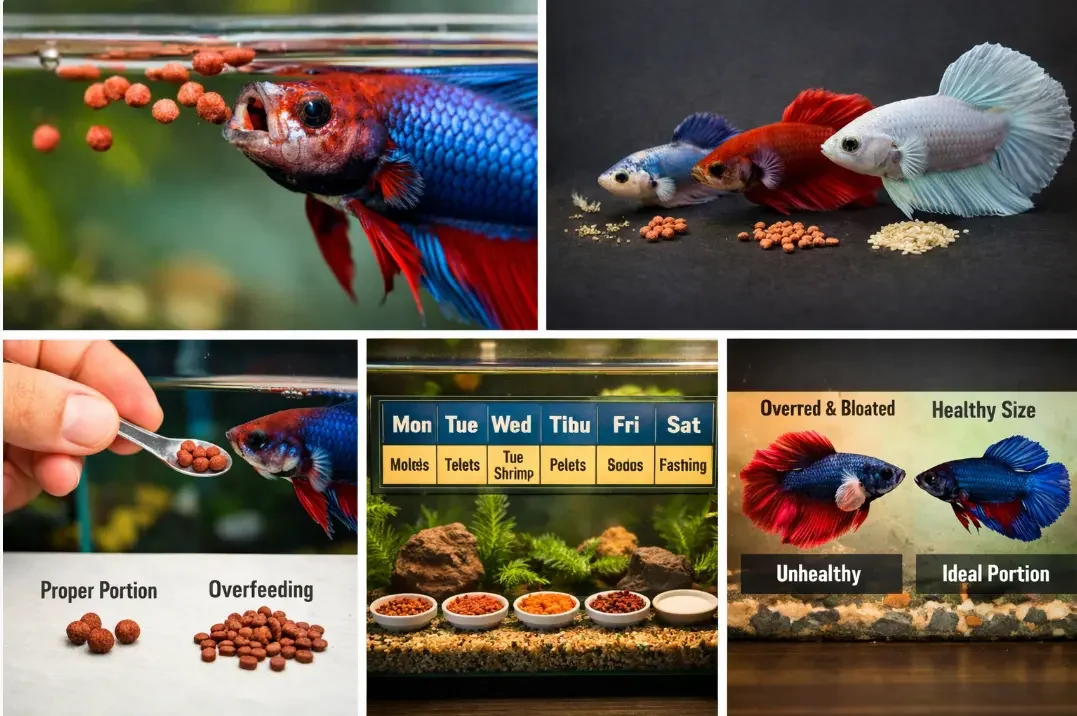
Bettas in the wild don’t eat on a fixed schedule and frequently go without. In captivity, the far bigger danger is overfeeding, the cause of constipation, swim bladder problems, and fouled water (see how often to feed a betta). A regular fasting day gives the digestive system a break and is standard good practice.
When “Not Eating” Becomes a Worry
What Affects How Long a Betta Can Go Without Food
The 5–7 day figure is a healthy-adult baseline. Several factors move it up or down:
- Age & health: a robust adult has fat reserves; fry, elderly, sick, or recently stressed bettas have far less and should never be fasted by choice.
- Condition before the fast: a well-fed betta going into a few unfed days copes far better than an already-thin one.
- Water quality & temperature: stable, warm, clean water lets a fasting betta rest calmly; poor water during a fast stacks two stressors.
- Tank biology: a mature planted tank has microfauna (tiny critters, biofilm) a betta can nibble, gently extending a short fast.
- Activity/stress: a calm betta burns less energy than one stressed by flow, tank mates, or constant disturbance.
If You Must Use a Feeder: Comparison
For trips past about a week, a reliable automatic feeder beats a dissolving block. These are real, commonly recommended feeders; set any of them conservatively (small portions, every other day) and test it before you travel.
| Product | Best for | Key spec | Notes |
|---|---|---|---|
| Eheim Everyday Fish Feeder | Best overall auto-feeder | Programmable, large drum, ventilated | Reliable and consistent; the long-standing keeper benchmark for pellet feeding |
| Fish Mate F14 Battery Feeder | Best for multi-day trips | 14 separate pre-portioned wells | You load each compartment, so portions can’t run away; very precise for a small betta |
| Zacro / Hygger Automatic Feeder | Best budget feeder | Programmable, USB/battery | Affordable and adequate for short trips; test portion size with pellets first |
| Python / Petbank Slow-Release (vacation gel), caution | Last resort only | Dissolving food block/gel | Generally discouraged for bettas, can foul small tanks; a short fast is usually safer |
Editorial picks: Best overall, Eheim Everyday Feeder. Best precise portioning, Fish Mate F14. Best budget, Zacro/Hygger. For trips of a week or less, the honest pick is no feeder at all: a healthy betta fasts safely.
What Actually Happens to a Betta Day by Day Without Food
The survival numbers make more sense once you understand what is happening internally across an unfed stretch. A betta is not simply “running out of food” on a countdown, it is shifting through metabolic stages, and knowing the stages tells you exactly when an unfed period is harmless and when it stops being so.
| Roughly | What is happening internally | Outward signs in a healthy adult |
|---|---|---|
| 0–24 hours | Normal digestion finishes; the gut clears and empties | None, fully normal, active, still begging hard |
| 1–2 days | Digestive system at rest; body drawing on recently eaten energy | None, this is the beneficial fasting window |
| 3–5 days | Body shifts to using stored reserves for routine energy | Still normal in a well-conditioned fish; perhaps slightly calmer |
| 5–7 days | Reserves carrying the fish; a fit adult copes, a thin one starts to struggle | Healthy fish fine; an already-lean fish may slim visibly |
| 7–14 days | Sustained reserve depletion; the body is now under genuine strain | Slimming, reduced activity, duller colour, survivable but not okay |
| Beyond ~14 days | Reserves exhausted; the body begins breaking down its own tissue | Visible wasting, lethargy, weakened immunity, decline |
Two things fall out of this. First, the first two days are not “surviving without food” at all, they are the rest the digestive system is built to use, which is precisely why a weekly fast is healthy rather than harmful. Second, the danger does not arrive suddenly at a hard deadline; it ramps up as reserves deplete, which is why a robust, well-fed betta tolerates a week far better than a thin or recently sick one. The number is a guide; the fish’s starting condition moves it.
The Single Biggest Mistake: Treating a Refusal Like a Fast
The most damaging error keepers make with this topic is conceptual, not numerical. They read “a betta can go a week without food,” then apply that reassurance to a betta that is refusing offered food, and quietly wait out a sick fish thinking it is “just fasting.”
These are opposite situations. A chosen fast is you withholding food from a bright, active, healthy fish; the fish is fine and the empty gut is doing useful work. A refusal is the fish declining food you are actively offering, which is a symptom, of cold water, bad water chemistry, stress, constipation, or illness. The survival timeframe is almost irrelevant in a refusal, because the clock is not the problem; the underlying cause is, and it is getting worse while you wait.
A simple test settles which one you are looking at. Offer a small amount of the betta’s normal favourite food and watch closely. A healthy fish on a chosen fast that you then feed will attack it instantly. A fish that ignores food, mouths it and spits it out, or shows no interest while also being lethargic, hiding, fading, or bloated is not fasting, it is unwell, and the right response is to test the water, check the temperature, and investigate the cause immediately, not to keep counting “safe” days. Misclassifying a refusal as a fast is one of the most common ways a treatable problem becomes fatal.
How to Run a Safe Multi-Day Fast (Step by Step)
Whether the unfed stretch is a deliberate health fast or a short trip, the protocol that keeps it safe is the same. The fast itself is rarely the risk, what surrounds it is.
- Condition the fish first. In the days before a planned multi-day fast or trip, feed normally and well so the betta goes in with full reserves. Do not crash-diet it beforehand, and equally do not “stock-load” it with a huge final meal, that just bloats it and fouls the water you are leaving behind.
- Get the water pristine before, not during. Do a water change and clean the filter a day or two ahead so the tank is biologically stable when the fast starts. You want zero ammonia and nitrite going into the unfed period, because you will not be there to correct a spike.
- Lock the temperature in. Confirm the heater holds a stable 78–80°F. A fasting fish in cool, swinging water is dealing with two stressors at once; a warm, steady tank lets it rest calmly and conserve energy.
- Reduce disturbance. A calm betta burns less energy than an agitated one. Stable lighting on a timer and no unnecessary disruption mean the fast costs the fish less.
- Do not compensate afterwards. When the fast ends, resume normal tiny portions. Do not “make up for” the missed days with large or extra feeds, that triggers exactly the constipation and water-fouling the careful fast just avoided.
- Watch the first feed back. A healthy fish should eat eagerly when feeding resumes. Reluctance or odd behaviour after a long unfed stretch means re-evaluate for stress or illness rather than assuming the fast alone caused it.
Done this way, even a five-to-seven-day unfed stretch in a healthy adult is genuinely low-risk, often lower-risk than an unreliable feeding gadget running unattended.
Vacation Decision Framework: Fast vs Feeder vs Sitter
For trips, the honest answer is that the right choice is driven almost entirely by trip length, and the default for short trips is the one people resist most, do nothing.
Up to about a week: fast, do not feed
For a healthy adult, an unfed stretch of up to roughly five to seven days is safer than any unattended automatic feeding for one small fish. The dominant risk on a short trip is not starvation, it is an over-portioning feeder or a dissolving block fouling a small volume of water with nobody there to fix it. A clean, warm, stable tank and a fasting fish beats that every time. This is the rare case where the lowest-effort option is also the safest.
About one to two weeks: tested auto-feeder or a sitter
Past a week, the balance shifts and the fish needs some food. A reliable, programmable auto-feeder set conservatively (small portions, ideally every other day) is appropriate, but only if you have run it on the actual tank with the actual food for several days before you leave to confirm portion size and that it does not jam. Alternatively, a trusted, briefed sitter works if you can make the instructions idiot-proof (see the section below).
Two weeks or more: a sitter is essential
Beyond about two weeks, leaving a betta unfed is no longer acceptable and no consumer feeder should be trusted unattended that long for a single small fish. This length requires a real person checking on the tank. The unfed stretch is now firmly in the strain zone, so this is not optional.
The recurring warning across all of this: cheap dissolving “vacation blocks” are the worst option in a small betta tank at any trip length. They tend to release far more than a betta needs, cloud and foul the water, and cause more harm than the short fast they were meant to replace.
Reading Your Betta During and After an Unfed Period
Knowing what is normal versus concerning during a fast prevents both panic and complacency. During a planned short fast, a healthy betta should look essentially unchanged: alert, patrolling, flaring at its reflection, and absolutely still begging at the glass. That begging is instinct, not evidence of suffering, reacting to it is the most common reason keepers abandon an otherwise perfect fasting plan.
What is genuinely fine over a few unfed days: normal activity, normal colour, an empty-looking belly (that is the point), and continued interest in you. What deserves attention if it appears during or after an unfed stretch: lethargy and hiding rather than calm resting, noticeably faded colour, a fish that ignores food when feeding resumes, visible thinning after only a day or two (a sign it was underweight to begin with), or bloating and clamped fins (which point to a problem the fast did not cause and may have coincided with). The distinction is consistent with the rest of this guide: a healthy fish handles a short unfed period invisibly, so visible deterioration on a short fast is a signal the fish was not as healthy as assumed, or that something other than the fast is going on, and that is the cue to investigate, not to keep waiting on the survival clock.
A stable tank makes a short fast far safer, make sure yours covers the full betta starter kit checklist. Then build the routine: a weekly fasting day, a plan for feeding a betta on vacation, and a check of why a betta won’t eat if refusal is involuntary.
Going on Vacation: A Plan by Trip Length
The real danger on a trip is rarely hunger. It is the extra food dumped in “to be safe”, a feeder block that dissolves and fouls a small tank, or a heater that fails while nobody is home. Match the plan to the length of the trip:
| Trip length | Safest plan |
|---|---|
| 1–4 days | Do not feed. A healthy adult is fine, and a short fast is safer than any device. |
| 5–7 days | Usually fine unfed if the fish is healthy and well fed beforehand. Or use a tested, pre-portioned automatic feeder. |
| 8–14 days | A tested automatic feeder with separate portion wells, or a fish-sitter with pre-measured doses. |
| More than 2 weeks | A fish-sitter is essential. Water quality and equipment need checking, not only food. |
Before you leave
- Do a normal partial water change 1–2 days before the trip, not on the morning you leave, so you can see the tank is stable.
- Check the heater and keep a separate thermometer in the tank. A failed heater is the biggest risk on a long trip.
- Do not feed extra before leaving. A heavy last meal only adds waste.
- Run any automatic feeder for a full week while you are still home. Count what lands in the tank each time.
- Skip slow-release “holiday” feeder blocks. They release too much and can cloud and foul a small betta tank.
Briefing a fish-sitter
Most sitters overfeed because they want to help. Put each day’s portion into a labelled pill organiser, write “if in doubt, skip a day” on the note, and ask them not to do water changes unless you say so. Leave your phone number and a photo of what a normal, healthy fish looks like in your tank.
Sources & Further Reading
The Aquarium Guide, how long can bettas go without food; Tropicflow, betta without food; JV Betta, betta fasting limits; Chewy, how long can fish go without food; The Aquarium Guide, bettas without food; JV Betta, how long betta without food.
Frequently Asked Questions
How long can a betta fish go without food?
A healthy adult can comfortably go 5–7 days, and up to ~10–14 days in an emergency (not ideal). Short 1–2 day fasts are actually healthy.
Is it safe to leave my betta unfed while on vacation?
For up to ~5–7 days, yes, a healthy betta is better left unfed than risking an unreliable feeder block. Longer trips need an auto-feeder or sitter.
Is fasting a betta cruel?
No, a regular 1–2 day fast is healthy and prevents constipation. Overfeeding is far more dangerous than a short fast.
My betta has not eaten in a week. Is that bad?
If it’s refusing offered food (not a planned fast), yes, investigate water, temperature, and illness. That’s a symptom, not normal fasting.
How often should I include a fasting day?
About once a week for a healthy adult betta, it gives the digestive system a rest. See the dedicated fasting-day guide.
Does tank setup affect how long a betta can go without food?
Yes, a mature, planted tank has microfauna and biofilm a betta can nibble, and stable warm water reduces stress, both of which help it cope with a short fast.
Are vacation feeder blocks safe for bettas?
They are not recommended. Slow-release blocks dissolve unevenly and can release too much food, which fouls a small tank. For trips under a week, a short fast is safer.
Should I feed my betta extra before going on vacation?
No. Extra food before a trip only adds waste to the water. Feed the normal portion and let a healthy adult fast while you are away.
Can a betta go 2 weeks without food?
A healthy adult may survive about 10-14 days in an emergency, but it is stressful and risky. For trips longer than a week, use a tested pre-portioned feeder or a fish-sitter.