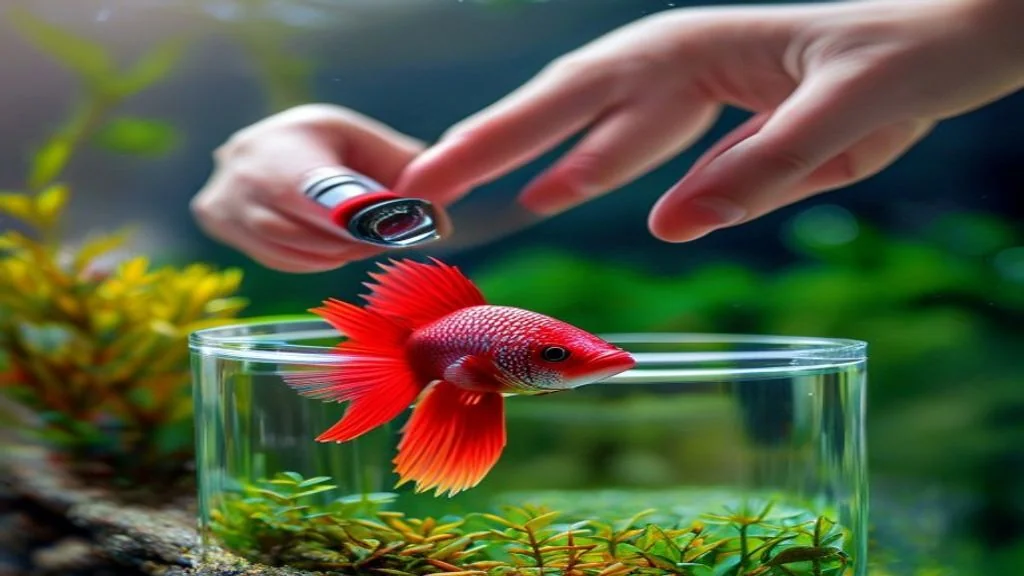
Betta vacation feeding is one of the few areas where doing less is doing better. The instinct before a trip is to “make sure it has plenty” — extra food, a feeder block, anything so the fish won’t go hungry. That instinct is exactly what kills bettas while their owners are away, because the real danger isn’t an empty stomach, it’s fouled water with no one to fix it. This guide gives you the safe plan by trip length, the auto-feeders worth trusting, and how to brief a fish-sitter so they can’t accidentally overfeed.
Quick answer: Betta vacation feeding depends on trip length. 1–4 days: don’t feed — a healthy betta is fine. 5–7 days: usually fine unfed, or a conservatively set auto-feeder. 1–2 weeks: a pre-portioned auto-feeder or a fish-sitter. 2+ weeks: a sitter is essential. Never use dissolving feeder blocks.
The Core Principle: A Short Fast Beats Overfeeding
A healthy adult betta safely goes 5–7 days without food (see how long can a betta go without food). The real danger on a trip isn’t hunger — it’s water quality. Extra food or a dissolving block fouls the water and spikes ammonia with no one there to fix it. An empty stomach is recoverable; an ammonia crash often isn’t.
Plan by Trip Length
| Trip | Best plan | Why |
|---|---|---|
| 1–4 days | Don’t feed. Feed normally before & after. | Healthy betta is fine; zero water-fouling risk |
| 5–7 days | Usually no feeding; OR a reliable auto-feeder set sparingly | Still within safe fasting; auto-feeder optional |
| 8–14 days | Pre-portioned auto-feeder OR trusted fish-sitter | Too long to fast; needs controlled feeding |
| 14+ days | Fish-sitter (with written instructions) | Beyond safe fasting; needs a real person |
Before ANY Trip: Prep the Tank
- Large water change & clean a day or two before leaving (how to clean a betta tank) — start with pristine water.
- Test parameters (parameters chart) — leave it stable.
- Check the heater & filter are reliable; a heater failure while away is the real worst case (best heater).
- Don’t “pre-load” food in the days before — keep normal portions.
- Reduce/adjust light with a timer to limit algae while you’re gone.
Automatic Feeders: Use With Caution
A programmable auto-feeder works for 1–2 week trips if:
- It’s reliable and tested for several days before you leave (jamming/over-dispensing is common).
- It dispenses tiny, betta-appropriate pellet portions — set it to under-feed, not over.
- You’d rather it skip a feed than double one — under-feeding is safe, overfeeding fouls the tank (overfeeding).
Why Vacation “Feeder Blocks” Are Risky
Using a Fish-Sitter (the Safest for Long Trips)
For trips beyond ~10–14 days, a person is best. Set them up to succeed:
- Pre-portion food into labelled containers/pill organiser — “feed only this, this day”. This prevents a well-meaning sitter overfeeding.
- Write simple instructions: feed amount, which days, “if water looks cloudy do a 25% change with the prepared water,” emergency contact.
- Leave dechlorinated water ready and a thermometer they can read.
- Show them what a healthy betta looks like vs warning signs.
How to Choose a Betta Vacation Feeder: Buying Criteria
- Pre-portioned over bulk-drum, for bettas: a feeder with separate compartments you fill yourself can’t “run away” and over-dispense the way a single hopper can.
- Small dispensing amount: it must be able to release a betta-sized portion (a few pellets), not a fish-flake avalanche.
- Reliable mechanism: a motor/barrel that won’t jam with small pellets, ideally with a moisture-resistant or ventilated design so food doesn’t clump.
- Programmable schedule: set it to feed less often (every other day is fine for a betta) and to under-feed rather than over.
- Battery/power resilience: battery-powered or battery-backup so a brief power blip doesn’t stop it — and test it for several days before the trip.
- Mounts securely to your specific lid/rim so it can’t fall into the tank.
Recommended Vacation Feeders
These are real, commonly recommended automatic feeders. For a betta, pre-portioned designs are the safest because they physically cap how much can be released.
| Product | Type | Best for | Notes |
|---|---|---|---|
| Fish Mate F14 Battery Feeder | 14 pre-portioned wells | Best overall for bettas | You load each well, so portions can’t overflow; ideal for precise small betta meals on multi-day trips |
| Eheim Everyday Fish Feeder | Programmable drum | Best programmable drum | Reliable benchmark feeder; set conservatively and test first — drum type can over-dispense if mis-set |
| Fish Mate F6 Feeder | 6 pre-portioned wells | Best for shorter trips | Same fail-safe well design as the F14 with fewer compartments; great for ~5–6 day trips |
| Zacro / Hygger Automatic Feeder | Programmable hopper | Best budget | Affordable; works if tested and set to tiny portions; less fail-safe than well-type feeders |
| Trusted fish-sitter + pre-portioned food | Human (no device) | Best for 2+ week trips | Not a product, but the safest option long-term; pre-portion food so they can’t overfeed |
| Dissolving “holiday/weekend” blocks — avoid | Slow-release block | Not recommended | Over-release food and foul small betta tanks; a short fast is safer |
Editorial picks: Best overall — Fish Mate F14 (fail-safe pre-portioned wells). Best programmable drum — Eheim Everyday Feeder (test it first). Best budget — Zacro/Hygger. Best for trips over two weeks — a fish-sitter with pre-portioned food. For trips of a week or less, the safest choice is still no feeder and a short fast.
Dos and Don’ts
| Do | Don’t |
|---|---|
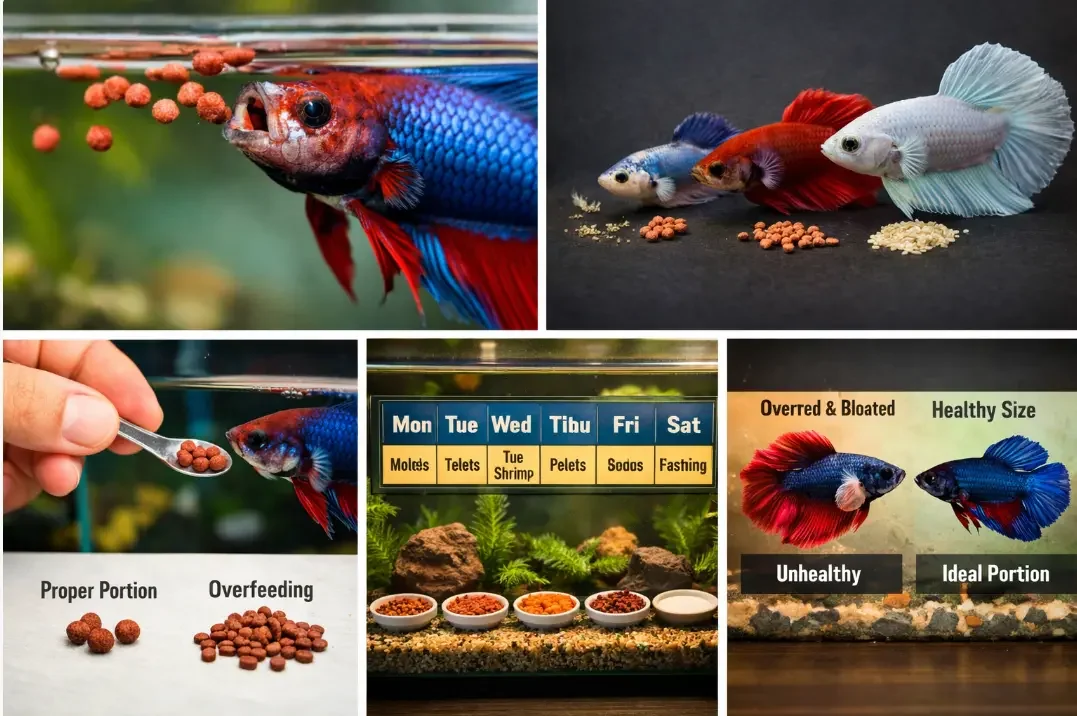
| Fast a healthy betta for trips up to ~5–7 days | Dump in extra food “to be safe” before leaving |
| Do a water change and test the day before | Leave on dirty or unstable water |
| Test the auto-feeder for several days first | Trust an untested feeder while away |
| Use a pre-portioned feeder set to under-feed | Use a dissolving vacation block in a small tank |
| Pre-portion food for a fish-sitter | Tell a sitter to “feed a pinch” with no portions |
Why the Real Vacation Danger Is Water, Not Hunger
The single most important idea in this entire guide is counterintuitive, so it is worth fully unpacking: when you leave a betta, the thing most likely to kill it is not going hungry — it is the water turning toxic with nobody there to intervene. Owners get this backwards because hunger feels urgent and intuitive, while water chemistry is invisible.
Here is the actual risk math. A healthy adult betta tolerates a week without food with essentially no harm, because short fasts are normal for the species and even beneficial. That side of the ledger is genuinely low-risk. The other side is not. A small betta tank holds very little water, so it has very little buffering capacity. Add extra food “to be safe,” or a dissolving block, and the surplus rots; rotting organic matter produces ammonia; ammonia in a small volume rises fast; ammonia burns gills and can crash a fish within days. Crucially, an empty stomach is fully recoverable the moment you get home and feed the fish — but an ammonia crash that happened on day three of a ten-day trip is often not recoverable, and you only discover it when you walk in.
So the two “solutions” people reach for to prevent the low-risk problem (hunger) directly cause the high-risk problem (toxic water). Every decision in this guide flows from that asymmetry: when in doubt, err toward less food and cleaner, more stable water, because under-feeding a healthy betta is safe and over-feeding an unattended tank is the classic way owners come home to a dead fish. The instinct to “make sure it has plenty” is precisely the instinct to override.
Trip-Length Decision Walkthrough (With the Reasoning)
The plan-by-length table gives the answer; this section gives the why, because keepers follow rules they understand and ignore rules they do not.
One to four days: do nothing, and that is the correct, expert answer
This is the length people most over-engineer. A healthy adult betta over a long weekend needs no intervention at all — no feeder, no block, no sitter feeding. Feed normally before you leave and normally when you return. The fast is well within the harmless range, and introducing any feeding mechanism here only adds the water-fouling and equipment-failure risks for zero benefit. For a weekend, the safest possible action is genuinely no action.
Five to seven days: usually still no feeding
A healthy adult is still within its safe unfed window across a week. For most keepers, a clean, stable tank and a fast remain safer than an unattended feeding device for one small fish. An auto-feeder is optional here, not required, and only worth it if you have a reliable, pre-tested one and a specific reason (for example, an older or already-lean fish you would rather not fast a full week).
Eight to fourteen days: now the fish needs food, carefully
Past a week, fasting is no longer the right call and controlled feeding becomes necessary. The two acceptable routes are a reliable, pre-portioned automatic feeder proven over several days of testing, or a properly briefed fish-sitter. The emphasis shifts from “avoid feeding” to “feed in a way that cannot over-deliver,” because at this length the fish does need calories but the water still cannot tolerate surplus.
Beyond two weeks: a real person is required
This length exceeds any safe fast and exceeds what one should trust to an unattended consumer feeder for a single small fish over that long. A briefed sitter who also eyeballs the tank’s clarity and the heater is essential. The longer the absence, the more the plan must include a human who can react to a problem, because the probability of an equipment or water issue over weeks is no longer negligible.
The thread through all four tiers: the shorter the trip, the more “do less” is the expert answer; the longer the trip, the more the plan must guarantee both controlled food and a way to catch a problem.
Stress-Testing an Auto-Feeder Before You Trust It
An automatic feeder that has never been run on your tank is not a safety device — it is an untested single point of failure aimed directly at your fish. The most common auto-feeder disasters are not exotic; they are jamming, clumping, and gross over-dispensing, and every one of them is catchable with a simple dry run.
- Load it with the actual food. Use the exact pellets you will leave, not a substitute. Pellet size, oiliness, and humidity sensitivity all affect whether a feeder jams or clumps, so the test is only valid with the real food.
- Run it on the real schedule for several days before the trip. Set the actual program (ideally feeding less often than daily) and let it run while you are home to watch every dispense. You are checking for jams, missed feeds, and especially over-dispensing.
- Measure what actually drops. Catch each dispense and confirm it is a genuine betta portion — a few tiny pellets, not a community-tank scoop. Many feeders cannot meter down to a single betta’s needs out of the box and must be partially blocked or adjusted to release less.
- Deliberately bias it to under-feed. Set the smallest reliable portion at the longest acceptable interval (every other day is fine for a betta). The design goal is that a malfunction errs toward a missed meal, never a dumped hopper, because a missed meal is harmless and a dumped hopper is potentially fatal.
- Confirm power resilience. Prefer battery or battery-backup so a brief outage does not stop or reset it, and check it survives a simulated power blip during your test window.
- Mount it so it physically cannot fall in. Verify it attaches securely to your specific lid or rim. A feeder that drops into the tank dumps its entire contents at once — the exact catastrophe you were trying to avoid.
This is also why pre-portioned well-type feeders are the safest design for a betta: each compartment physically caps how much can be released, so even a misbehaving unit cannot empty a whole hopper into a small tank. A drum or hopper feeder can be made to work, but only after it has earned trust through a real, food-accurate, multi-day test on your tank.
Briefing a Fish-Sitter So They Physically Cannot Overfeed
When a trip needs a person, understand the actual threat: it is almost never that the sitter forgets to feed the fish. It is that the sitter, watching a betta beg at the glass, decides it looks starving and “just adds a little more” — repeatedly. A well-meaning sitter handed a tub of pellets is one of the most reliable ways to come home to a fouled tank. The entire briefing strategy is to remove every judgement call from the task.
Pre-portion everything. Put each individual feed — the exact tiny correct amount — into its own compartment of a daily pill organiser or its own small twist of paper, labelled by day. The instruction becomes “give the contents of one labelled section on its day and absolutely nothing else.” Tell the sitter, in plain words, the thing they will not believe: with this fish, too little food is completely safe and too much can kill it, which is the opposite of nearly every other pet they have looked after. Explicitly instruct them to ignore begging, never to add extra, and that if they are ever unsure whether they fed it, the correct choice is to skip rather than double up.
Give them a tiny written sheet, not a verbal explanation that will be forgotten. It should state: the feed amount and which days; “if the water looks cloudy, do a 25% change using the prepared dechlorinated water in the labelled container”; what a healthy betta looks like versus warning signs (lethargy, clamped fins, gasping, faded colour); the thermometer reading it should be near; and an emergency contact. Leave the prepared replacement water and a readable thermometer out where they cannot be missed. The objective throughout is a system where the sitter could not overfeed even if they wanted to, because the decision was already made and physically portioned before you left.
Heater and Equipment Failure: The Worst-Case Nobody Plans For
Feeding gets all the attention before a trip, but the single most catastrophic thing that can happen while you are away has nothing to do with food: a heater failing. A stuck-off heater lets a small tank slide into chronic cold over days; a stuck-on heater can cook a small volume of water alarmingly fast. Either way there is nobody home to notice, and temperature failures kill more unattended bettas than hunger ever will.
Mitigate it deliberately as part of trip prep. Confirm the heater has been holding a stable, correct temperature reliably for a while before you leave — a heater already behaving oddly should be replaced before a trip, not nursed through one. If the heater is old, this is a strong reason to replace it proactively before an extended absence rather than gamble on it. Make sure the tank has a lid (it slows both heat loss and evaporation) and is not sitting against a cold exterior wall or in a spot that bakes in afternoon sun, both of which amplify a temperature swing if the heater falters. For longer trips, this is a major argument for a sitter even when feeding could technically be automated: a device can drop food, but only a person can notice the tank has gone cold or hot and actually do something about it. The same logic applies to the filter and air pump — verify they are running reliably before you go, since a circulation or filtration failure during a long absence quietly degrades water quality on top of everything else. Planning the feeding perfectly while ignoring the heater is solving the small problem and leaving the big one to chance.
Safe vacation feeding leans on reliable gear — confirm your setup against the full betta starter kit checklist and a dependable heater. It also helps to know exactly how long a betta can go without food and why a short fast beats overfeeding.
Sources & Further Reading
The Aquarium Guide — bettas without food; JV Betta — how long betta without food; Tropicflow — betta without food; Chewy — how long can fish go without food.
Frequently Asked Questions
How do I feed my betta while on vacation?
By trip length: 1–4 days don’t feed (a healthy betta is fine), 5–7 days unfed or a careful auto-feeder, 1–2 weeks a reliable pre-portioned auto-feeder or sitter, 2+ weeks a fish-sitter.
Can I leave my betta for a week without food?
Usually yes — a healthy adult betta safely goes 5–7 days unfed, which is safer than overfeeding or a feeder block fouling the water.
Are vacation feeder blocks safe for bettas?
No — they over-release food and foul the water, often causing an ammonia crash. Avoid them; fast or use a tested auto-feeder instead.
Do automatic feeders work for bettas?
Yes, for 1–2 week trips, if reliable, tested beforehand, and set to dispense tiny portions (set it to under-feed, not over).
Should I feed extra before leaving for vacation?
No — never “pre-load.” Keep normal portions; extra food causes constipation and fouls water. Just feed normally before and after.
What’s the biggest risk when leaving a betta alone?
Water quality — a heater failure or food fouling the tank with no one to fix it. Prep clean stable water and reliable equipment before any trip.
How long can a betta be left with a sitter checking in?
Indefinitely if the sitter follows pre-portioned feeding and basic water-check instructions — the safest option for long trips.
What is the best automatic feeder for a betta on vacation?
The Fish Mate F14 is a top pick because you pre-load each compartment, so it physically can’t over-dispense. The Eheim Everyday Feeder is a solid programmable option if tested and set conservatively first.
How often should a vacation auto-feeder feed a betta?
Set it sparingly — a tiny portion every other day is fine for a betta. Always configure it to under-feed rather than over, since underfeeding is safe but overfeeding fouls the tank.
Should I do a water change before going on vacation?
Yes — do a water change and test parameters a day or two before leaving so the betta starts your absence in clean, stable water with reliable equipment.