
This aquarium substrate calculator tells you how many pounds, liters and bags of gravel, sand or plant soil your tank needs. Pick your tank, choose the depth and read the answer. As a rough guide, a standard 10 gallon tank takes about 12 pounds of gravel for a 1 inch bed and about 23 pounds for 2 inches.
The tool handles a flat or sloped bed, a second layer on top, bow front and round tanks, and metric units. If you already own a bag, switch to How deep will my bag go? and it runs backwards, turning your pounds or liters into a depth.
How Much Substrate Each Tank Size Needs
No need to run the tool for a standard tank. These figures use the footprint of each tank from Aqueon’s chart, so they run a touch over what you will actually pour in. That small margin is what you want when you are buying.
| Tank | Footprint (in) | Gravel, 1 in | Gravel, 2 in | Fine sand, 1 in | Plant soil, 2 in |
|---|---|---|---|---|---|
| 2.5 gallon | 12.1875 x 6.125 | 4.0 lb | 8.1 lb | 4.3 lb | 2.4 L |
| 5.5 gallon | 16.1875 x 8.375 | 7.3 lb | 14.7 lb | 7.8 lb | 4.4 L |
| 10 gallon | 20.25 x 10.5 | 11.5 lb | 23.0 lb | 12.3 lb | 7.0 L |
| 15 gallon | 24.25 x 12.5 | 16.4 lb | 32.9 lb | 17.5 lb | 9.9 L |
| 20 gallon high | 24.25 x 12.5 | 16.4 lb | 32.9 lb | 17.5 lb | 9.9 L |
| 20 gallon long | 30.25 x 12.5 | 20.5 lb | 41.0 lb | 21.9 lb | 12.4 L |
| 29 gallon | 30.25 x 12.5 | 20.5 lb | 41.0 lb | 21.9 lb | 12.4 L |
| 40 gallon breeder | 36.1875 x 18.25 | 35.8 lb | 71.6 lb | 38.2 lb | 21.6 L |
| 55 gallon | 48.25 x 12.75 | 33.3 lb | 66.7 lb | 35.6 lb | 20.2 L |
| 75 gallon | 48.5 x 18.5 | 48.6 lb | 97.2 lb | 51.9 lb | 29.4 L |
| 125 gallon | 72.5 x 18.5 | 72.7 lb | 145.4 lb | 77.5 lb | 44.0 L |
Look at the 20 gallon long and the 20 gallon high. They hold about the same water, but the long tank needs roughly 25% more substrate, because substrate depends on the floor of the tank and not on its gallons. That is why gallons alone make a poor guide.
The Substrate Formula, If You Want to Check by Hand
For a rectangular tank, multiply length by width by depth in inches. Divide by 1,728 to get cubic feet, then multiply by the weight of your substrate per cubic foot.
Pounds = (length x width x depth) / 1,728 x pounds per cubic foot
Say the tank floor is 20 by 10 inches and you want 1 inch of gravel at about 94 pounds per cubic foot. That is 200 cubic inches, or 0.116 cubic feet, which comes to about 10.8 pounds.
In metric it is simpler. Length times width times depth in centimeters, divided by 1,000, gives liters. Multiply liters by the density in kilograms per liter to get kilograms. The same bed is 3.3 liters and about 4.9 kg of gravel.
Working out a slope
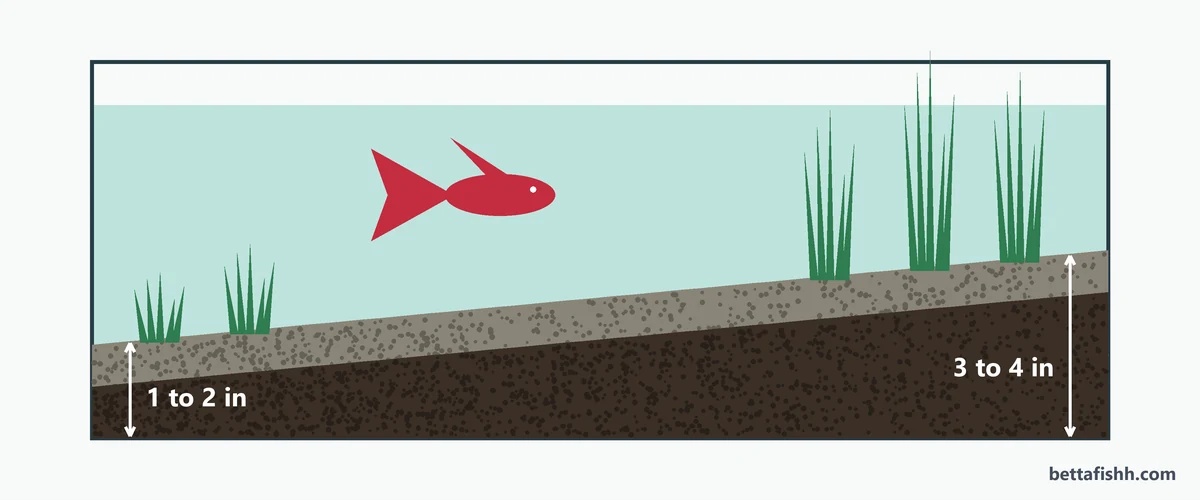
Take the average of the front and back depths and use that as your depth. A bed running from 1 inch at the glass to 3 inches at the back works out the same as a flat 2 inch bed, which is exactly what the sloped option in the tool does.
How Deep Should Aquarium Substrate Be?
| Your setup | Depth | Why |
|---|---|---|
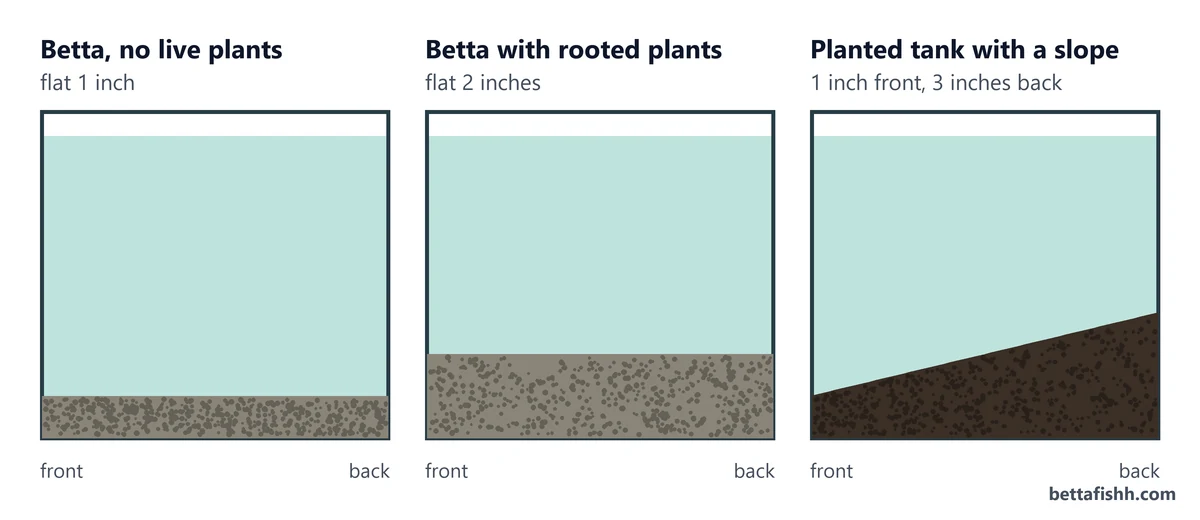
| Betta, no rooted plants | About 1 inch | Covers the glass and gives bacteria somewhere to live, with little to keep clean |
| Betta with rooted plants | About 2 inches | Enough for roots to anchor |
| Fine sand in any betta tank | About 1 inch, up to 1.5 | Deep sand packs down and can form low-oxygen pockets |
| Planted tank, general | 2 to 4 inches | Deep-rooted plants need the extra room |
| Aquascape with a slope | 1 to 2 inches front, 3 to 4 back | Gives a sense of depth, and the back hides plant roots |
| Fish-only community tank | 1 to 2 inches | A deep bed only traps uneaten food |
| Saltwater, shallow sand bed | 1 to 2 inches | The usual starting depth for marine tanks |
For betta tanks, our substrate guide goes through sand against gravel against a bare bottom. Whatever you choose, it should be smooth. Long fins catch on sharp grains, so run a pair of pantyhose over the substrate before you buy it. If it snags, leave it at the store.
Why the Same Depth Can Weigh So Differently
Substrate is sold by the pound, by the kilogram or by the liter, and that trips people up. Density is the link between them. A liter of plant soil weighs a little over half of what a liter of gravel does, so 20 pounds of soil covers far more floor than 20 pounds of gravel.
| Substrate | Density (kg per L) | Pounds per sq ft, per inch of depth | Buying note |
|---|---|---|---|
| Aquarium gravel, 2 to 5 mm | 1.5 | 7.8 | Sold by weight |
| Pea gravel, coarse | 1.6 | 8.3 | Sold by weight |
| Fine aquarium sand | 1.6 | 8.3 | Sold by weight |
| Pool filter sand | 1.5 | 7.8 | Sold by weight, in large sacks |
| Crushed coral or aragonite | 1.55 | 8.1 | Sold by weight. Raises pH and hardness |
| Fired clay, Flourite type | 1.3 | 6.8 | A 7 kg bag is about 5.3 liters |
| Plant soil, Amazonia or Stratum type | 0.9 | 4.7 | Often sold by liters, such as a 9 liter bag |
These are typical bulk figures, and published ones vary. Gravel is listed anywhere from about 1.44 to 1.6 kg per liter depending on grain size and how it packs, which is why the tool shows a range of plus or minus 10%. If a bag prints both its weight and its volume, divide kilograms by liters and enter that under My own density.
Four Things That Change Your Number
The old pound-per-gallon rule. You will often hear one pound of gravel per gallon. In a standard 10 gallon that gives about 0.9 inches, close enough. In a 55 gallon it gives about 1.6 inches, because a 55 is tall and narrow and has little floor for its size. The rule only works for tanks shaped like a 10 gallon.
Rock and wood. Hardscape sitting on the floor means less substrate. Hardscape buried in it means more depth around the stone. Neither moves the number much unless the rocks are large.
Rinsing and settling. Beds lose some volume as fine dust washes out and grains settle. Buying 10 to 20% extra covers this and any slope you decide on later. Leftovers keep indefinitely and are handy for topping up.
Water displaced. Substrate takes room away from the water. Gaps between grains fill with water, so only about 60% of the bed really counts. Two inches of gravel in a 55 gallon is about 67 pounds and pushes out about 3.2 gallons. Enter your bed in the aquarium volume calculator to see what is left, which is the number to use for water changes and medicine doses.
Buying and Laying It
Rinse gravel and sand in a bucket until the water runs close to clear, then add it to the empty tank and shape the bed before filling. Most plant soils should not be rinsed, since washing breaks down the granules, so follow the label. Pour water slowly onto a plate or a clean bag to keep the bed from washing out. The full order of jobs is in how to set up a betta tank.
Rooted plants need more than depth. Plain gravel and sand hold no food, so heavy root feeders like swords and crypts usually need root tabs. For plants that grow on wood instead, such as anubias and java fern, depth does not matter at all. See the best live plants for bettas before you decide how deep to go.
Sources
Aqueon, aquarium size chart (tank dimensions). Charterhouse Aquatics, substrate calculator (densities for sand, soil and gravel). AquariumCalc, substrate calculator (density per gallon and sloped beds). Top Shelf Aquatics, sand bed calculator (formula and marine depths). Spec-Tanks, substrate calculator (bag volumes for Flourite, Stratum and Amazonia).
Frequently Asked Questions
How much substrate do I need for a 10 gallon tank?
About 12 pounds of gravel for a 1 inch bed, or about 23 pounds for 2 inches. In plant soil, a 2 inch bed takes about 7 liters.
How much gravel do I need per gallon?
The old rule is 1 pound per gallon. That gives just under an inch in a 10 gallon, but about 1.6 inches in a 55 gallon because tall tanks have less floor. Measuring the footprint is more reliable.
How deep should substrate be in a betta tank?
About 1 inch without rooted plants, and about 2 inches with them. Keep fine sand to about 1 inch, and no more than 1.5, so that low-oxygen pockets do not form.
How much sand do I need for a 20 gallon long tank?
About 22 pounds of fine sand for a 1 inch bed. Two 20 pound bags cover it with some spare.
Is sand heavier than gravel?
Slightly, at the same depth. Fine sand packs tighter, at about 1.6 kg per liter against about 1.5 for typical gravel. Plant soil is far lighter, at about 0.9.
How do I calculate substrate for a sloped bed?
Average the front and back depths and use that as the depth. A slope from 1 inch to 3 inches needs the same amount as a flat 2 inch bed.
Should I buy extra substrate?
Yes, about 10 to 20% more than the calculation. It covers rinsing losses, settling and any slope you add while aquascaping.
Does substrate reduce how much water my tank holds?
Yes, by about 60% of the bed volume, since water fills the gaps between grains. Two inches of gravel in a 55 gallon takes away about 3.2 gallons.