
This aquarium volume calculator gives your tank’s size in US gallons, liters and UK gallons, then shows how much water is really in it once glass, substrate and decor are taken out. It also works out the filled weight. For a rectangular tank the formula is simple: length times width times height in inches, divided by 231, gives US gallons.
More accuracy: glass, water line, substrate and decor
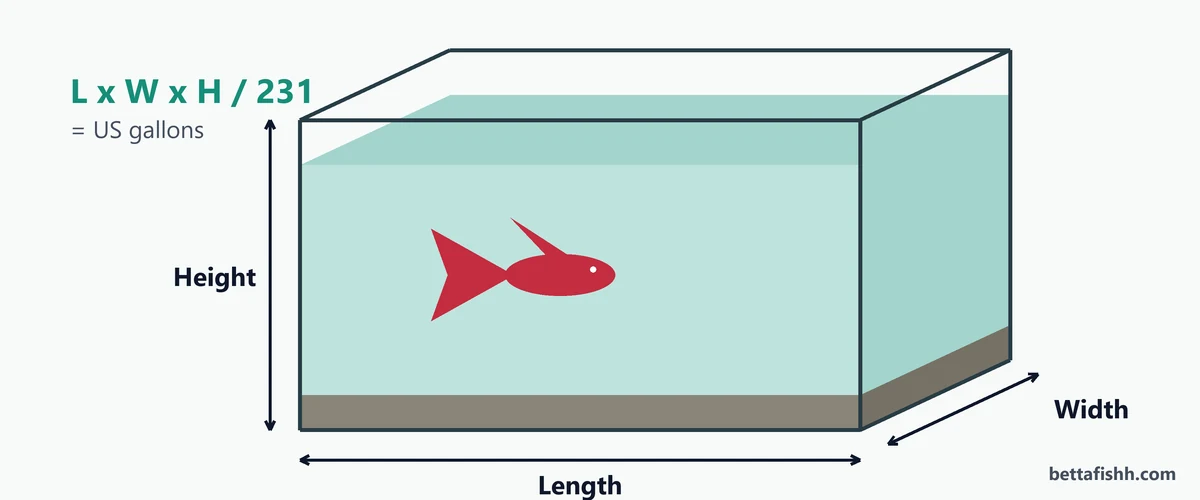
Choose a standard tank to fill in everything at once, or enter your own measurements for any of eight shapes. The large figure is the one to use for water changes and medicine. The rows below it show how the tool got there.
Aquarium Volume Formulas for Every Shape
All of these use inches and give US gallons. For liters, measure in centimeters and divide by 1,000 instead of 231.
| Tank shape | Floor area | Then |
|---|---|---|
| Rectangle or cube | Length x width | x height / 231 |
| Bow front | Length x side depth, plus the curved segment at the front | x height / 231 |
| Cylinder | 3.1416 x (diameter / 2) squared | x height / 231 |
| Half cylinder | Cylinder floor area / 2 | x height / 231 |
| Quarter circle corner | 3.1416 x side squared / 4 | x height / 231 |
| Triangle corner | Side x side / 2 | x height / 231 |
| Hexagon | 0.866 x width squared (flat to flat) | x height / 231 |
| Octagon | 0.828 x width squared (flat to flat) | x height / 231 |
Worked example: a tank measuring 36 by 18 by 16 inches is 10,368 cubic inches. Divide by 231 and you get 44.9 gallons. In metric, a tank of 60 by 30 by 30 cm is 54,000 cubic centimeters, which is 54 liters.
Bow fronts are the awkward ones. Measure the depth at the sides and again at the middle of the bow. The difference is how far the glass curves out, and the tool works out that curved strip as a true circular segment. Treating a bow front as a plain rectangle using the center depth overstates it, and using the side depth understates it.
Why Your Tank Holds Less Than the Label Says
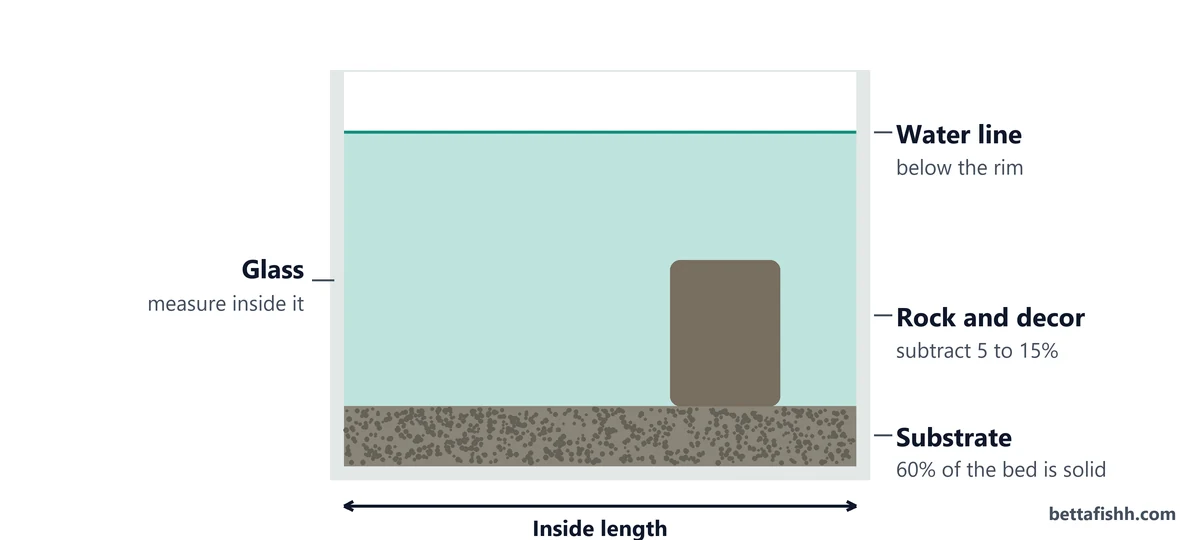
A “10 gallon” is a name, not a measurement. Aqueon lists its 10 gallon Leader at 20.25 by 10.5 by 12.56 inches on the outside, which multiplies out to 11.6 gallons. Take off the glass, leave an inch at the top, add an inch of gravel and a few decorations, and about 8.7 gallons of water remain. That is typical: rock, substrate and equipment commonly take 10 to 20% out of a tank.
The gap between name and math varies from tank to tank. The 40 gallon breeder comes to about 48.4 gallons from its outside dimensions, well over its name, then settles at about 37.2 gallons once it is set up. So check your own tank, especially before dosing anything.
It matters most for medicine and water conditioner. Doses are per gallon of water, so basing them on the label of a heavily decorated tank means overdosing. Use the large figure from the tool. For water changes it barely matters, so round freely.
How to measure properly
- Measure the inside of the glass if you can reach it. If you can only measure the outside, choose Outside the glass and the tool takes off the thickness.
- Measure the height to your real water line, or enter the gap under the rim. Most tanks run about an inch below it.
- Ignore plastic rims and trim. They add to the outside height, not to the water.
- If you need an exact answer, fill the tank from a measured bucket once and count. Nothing beats that.
Standard Tank Sizes, Real Water and Weight
Dimensions and weights are as printed in Aqueon’s chart, and other makers differ slightly. Real water assumes the setup in the tool: an inch below the rim, an inch of gravel and 10% decor.
| Tank | Outside size (in) | Real water | Empty | Filled |
|---|---|---|---|---|
| 2.5 gallon | 12.1875 x 6.125 x 8.12 | 1.7 gal / 7 L | 2.6 lb | 27 lb |
| 5.5 gallon | 16.1875 x 8.375 x 10.50 | 4.4 gal / 17 L | 7 lb | 62 lb |
| 10 gallon | 20.25 x 10.5 x 12.56 | 8.7 gal / 33 L | 11 lb | 111 lb |
| 15 gallon | 24.25 x 12.5 x 12.75 | 12.4 gal / 47 L | 21 lb | 170 lb |
| 20 gallon high | 24.25 x 12.5 x 16.75 | 16.9 gal / 64 L | 25 lb | 225 lb |
| 20 gallon long | 30.25 x 12.5 x 12.75 | 15.5 gal / 59 L | 25 lb | 225 lb |
| 29 gallon | 30.25 x 12.5 x 18.75 | 23.5 gal / 89 L | 40 lb | 330 lb |
| 30 gallon | 36.25 x 12.625 x 16.75 | 25.2 gal / 95 L | 43 lb | 343 lb |
| 38 gallon | 36.25 x 12.625 x 19.75 | 30.2 gal / 114 L | 47 lb | 427 lb |
| 40 gallon breeder | 36.1875 x 18.25 x 16.94 | 37.2 gal / 141 L | 58 lb | 458 lb |
| 55 gallon | 48.25 x 12.75 x 21 | 43.6 gal / 165 L | 78 lb | 625 lb |
| 65 gallon | 36.375 x 18.375 x 25 | 56.3 gal / 213 L | 90 lb | 775 lb |
| 75 gallon | 48.5 x 18.5 x 21.12 | 64.9 gal / 246 L | 98 lb | 785 lb |
| 90 gallon | 48.5 x 18.5 x 25.12 | 76.4 gal / 289 L | 135 lb | 1,050 lb |
| 125 gallon | 72.5 x 18.5 x 23.12 | 104.9 gal / 397 L | 177 lb | 1,400 lb |
For most of the range the filled figure works out at about 11 pounds per gallon of tank size, more than water alone at 8.34 pounds, because it allows for the glass, gravel and decor. The tool adds up your own setup and usually lands below Aqueon’s figure. When buying a stand, plan around the higher number.
What a Full Tank Does to a Floor or Stand
A full tank is the heaviest thing most people keep at home on so little floor. Aqueon’s 55 gallon weighs 625 pounds on a footprint of about 4.3 square feet, or roughly 146 pounds per square foot. For comparison, the International Residential Code in the US designs living areas for 40 pounds per square foot and sleeping rooms for 30, spread across the whole room.
That does not make a 55 gallon unsafe, as a stand spreads its load over several joists and floors usually have some margin. It does mean you should take care with larger tanks: run the long side across the joists, keep to a wall where you can, and ask a builder about anything from about 100 gallons up, or about any older or upstairs floor. Aqueon says every tank needs a suitably designed stand, and an ordinary desk or dresser is rarely built for it. A 20 gallon is already about 225 pounds.
What to Do With Your Number
- Water changes. The tool lists 10, 25, 30 and 50% for your tank. How often you need one is covered in how often to clean a betta tank.
- Heater size. Work on 3 to 5 watts per gallon, so about 25 watts for 5 gallons and 50 watts for 10. See the best heater for a betta tank.
- Filter size. Match the filter to real gallons. For a betta, keep the flow gentle: the best filter for a betta tank.
- Fish. Carry your gallons straight into the aquarium stocking calculator.
- Substrate. The aquarium substrate calculator turns your footprint into bags to buy.
For a betta specifically, 5 gallons is our minimum and 10 is easier to keep stable. Anything under that is hard to keep warm and clean, as our 1 gallon guide explains. The betta tank size guide goes through the choice size by size.
Sources
Aqueon, aquarium size chart (dimensions, empty and filled weights, and stand advice). Top Shelf Aquatics, aquarium volume calculator (formulas, worked examples and usable water). Omni Calculator, aquarium calculator (bow front formula). Aquarium Tracker, aquarium volume calculator (metric example and water changes). My First Fish Tank, water volume calculator (displacement). International Code Council, International Residential Code, table R301.5 (floor live loads).
Frequently Asked Questions
How do I calculate the gallons in a fish tank?
Multiply length, width and height in inches, then divide by 231. A tank of 24 by 12 by 16 inches is 4,608 cubic inches, or about 20 gallons. Use the inside measurements and the height of the water for the real figure.
How do I calculate aquarium volume in liters?
Multiply length, width and height in centimeters, then divide by 1,000. A tank of 60 by 30 by 30 cm holds 54 liters. One US gallon is about 3.785 liters.
Why does my tank hold less water than its size?
Glass thickness, the gap below the rim, substrate, rock and equipment all take up room. Together they commonly remove 10 to 20%, so a 10 gallon tank often holds about 9 gallons.
How much does a 10 gallon fish tank weigh when full?
Aqueon lists 111 pounds filled and 11 pounds empty. Water alone weighs 8.34 pounds per US gallon.
How much does a 55 gallon fish tank weigh?
Aqueon lists 625 pounds filled and 78 pounds empty. Use a stand built for it, not ordinary furniture.
Should I measure the inside or outside of the tank?
The inside is more accurate, since glass and trim hold no water. If you can only measure the outside, select that option and the calculator takes off the glass thickness.
How do I work out the volume of a bow front tank?
Measure the length, the depth at the sides, the depth at the center of the bow and the height. Choose Bow front in the calculator, which adds the curved section to the rectangle behind it.
How much water do I remove for a 25% water change?
Multiply your real water by 0.25. A 10 gallon tank holding about 8.7 gallons needs about 2.2 gallons removed and replaced. The calculator lists this for your tank.