
This aquarium stocking calculator shows how full your tank will be with the fish you have in mind. It then checks what a percentage alone cannot: tank size, group size, shared temperature, and whether those fish will actually get along. It covers 41 common freshwater fish, shrimp and snails, with the betta rules built in. For most tanks, aim for 40 to 70%.
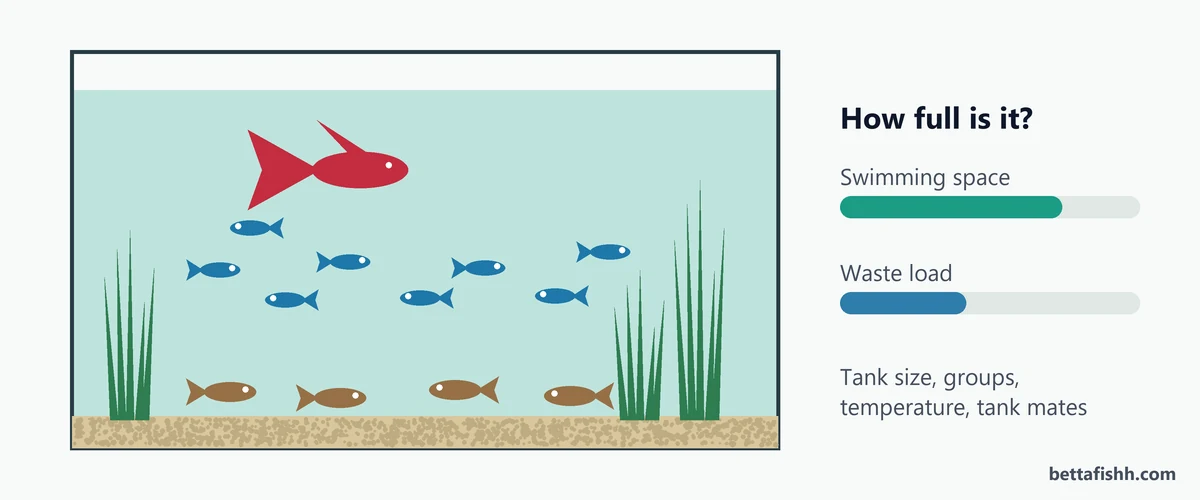
The white mark on each bar is 100%. Your final figure is whichever bar is higher.
What the Percentage Means
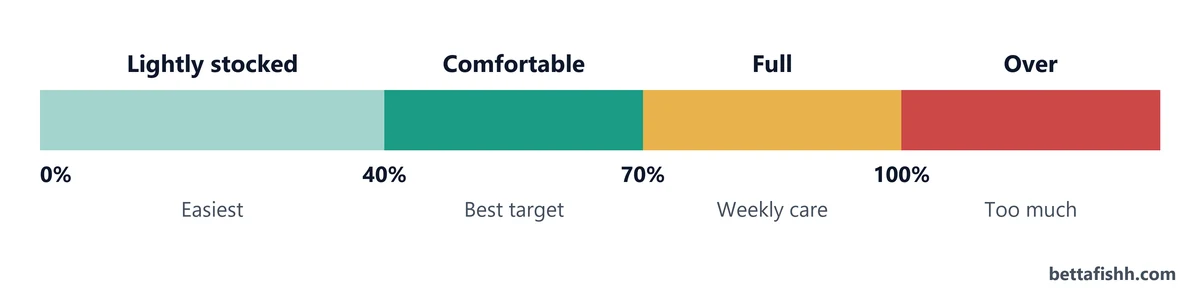
Under 40% leaves plenty of margin, and small mistakes rarely cause trouble. 40 to 70% is the range most keepers aim for: enough fish to enjoy with water that stays stable. 70 to 100% can work well, but it asks for a matched filter and a water change every week without fail. Over 100% means something has to give, and it is usually water quality.
A low figure does not mean a mix is safe. Two male bettas in a 75 gallon tank read as lightly stocked and will still fight, so read the notes under the result first. A problem note outranks any percentage.
Why We Measure Space and Waste Separately
The old rule of one inch of fish per gallon treats all inches as equal, and they are not. Aquarium Science calls the rule “extremely inaccurate” and shows why, using estimated metabolic weights for 100 inches of fish in a 100 gallon tank:
| Fish in the tank | Total inches | Metabolic weight | Stocking level |
|---|---|---|---|
| 100 fish of 1 inch | 100 | 100 g | Light |
| 50 fish of 2 inches | 100 | 350 g | Moderate |
| 25 fish of 4 inches | 100 | 1,175 g | Heavy |
| 13 fish of 8 inches | 104 | 2,171 g | Very heavy |
Almost the same inches, more than 20 times the load. Weight grows far faster than length, so the rule falls apart above about 2 inches. It fails in the other direction too. On waste alone, dozens of neons would fit in a 10 gallon tank, yet nobody would call that a home. So the tool tracks two limits and reports the tighter one:
- Swimming space compares body length, adjusted for build, with the water left after allowing 10% for substrate and decor. A deep-bodied angelfish counts for more than a slim tetra of the same length. Small schooling fish usually hit this limit first.
- Waste load uses the metabolic weights above. 100% is set at 9 grams per gallon, the level Aquarium Science treats as moderate stocking. Goldfish, plecos and other large fish usually hit this limit first.
Your filter, plants and water changes only move the waste bar. A bigger filter clears more ammonia, but it gives nobody more room to swim. This is a planning estimate and not a measurement, so test your water to see how the tank is really coping.
How Many Fish Can Live With a Betta?
Fewer than the percentage suggests, because tank size controls aggression as well as waste. The same betta that ignores rasboras in 20 gallons may hunt them in 5. These plans all pass the checks in the tool at weekly water changes, with a matched filter:
| Tank | Stock | Result | Space | Waste |
|---|---|---|---|---|
| 5 gal | Betta alone | 62% | 62% | 44% |
| 5 gal | Betta and a nerite snail | 71% | 71% | 45% |
| 10 gal | Betta and 6 ember tetras | 74% | 74% | 26% |
| 10 gal | Betta and 3 amano shrimp | 44% | 44% | 26% |
| 15 gal | Betta and 8 lambchop rasboras | 78% | 78% | 26% |
| 20 gal | Betta and 6 bronze corydoras | 96% | 96% | 90% |
| 20 gal | Betta, 6 kuhli loaches and a nerite snail | 83% | 83% | 60% |
| 20 gal | Betta and a bristlenose pleco | 55% | 54% | 55% |
| 29 gal | Betta, 6 harlequin rasboras and 6 sterbai corydoras | 92% | 92% | 58% |
| 29 gal | No betta: 12 neon tetras and 6 panda corydoras | 81% | 81% | 26% |
| 40 gal | No betta: honey gourami, 8 harlequin rasboras, 6 bronze corydoras | 79% | 79% | 55% |
A betta in 5 gallons reads as comfortable, and that tank is for the betta alone, plus perhaps a snail. Shrimp and small schools need 10 gallons or more, and most community fish need 15 to 20 or more. Fin-nippers such as tiger barbs are out at any size. So are other bettas, unless you are setting up a group of at least five females in 20 gallons or more, as the female betta guide explains. Reasons for each pairing are in the best tank mates for bettas.
Individual temperament beats every list. Some bettas ignore a whole community, and others attack anything that moves. Keep a spare tank ready before adding companions, and watch closely for the first 48 hours.
Four Mistakes the Calculator Helps You Avoid
Stocking for the size in the shop. Fish are sold young. A common pleco small enough to fit in your palm commonly reaches 12 to 18 inches. The tool always uses adult size, so it may look strict at first.
Buying a school of two. Schooling fish kept in tiny groups get stressed, and some turn nippy. The tool warns you when a group is too small, and fills in the right number when you pick a fish.
Mixing temperatures. A betta and a goldfish can never both be comfortable. The tool works out the temperature and pH range your whole mix shares, and tells you when there is none. It also shows where your fish swim, so you can spread them across the top, middle and bottom.
Adding everything at once. Even a tank that passes needs time. Cycle first with this guide, then add fish in small batches, a week or two apart, testing ammonia and nitrite as you go. Quarantine new arrivals where you can.
The Fish Data Behind the Calculator
Adult size is the maximum standard length, which leaves out the tail. Minimum tanks come from the base dimensions in Seriously Fish, rounded to common tank sizes, and raised where our betta guides ask for more. Shrimp and snails are not given a temperature because they do not limit a betta tank in practice.
| Species | Adult size | Min tank | Min group | Temp (F) | pH | With a betta |
|---|---|---|---|---|---|---|
| Amano shrimp | 2 in | 10 gal | 3 | – | – | Good pick (10+ gal) |
| Angelfish | 6 in | 55 gal | 1 | 75–86 | 6–7.4 | Avoid |
| Betta, female | 2.25 in | 5 gal | 1 | 72–86 | 6–8 | – |
| Betta, male | 2.8 in | 5 gal | 1 | 72–86 | 6–8 | – |
| Black skirt tetra | 2.4 in | 20 gal | 6 | 68–79 | 6–7 | Avoid |
| Bolivian ram | 3.1 in | 40 gal | 1 | 75–82 | 6–7.5 | Avoid |
| Bristlenose pleco | 5 in | 20 gal | 1 | 73–81 | – | Good pick (20+ gal) |
| Bronze corydoras | 3 in | 20 gal | 6 | 70–81 | 6–8 | Good pick (20+ gal) |
| Cardinal tetra | 1.4 in | 15 gal | 6 | 73–84 | 3.5–7.5 | Use care (15+ gal) |
| Cherry barb | 2 in | 15 gal | 6 | 68–81 | 6–8 | Use care (20+ gal) |
| Cherry shrimp | 1.25 in | 5 gal | 6 | – | – | Use care (10+ gal) |
| Chili rasbora | 0.8 in | 10 gal | 8 | 68–82 | 4–7 | Use care (10+ gal) |
| Clown loach | 16 in | 170 gal | 5 | 75–86 | 5–7 | Avoid |
| Common pleco | 15 in | 125 gal | 1 | 72–82 | – | Avoid |
| Dwarf gourami | 3.5 in | 15 gal | 1 | 72–81 | 6–7.5 | Avoid |
| Ember tetra | 0.8 in | 10 gal | 6 | 68–82 | 5–7 | Good pick (10+ gal) |
| Endler’s livebearer | 1 in | 10 gal | 3 | 75–86 | 7–8.5 | Use care (20+ gal) |
| Fancy goldfish | 7 in | 30 gal | 1 | 62–72 | – | Avoid |
| German blue ram | 1.6 in | 15 gal | 2 | 81–86 | 4–7 | Avoid |
| Glowlight tetra | 1.6 in | 20 gal | 6 | 75–82 | 5.5–7.5 | Use care (20+ gal) |
| Guppy | 2.4 in | 10 gal | 3 | 63–82 | 7–8.5 | Avoid |
| Harlequin rasbora | 1.8 in | 15 gal | 6 | 70–82 | 5–7.5 | Good pick (20+ gal) |
| Honey gourami | 2.2 in | 15 gal | 1 | 72–81 | 6–7.5 | Avoid |
| Kuhli loach | 3.9 in | 15 gal | 6 | 70–79 | 3.5–7 | Good pick (20+ gal) |
| Lambchop rasbora | 1.2 in | 15 gal | 8 | 73–82 | 5.5–7.5 | Good pick (15+ gal) |
| Molly | 3.1 in | 20 gal | 3 | 70–82 | 7–8.5 | Avoid |
| Mystery snail | 2 in | 5 gal | 1 | – | – | Good pick (5+ gal) |
| Neon tetra | 1.2 in | 10 gal | 6 | 70–77 | 4–7.5 | Use care (10+ gal) |
| Nerite snail | 1.25 in | 5 gal | 1 | – | – | Good pick (5+ gal) |
| Otocinclus | 1.4 in | 10 gal | 6 | 70–79 | 5.5–7.5 | Use care (20+ gal) |
| Panda corydoras | 2 in | 10 gal | 6 | 72–77 | 6–7.4 | Use care (20+ gal) |
| Pearl gourami | 4.7 in | 20 gal | 1 | 75–86 | 5.5–8 | Avoid |
| Platy | 2 in | 15 gal | 3 | 68–79 | 7–8.2 | Use care (20+ gal) |
| Pygmy corydoras | 1.2 in | 10 gal | 6 | 72–79 | 6.4–7.4 | Use care (10+ gal) |
| Rummy nose tetra | 2 in | 20 gal | 10 | 75–81 | 5.5–7 | Use care (30+ gal) |
| Serpae tetra | 1.6 in | 20 gal | 6 | 68–82 | 5–7.5 | Avoid |
| Sterbai corydoras | 2.6 in | 20 gal | 6 | 75–82 | 6–7.6 | Good pick (20+ gal) |
| Swordtail | 5.5 in | 30 gal | 3 | 61–82 | 7–8 | Use care (30+ gal) |
| Tiger barb | 2.4 in | 20 gal | 6 | 68–79 | 5–8 | Avoid |
| White cloud minnow | 1.6 in | 15 gal | 6 | 57–72 | 6–8.5 | Avoid |
| Zebra danio | 2 in | 20 gal | 6 | 64–77 | 6–8 | Avoid |
Sizes for the bristlenose, goldfish and common pleco are typical aquarium figures, because published numbers vary by species and strain. Bettas follow our own care standard of 5 gallons minimum at 78–80°F, which you can see in the betta tank size guide and the water parameters chart.
Sources
Seriously Fish, species profiles (sizes, water ranges, base dimensions and group sizes). Aquarium Science, section 13.2, Calculating Stocking Ratio (metabolic weights and stocking levels). Chewy, bristlenose pleco care guide (size and tank). Fishkeeping.co.uk, goldfish size and tank recommendations. AquariumSource, common pleco care guide (size).
Frequently Asked Questions
How many fish can I put in my tank?
It depends on adult size, body shape, your filter and how often you change water. Enter your tank and fish in the calculator above, and aim for 40 to 70%. Check the notes too, because tank size and group size can rule out a fish whatever the percentage says.
Is the one inch per gallon rule accurate?
Only roughly, and only for fish up to about 2 inches. Weight rises much faster than length, so 25 four-inch fish make over 10 times the waste load of 100 one-inch fish, even though the inches match.
What is a good stocking percentage?
Between 40 and 70% suits most tanks. From 70 to 100% can work with a good filter and strict weekly water changes. Over 100% is overstocked.
How many fish can go in a 5 gallon tank?
One betta, with one or two snails if you like. A betta alone reads about 62% in the calculator. A 5 gallon is too small for a school of other fish alongside a betta.
How many fish can go in a 10 gallon tank?
A betta with six ember tetras reaches about 74%, and a betta with three amano shrimp about 44%. Small species only: a 10 gallon cannot take larger fish or several schools.
How many fish can go in a 20 gallon tank?
A betta with a bristlenose pleco reaches about 55%, and a betta with six bronze corydoras about 96%. Those corys nearly fill the tank on their own, so add nothing more.
Do plants and a bigger filter let me keep more fish?
They help with waste, not with space. Plants take up ammonia and a larger filter holds more bacteria, so the waste bar falls. The swimming space bar does not change.
Is this calculator accurate?
It is a careful estimate for planning, not an exact measure. Real tanks vary with feeding, maintenance and the temperament of each fish. Use it to rule out bad plans, then let your water test results guide you.