
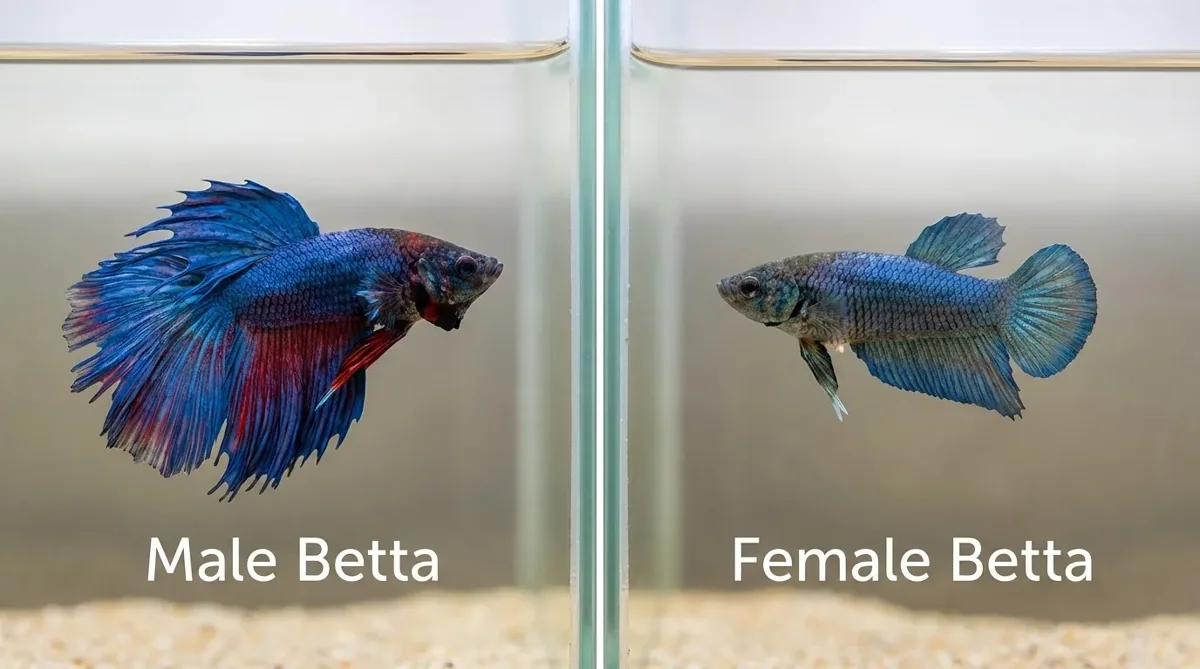
A female betta fish is the same species as the long-finned male you see in pet store cups, but she looks and behaves a little differently: shorter fins, a rounder body, and usually a calmer temper. She needs exactly the same heated, filtered tank as a male, and she makes an excellent first fish. This guide covers how to recognise a female, the tank and food she needs, the main female types and colours, how she behaves, whether female bettas can live together, and the egg-related problems only females get.
Female Betta Fish at a Glance
| Female betta | |
|---|---|
| Species | Betta splendens (Siamese fighting fish) |
| Adult size | About 2 to 2.5 inches, usually a little shorter but stockier than a male |
| Lifespan | 3 to 5 years with good care (see betta lifespan) |
| Minimum tank | 5 gallons, heated and filtered; 10 gallons is easier to keep stable |
| Temperature | 78–80°F (25.5–26.7°C) |
| Water | Ammonia 0, nitrite 0, nitrate 20 ppm or lower, pH 6.5–7.8 and stable |
| Diet | Carnivore: 2–3 soaked pellets once or twice a day, plus frozen treats |
| Temperament | Territorial, but usually calmer than a male |
| Living with other bettas | Only in a carefully planned sorority of 5+ females; never with a male except briefly for breeding |
How to Tell a Female Betta From a Male
Fin length is the first thing most people notice, but it is not enough on its own. Check these signs together:
- Egg spot (ovipositor): a small white or cream dot on the belly, between the ventral (belly) fins and the anal fin. It is the most reliable sign, though it can be hard to see on pale fish.
- Shorter fins: a female’s tail and anal fin are short and rounded rather than long and flowing.
- Rounder body: females look wider through the belly, especially when they are carrying eggs.
- Smaller beard: the membrane under the gill covers is small and often hidden, even when she flares.
- Vertical bars: a female ready to breed shows pale vertical bars on her body. Horizontal stripes are a stress sign and appear in both sexes.
Female Betta Types and Colours
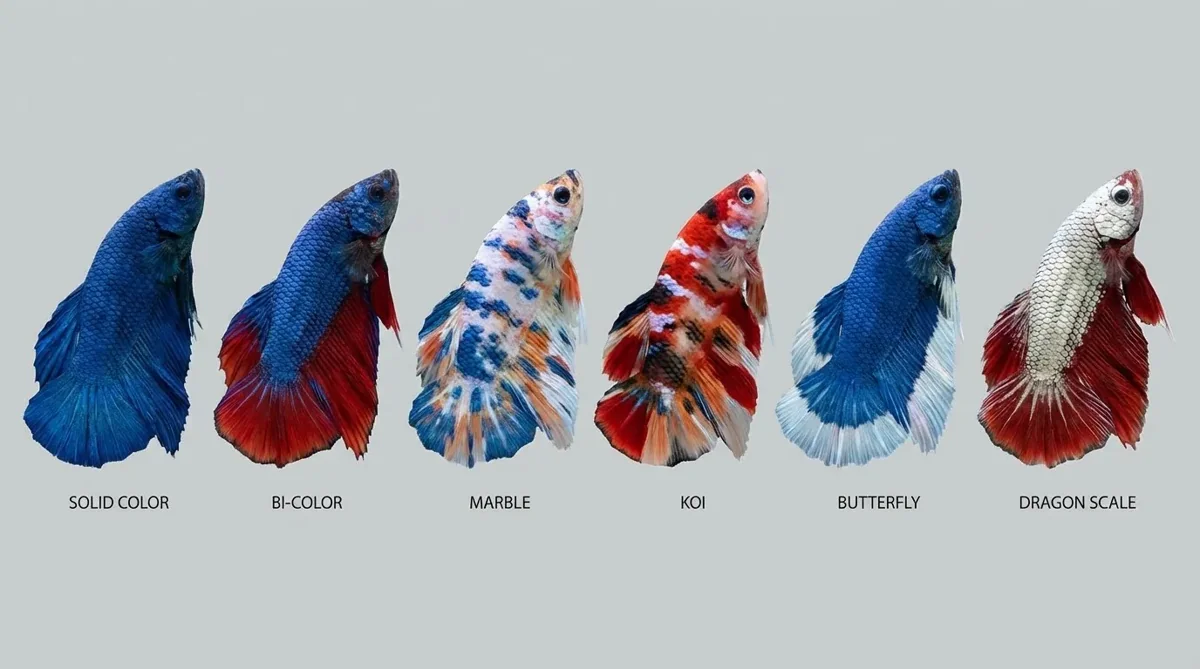
Female bettas come in the same tail types and colour patterns as males; the fins are simply shorter. These are the ones you will see most often:
| Type | What a female looks like | Good to know |
|---|---|---|
| Veiltail female | Short, slightly drooping tail | The most common female in pet stores and usually the cheapest |
| Halfmoon female | Short tail that spreads into a wide, rounded fan | Looks much like a halfmoon plakat (HMPK), the short-finned halfmoon type |
| Crowntail female | Short tail with spiky rays that stick out past the webbing | The rays are shorter than a male’s but still easy to see |
| Plakat female | Short, round tail very like a plakat male | Check the egg spot; this is the type most often mis-sexed |
| Koi female | Patches of orange, red, black and white like a koi carp | Koi bettas carry the marble gene, so their colours can shift over time |
| Dragon scale female | Thick, metallic white scales over a darker body | The heavy scaling can spread over the eyes in some lines |
Colour is not a reliable way to sex a betta: selective breeding has produced females as bright as males. If your koi or marble female changes colour over a few months, it is usually genetics, not illness; see why is my betta losing color. For every tail type and pattern, see betta fish types and colors.
Tank Setup for a Female Betta
A female betta needs exactly the same home as a male. The only difference is that her short fins cope a little better with gentle current.
- Size: 5 gallons minimum; 10 gallons is more stable and leaves room for plants. See the betta tank size guide.
- Heater: an adjustable heater holding 78–80°F, about 25 W for 5 gallons and 50 W for 10 gallons. See the best heater for a betta tank.
- Filter: a gentle sponge filter or a baffled hang-on-back.
- Lid: females jump just as well as males.
- Plants and hides: soft live or silk plants and a cave give her somewhere to rest; see the best live plants for betta tanks.
- Cycle first: run the tank until ammonia and nitrite both read 0 before she goes in. The full process is in how to set up a betta tank.
Keep up a 25–30% water change every week in a 5-gallon tank, or 20–25% in a 10-gallon, with dechlorinated, temperature-matched water.
Feeding a Female Betta
Females eat the same carnivore diet as males. Feed 2–3 soaked betta pellets once or twice a day, and add frozen bloodworms, brine shrimp or daphnia a couple of times a week. A rich, protein-heavy diet makes a female develop eggs faster, so a round belly after a few weeks of good feeding is not always a sign of overfeeding. If the belly is round but she is also not pooping, it is more likely constipation (see the table further down). Portion details are in how many pellets to feed a betta and food choices in best betta fish food.
Female Betta Behaviour: What Is Normal
- Flaring: females flare at their reflection, at other fish and sometimes at you. Short bursts are normal; constant flaring means a trigger to remove (why is my betta flaring).
- Aggression: females are territorial too. Many will chase or nip other fish, and some are as fierce as a male. Judge your own fish rather than the label (betta aggression and chasing).
- Bubble nests: rare in females, but some do build small ones. It does not mean she is a male.
- Breeding bars: pale vertical bars, often with a darker body, show she is ready to spawn. They can appear whenever she can see a male.
- Stress stripes: horizontal lines, hiding and clamped fins point to stress or poor water; see signs of stress in betta fish.
Can Female Bettas Live Together? (Betta Sorority)
Sometimes. A group of female bettas kept together is called a sorority. It can work, but it is an advanced setup that fails often, and the safest home for a female is still a tank of her own. If you want to try:
- Keep at least five females. With two or three, the strongest fish focuses all her aggression on the others. Many keepers prefer odd numbers so the pecking order spreads out.
- Use a long tank of 20 gallons or more. Floor length matters more than height, because it gives each fish room to claim a space.
- Plant it heavily. Dense plants, caves and driftwood break the line of sight so a bullied fish can escape.
- Add all the females at the same time, ideally young fish of a similar size, after quarantining them.
- Confirm every fish is female. One male in a sorority leads to fighting.
- Have a spare heated tank ready. Remove any fish that is chased all the time, hides constantly, stops eating or has torn fins.
Some chasing and flaring in the first days is normal while the group sorts itself out. Torn fins, a fish pinned in a corner or one that stops eating means the group is failing. Never keep a male and a female together outside a short, supervised breeding attempt; that question is covered in male vs female bettas.
Female Betta Tank Mates
Many females accept peaceful tank mates a little more readily than males, but the rules are the same: 5 gallons is enough for a snail, 10 gallons or more for shrimp, 15–20 gallons or more for small schooling fish, and no bright, long-finned or fin-nipping species. Good options are nerite snails, Amano shrimp, ember tetras, corydoras and harlequin rasboras. See the best tank mates for betta fish for sizes and the fish to avoid.
Female Health: Eggs, Egg Binding and a Round Belly
Female bettas produce eggs whether or not a male is present. Usually she reabsorbs them or occasionally releases a few unfertilised eggs, and nothing needs doing. Rarely, a female becomes egg-bound and cannot pass them; she stays swollen, stops eating and becomes lethargic. A round belly can also come from constipation or dropsy, so check the clues together:
| What you see | Most likely | What to do |
|---|---|---|
| Round belly, active, eating, egg spot visible, vertical bars near other bettas | Carrying eggs (normal) | Nothing; keep the water clean |
| Round belly, no poop for a few days, eating less | Constipation | Fast for 2–3 days, then feed small soaked portions (swim bladder and constipation guide) |
| Scales sticking out like a pinecone, seen from above | Dropsy (serious) | Isolate and treat promptly (betta dropsy treatment) |
| Swollen for weeks, not eating, lethargic, no change after fasting | Possible egg binding | Keep her warm in clean water and contact an aquatic vet if it does not improve |
For any other symptom, start with the betta disease guide: test the water first, then match the signs to the right treatment.
Breeding Female Bettas
A female is ready to breed when she is round with eggs, shows strong vertical bars, has a clearly visible egg spot and approaches the male with interest instead of fleeing. Most breeders use young females of about 4 to 12 months after roughly two weeks of conditioning on live and frozen food. Spawning is the easy part; raising dozens of fry and jarring the males is the real commitment. The full process is in how to breed betta fish.
Should You Get a Female Betta?
A female is a good choice if you like an active, curious fish with tougher, shorter fins that are less prone to tearing and fin rot. A male is the better choice if you want the long, flowing show fins. Care, tank size and lifespan are the same for both, so either makes a good beginner fish when kept alone in a proper tank.
Sources & Further Reading
Hepper (vet-reviewed), Can Two Female Betta Fish Live Together? and Female Betta Sorority Tank Guide; Aquariadise, Keeping Female Betta Fish; Hepper, How to Tell if Your Betta Fish Is Pregnant (egg binding); Fish Tank Advisor, sorority stocking.
Frequently Asked Questions
Are female bettas less aggressive than males?
Usually a little, but not always. Females are territorial and many will chase or nip other fish. Some are as aggressive as a male, so judge your own fish rather than relying on its sex.
Can two female bettas live together?
Not as a pair. Two females usually end up with one bullying the other. If you want more than one, a sorority needs at least five females in a long, heavily planted tank of 20 gallons or more, with a spare tank ready.
How big do female bettas get?
Most adult females reach about 2 to 2.5 inches long, usually a little shorter but stockier than males.
Do female bettas need a heater?
Yes. Female bettas are tropical fish just like males and need a stable 78–80°F, which in most homes means an adjustable heater.
Do female bettas build bubble nests?
Rarely, but some do. A bubble nest on its own does not prove a betta is male; check for the egg spot and the size of the beard instead.
Can a female betta lay eggs without a male?
She produces eggs without a male, but she usually reabsorbs them or releases a few unfertilised eggs. They never hatch. Only if she stays swollen for weeks and stops eating is egg binding a concern.
How long do female bettas live?
About 3 to 5 years with good care, the same as males. Clean, warm water and a varied diet make the biggest difference.
Are female bettas good for beginners?
Yes. They need the same simple care as a male, and their shorter fins are less likely to tear. Keep one female alone in a heated, filtered tank of 5 gallons or more.