
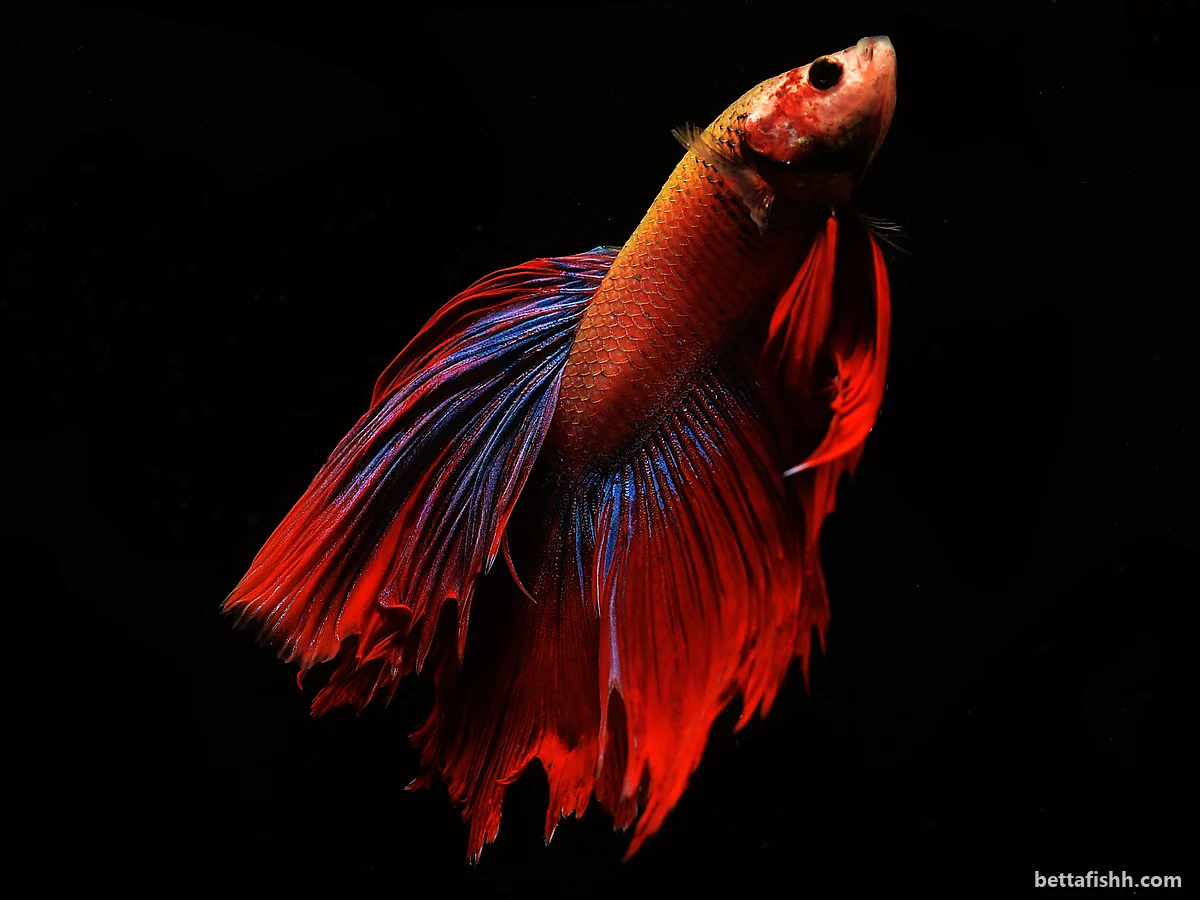
A veiltail betta is the fish most people picture when they hear the word betta: a long, flowing tail that droops behind the body like a veil. It is the type you are most likely to see in a pet store cup, and usually the cheapest. Do not let that fool you. A healthy veiltail is a beautiful fish that lives just as long as an expensive show betta if you give it the right tank. This guide covers how to recognise one, male vs female, colors, why they cost so little, and how to stop those long fins from tearing.
Veiltail Betta at a Glance
| Veiltail betta | |
|---|---|
| Species | Betta splendens (a tail type, not a separate species) |
| Adult size | About 2.25 to 3 inches including the tail |
| Lifespan | 3 to 5 years with good care (see betta lifespan) |
| Tank size | 5 gallons minimum; 10 gallons is easier to keep stable |
| Temperature | 78–80°F (25.5–26.7°C) |
| Water | Ammonia 0, nitrite 0, nitrate 20 ppm or lower, pH 6.5–7.8 and stable |
| Diet | Carnivore: 2–3 soaked pellets once or twice a day, plus frozen treats |
| Temperament | Territorial; keep males alone |
| Biggest risks | Torn fins, tail biting and fin rot |
How to Recognise a Veiltail Betta
Look at the tail when the fish is relaxed. A veiltail’s tail falls downward from the body in a soft curve, and it does not form a neat, even fan even when the fish flares. Three things set it apart:
- A drooping tail: it hangs below the line of the body instead of standing out behind it.
- A tail that is not symmetrical: the top and bottom edges do not mirror each other, unlike a halfmoon betta.
- Smooth fin edges: the webbing reaches the end of the rays, unlike the spiky edge of a crowntail betta.
If the fish has a short, rounded tail, it is more likely a female or a plakat betta. For the full set of tail types, see betta fish types and colors.
Why Are Veiltail Bettas So Common and Cheap?
The veiltail is one of the oldest fancy betta types in the pet trade. Researchers studying betta genetics describe it as one of the four most popular pet varieties, alongside solid red, royal blue and crowntail. The usual explanation for the low price is that the type is long established and does not need the strict selection of a show halfmoon, so it can be produced in large numbers.
A low price says nothing about how hard the fish is to keep. A veiltail needs the same equipment as any other betta. Many store fish have also been through a long supply chain, so look for clear eyes, an interest in food and intact fins before you buy, and introduce it to the tank gently.
Veiltail Betta Male vs Female
The difference is easier to see here than in most types, because a female veiltail looks like a different fish. Compare these signs on an adult:
| Sign | Male veiltail | Female veiltail |
|---|---|---|
| Tail | Long and drooping, often longer than the body | Short, with only a slight droop |
| Other fins | Long dorsal and anal fins | Short and rounded |
| Egg spot | None in most fish | Small white dot behind the belly fins |
| Body | Longer and slim | Shorter and rounder, especially with eggs |
| Beard | Large; shows clearly when flaring | Small and often hidden |
| Color | Usually deeper | Can be bright but is often a little paler |
A very young male can have short fins, so a small store fish may surprise you later. The full method is in male vs female bettas, and care specifics are in the female betta fish guide.
Veiltail Betta Colors
Veiltails come in a wide range of colors, including red, blue, green, white, black, purple, yellow and orange, plus two-color fish. Red and blue are the ones you will see most in stores. Look past the pale fish in the cup, too: a stressed betta often loses color and regains it after a few weeks in clean, warm water. If color fades on a fish that is already settled, see why is my betta losing color.
How to Protect Veiltail Fins
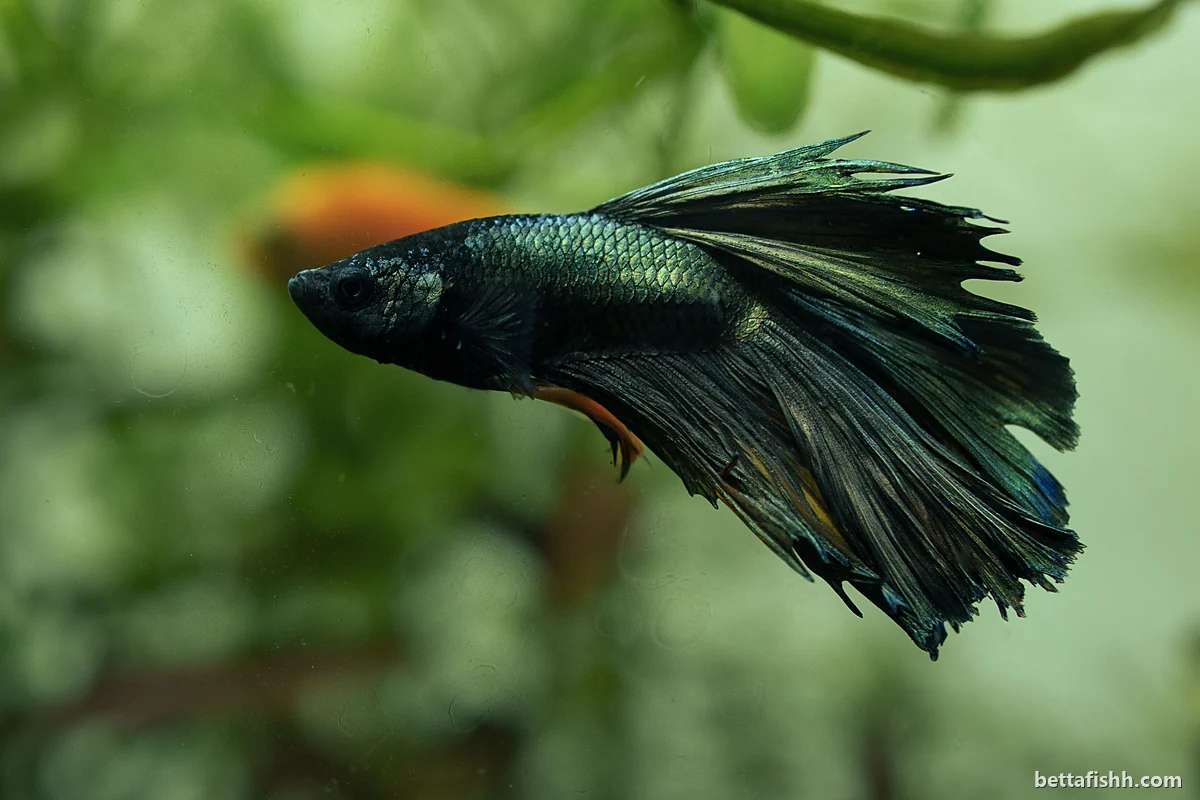
All that fin is the veiltail’s main weakness. The thin, trailing edges tear easily, and they give bacteria plenty of surface to attack. These habits prevent most problems:
- Keep the flow gentle. Strong current can shred the trailing edge into ragged strips that look like fin rot. Baffle the filter if the fish struggles to swim against it.
- Remove anything rough. Replace hard plastic plants and sharp ornaments with soft or smooth ones.
- Avoid fin nippers. A slow fish with a long tail is an easy target for barbs and many tetras.
- Give it places to rest. Long fins are tiring, so add a leaf or hammock near the surface.
- Watch for tail biting. If chunks go missing with no sign of infection, the fish may be biting its own tail. Check for stress and boredom first; see signs of stress in betta fish.
- Keep the water clean. Weekly water changes matter most. If edges darken or the fin gets shorter over a few days, start fin rot treatment.
Veiltail Betta Tank Setup
- Size: 5 gallons is the minimum and 10 gallons is easier to keep stable. A long tank beats a tall one, because a heavy-finned fish tires reaching the surface. See the betta tank size guide.
- Heater: an adjustable heater holding 78–80°F, about 25 W for 5 gallons and 50 W for 10 gallons; see the best heater for a betta tank.
- Filter: a sponge filter or a baffled hang-on-back. Long fins act like a sail, so the current should be barely visible; see the best filter for a betta tank.
- Plants and decor: live plants or silk plants and smooth decorations only. If nylon snags on an item, it will catch a fin.
- Lid: all bettas can jump.
- Cycle first: ammonia and nitrite should read 0 before the fish goes in. Follow how to set up a betta tank.
Change 25–30% of the water each week in a 5-gallon tank, or 20–25% in a 10-gallon, with dechlorinated, temperature-matched water.
Feeding a Veiltail Betta
Feed 2–3 soaked pellets once or twice a day, and add frozen bloodworms, brine shrimp or daphnia a couple of times a week. Overfeeding is a common reason for swim bladder trouble, which is harder on a fish already dragging a long tail. Portions are in how many pellets to feed a betta.
Veiltail Temperament and Tank Mates
Veiltails are not less aggressive than other bettas, despite what you may read. Temperament depends far more on the individual fish than on its tail, so never keep two males together. The real difference is that a veiltail is slower, which makes it more likely to be the victim in a mixed tank.
The safest choice is a nerite snail in 5 gallons or more. Shrimp need at least 10 gallons, and small peaceful schooling fish need 15–20 gallons or more, and only species that leave long fins alone. See the best tank mates for betta fish and betta aggression and chasing.
Is a Veiltail Betta Good for Beginners?
Yes. It is low cost and easy to find, and the care is the same simple routine as any betta. Plan for the tank and heater before you buy the fish, since those matter far more than the price of the betta. Read the beginner betta care mistakes first.
Sources & Further Reading
Gensou, Veiltail Betta Fish Care Guide (trade history, flow damage); The genetic architecture of phenotypic diversity in the betta fish (bioRxiv, 2021) and a related seminar summary (popular varieties); Thailand Betta Fish, veiltail listings. Sources differ on lifespan and temperature; the figures here follow this site’s care standards.
Frequently Asked Questions
Why are veiltail bettas so cheap?
The type is long established and bred in large numbers, and it does not need the strict selection of a show halfmoon. The low price reflects how easy it is to produce, not poor quality.
Are veiltail bettas rare?
No. The veiltail is the most common betta in pet stores. Particular colors can be harder to find, but the tail type itself is everywhere.
Are veiltail bettas less aggressive?
No, not as a rule. Temperament depends on the individual fish. Veiltails are slower than short-finned types, which can make them look calmer, but males still fight and must be kept alone.
What is the difference between a veiltail and a betta?
A veiltail is a betta. “Betta” is the fish, and “veiltail” is one of its tail types, named for the long tail that droops like a veil.
How big do veiltail bettas get?
About 2.25 to 3 inches long, including the tail. The long fins can make them look larger than that.
How long do veiltail bettas live?
About 3 to 5 years with good care, the same as other bettas. Clean, warm water and a varied diet make the biggest difference.
Do veiltail bettas have fin problems?
They can. Long, thin fins tear easily and are prone to biting, fin rot and curling. Gentle flow, soft decor and clean water prevent most of it.
Do female veiltail bettas have long tails?
No. A female veiltail has a short tail with only a slight droop. If a young short-finned fish later grows a long, hanging tail, it was probably a male.