
Wild betta fish are the bettas that still live in the wetlands and forest streams of Southeast Asia, and they look nothing like a pet store halfmoon. The wild form of the common betta is mostly green, brown and grey, with short fins. It shows strong colors only when it is excited. The genus also holds around 70 other species, from tiny peat swamp fish to mouthbrooders that carry their eggs. This guide covers where bettas come from, how they live, the main wild types and whether you can keep one.
Where Do Betta Fish Come From?
The common betta is native to mainland Southeast Asia. Wikipedia lists Cambodia, Laos, Myanmar, Malaysia, Thailand and Vietnam. Seriously Fish describes its core range as central Thailand, from Chiang Rai in the north to just below the Isthmus of Kra, and notes that some records elsewhere may be introduced fish. Most of its habitat lies in the Mekong and Chao Phraya river basins.
Its home water is still or sluggish: rice paddies, swamps, roadside ditches, ponds and slow streams, often shaded by plants and low in oxygen. That is why bettas have a labyrinth organ, which lets them gulp air at the surface. It is also why they dislike strong current in a tank.
Do bettas live in puddles?
No. This myth is used to sell bowls. A rice paddy or swamp is shallow, but it covers a huge area of water that stays warm and full of plants. A betta in the wild has far more water around it than any bowl, which is why a pet betta needs a heated, filtered tank of 5 gallons or more.
What Wild Bettas Look Like
| Wild Betta splendens | Pet store betta | |
|---|---|---|
| Fins | Short and practical | Bred long, from veiltail to halfmoon |
| Color | Green, brown and grey, bright only when agitated | Bred for bright, permanent color |
| Aggression | Territorial, but less extreme | Seriously Fish rates ornamental strains as more aggressive than any wild Betta |
| Size | Body up to 2.8 inches | About the same body, longer overall with fins |
Centuries of breeding in Thailand turned that dull, hardy fish into the colors and fin types on sale today. You can see the result in betta fish types and colors, and in the patterns covered in koi betta and rare betta fish. The wild form itself is rarely sold.
How Many Kinds of Wild Betta Are There?
Wikipedia records around 73 species in the genus Betta, and new ones are still being described. Scientists group them into complexes of close relatives, such as the splendens, coccina and akarensis groups. They split into two breeding styles:
- Bubble nesters such as B. splendens, B. imbellis and the small peat swamp species. The male builds a floating nest of bubbles and guards the eggs, just as a pet betta does. See what a bubble nest means.
- Mouthbrooders such as B. channoides, B. albimarginata and B. macrostoma. The male carries the eggs and fry in his mouth. Many live in flowing forest streams, where a floating nest would wash away, and a 2004 study tentatively concluded that mouthbrooding evolved more than once in the genus.
Wild Betta Types at a Glance
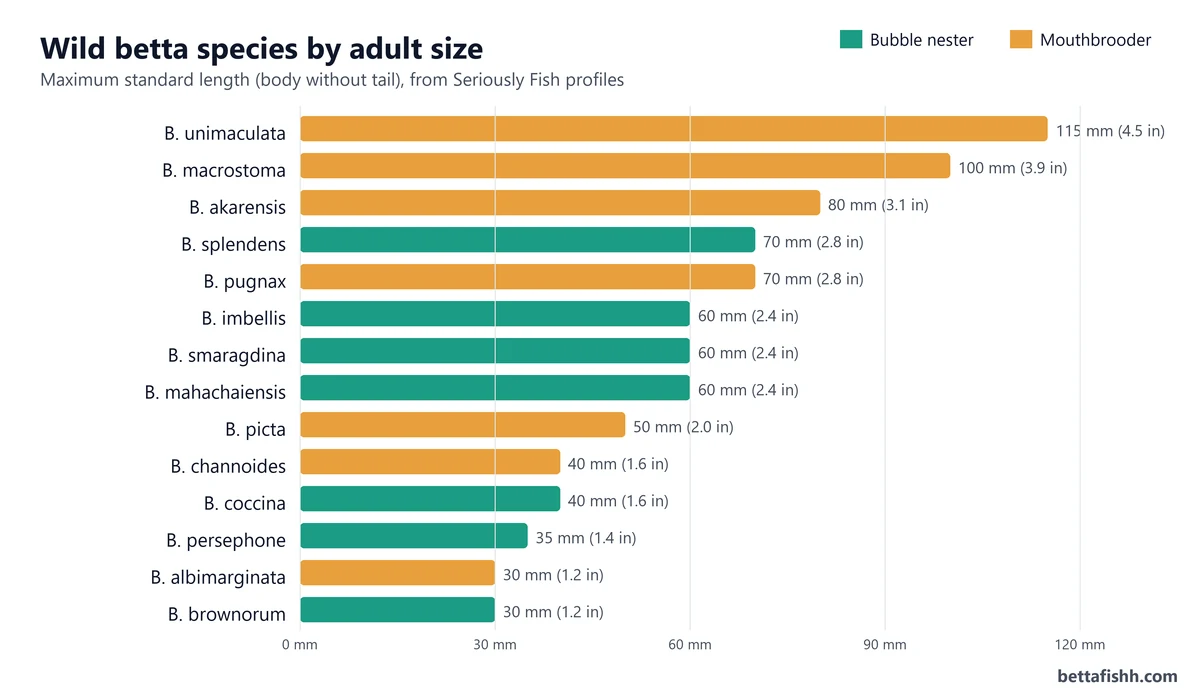
A cross-section of the wild bettas most often mentioned in the hobby. Size is maximum standard length, the body without the tail, and pH is the range Seriously Fish gives for keeping them.
| Species | Max size | Where | Habitat | Breeding | pH |
|---|---|---|---|---|---|
| B. splendens, common betta | 70 mm (2.8 in) | Central Thailand and neighbouring countries | Rice paddies, swamps, ditches | Bubble nest | 6.0–8.0 |
| B. imbellis, “peaceful” betta | 60 mm (2.4 in) | Southern Thailand, Peninsular Malaysia, northern Sumatra | Rice paddies, swamps, ditches | Bubble nest | 5.0–7.5 |
| B. smaragdina, emerald betta | 60 mm (2.4 in) | Khorat Plateau, eastern Thailand | Still, plant-filled water | Bubble nest | 5.5–7.5 |
| B. mahachaiensis | 60 mm (2.4 in) | Gulf of Thailand coast near Bangkok | Brackish, tidal nipa palm swamps | Bubble nest | 7.0–8.5 |
| B. coccina, wine red betta | 40 mm (1.6 in) | Sumatra and Johor, Malaysia | Dark peat swamp forest | Bubble nest | 4.0–6.0 |
| B. persephone | 35 mm (1.4 in) | Southwest Johor, Malaysia | Peat swamp forest | Bubble nest | 4.0–6.0 |
| B. hendra | 45 mm (1.8 in) | Sabangau peat swamp, Borneo | Blackwater | Bubble nest | 4.0–6.5 |
| B. channoides, snakehead betta | 40 mm (1.6 in) | Mahakam basin, East Kalimantan, Borneo | Shallow, brown, acidic forest streams | Mouthbrooder | 4.0–6.5 |
| B. albimarginata | 30 mm (1.2 in) | Sebuku River, East Kalimantan, Borneo | Very shallow forest streams | Mouthbrooder | 4.0–6.5 |
| B. picta, spotted betta | 50 mm (2.0 in) | Java, Indonesia | Clear hill streams | Mouthbrooder | 5.5–7.5 |
| B. pugnax, Penang betta | 70 mm (2.8 in) | Peninsular Malaysia and Singapore | Clear hill streams | Mouthbrooder | 4.0–7.5 |
| B. macrostoma, Brunei beauty | 100 mm (3.9 in) | Brunei and northern Sarawak, Borneo | Shady pools above rainforest waterfalls | Mouthbrooder | 4.0–6.0 |
| B. unimaculata | 115 mm (4.5 in) | East Kalimantan, Borneo | Streams and headwater pools | Mouthbrooder | 5.0–7.5 |
The name imbellis is Latin for peaceful, but that is relative. Seriously Fish still advises keeping it alone or only with very peaceful fish, as with the common betta.
Four Places Wild Bettas Live
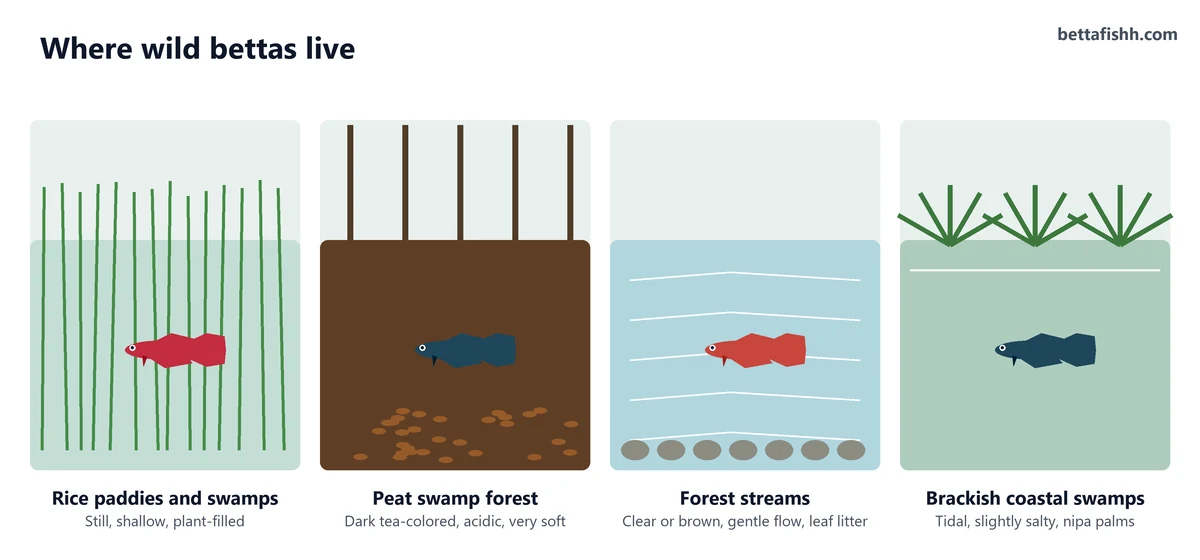
- Rice paddies and swamps. Warm, shallow, still and full of plants. Home to the common betta and its closest relatives.
- Peat swamp forest. Tea-colored blackwater under a dense canopy, very soft and acidic, with a pH often below 6. Home to the small red coccina group, several of which are found in just a few forest patches.
- Forest streams. Clear or brown water with gentle flow over sand, leaves and roots, where many mouthbrooders live. B. albimarginata lives in water only 5 to 10 cm deep.
- Brackish coastal swamps. B. mahachaiensis is the only betta found only in brackish water, among nipa palms on the tidal coast near Bangkok.
Wild Bettas Under Threat
Wild habitat is disappearing fast, mostly to drainage, farming and plantations. Several species are on the IUCN Red List:
| Species | IUCN status | Main threat |
|---|---|---|
| B. splendens (wild form) | Vulnerable | Pollution and habitat loss |
| B. persephone | Critically Endangered | Only a few pockets of peat swamp forest remain |
| B. livida | Endangered | Its range is being cleared for oil palm and rubber |
| B. macrostoma | Vulnerable | A tiny range; Brunei has banned its export |
| B. burdigala | Vulnerable | Found only on Bangka island, Indonesia |
Pet bettas are captive bred in huge numbers and have no effect on wild populations. If you ever keep a wild species, choose captive-bred fish, and breed them if you can.
Can You Keep Wild Bettas?
Yes, but they are a step up from a pet store betta. Each species has its own needs, and most are sold by specialist breeders rather than chain stores. What they usually need:
- Soft, acidic water for most species, matching the pH in the table above. Peat swamp species are the most demanding, while B. mahachaiensis needs harder, slightly brackish water.
- Tannins and leaf litter. Dried Indian almond leaves tint the water and recreate the forest floor.
- Dim light, dense plants and very gentle flow.
- A tight-fitting lid. Wild bettas jump, and fry need warm, humid air above the water to develop their labyrinth organ.
- Live and frozen foods. Many wild bettas refuse pellets at first; see live foods for bettas.
- Space for pairs. Seriously Fish lists base sizes of about 18 by 12 inches for the small species and around 30 by 12 inches for large mouthbrooders. Some species can be kept as a pair, unlike pet males.
If you are new to bettas, start with a pet Betta splendens, using how to set up a betta tank, and quarantine any new fish. For sizes across the genus and how pet bettas compare, see how big betta fish get.
Sources
Seriously Fish, species profiles for Betta splendens, imbellis, smaragdina, mahachaiensis, coccina, persephone, hendra, livida, burdigala, channoides, albimarginata, picta, pugnax, macrostoma, unimaculata and brownorum (range, habitat, size, pH, breeding and conservation). Wikipedia, Betta (number of species, breeding styles) and Siamese fighting fish (native range, wild coloration, IUCN status). Frank’s Bettas, Wild Betta 101 (tannins). Bettafishh care standards.
Frequently Asked Questions
Where do betta fish come from?
Southeast Asia. The common betta is native to Thailand, Cambodia, Laos, Vietnam and nearby countries, where it lives in rice paddies, swamps, ditches and slow streams.
What do betta fish look like in the wild?
Wild Betta splendens is mostly green, brown and grey, with short fins. It shows strong colors only when it is agitated. The long fins and bright colors of pet bettas come from selective breeding.
How many betta species are there?
Around 73 species are recognised in the genus Betta, according to Wikipedia, and new ones are still being described. The common pet betta is just one of them.
Do bettas live in puddles in the wild?
No. They live in rice paddies, swamps and slow streams. These are shallow but cover a large area of warm water, which is far more than any bowl.
Are wild bettas endangered?
Some are. The wild common betta is listed as Vulnerable, and Betta persephone is Critically Endangered. Pet bettas are captive bred and are not threatened.
Is Betta imbellis really peaceful?
Its name means peaceful, and it is less aggressive than ornamental strains. Seriously Fish still advises keeping it alone or with very peaceful fish only.
Can you keep wild bettas as pets?
Yes, but they need more care than a pet store betta: usually soft, acidic water, dim light, dense plants, a tight lid and live or frozen food. Buy captive-bred fish from a specialist.
Do all bettas build bubble nests?
No. Bubble nesters include the common betta and its relatives, but many species are mouthbrooders, where the male carries the eggs and fry in his mouth.