If you only learn one number about betta care, make it this: the ideal betta water temperature is a stable 78–80°F. Get the temperature right and you prevent the majority of “mystery” illnesses, faded colour, and listless behaviour that send new owners searching for answers. Get it wrong and even a perfectly fed, clean-water betta will slowly decline. This guide gives you the exact ranges, the science in plain English, and a step-by-step method to lock the temperature in for good.
The Numbers (memorise these)
| Range | °F | °C | Status |
|---|---|---|---|
| Ideal | 78–80°F | 25.5–26.7°C | Thriving |
| Acceptable | 76–82°F | 24.5–28°C | OK |
| Survival only | 72–86°F | 22–30°C | Stressed |
| Dangerous | <72°F or >86°F | <22°C or >30°C | Harmful |
Too Cold vs. Too Hot (quick view)
| Too cold (<74°F) | Too hot (>84°F) |
|---|---|
| Lethargy, lying at bottom | Frantic darting, restlessness |
| Loss of appetite | Gasping (low oxygen) |
| Weak immunity, disease | Faster ageing, shorter life |
Full detail: betta water too cold and the too-hot section further down this page. Cold-water lethargy is a very common “why won’t my betta move” cause, see also why is my betta lethargic.
How to Hold Temperature Steady
- Adjustable heater sized to the tank (≈3–5 watts per gallon as a rough guide).
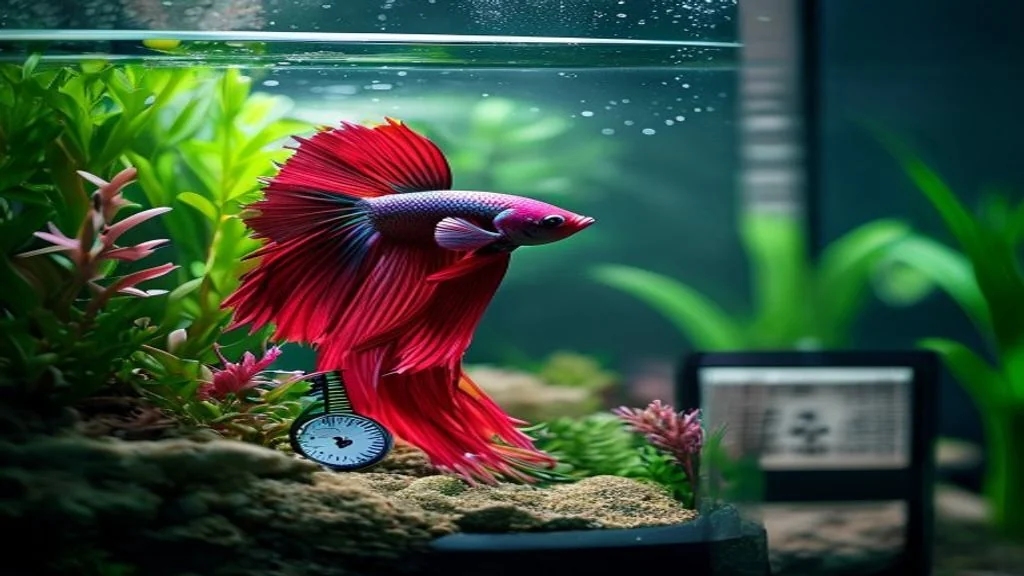
- A reliable thermometer: don’t trust the heater dial alone; verify with a separate thermometer.
- Stable room placement: away from windows, AC, heaters, and direct sun.
- Match new water temperature at water changes, and warm or cool water by no more than about 1–2°F per hour.
- Adequate tank size: small tanks/bowls swing fast (a key point in beginner mistakes).
How Temperature Touches Every Part of Betta Health
Temperature isn’t just “comfort”, it’s the control dial for your betta’s entire body. Understanding this is what separates owners whose bettas thrive for years from those who lose fish in months.
| System | At 78–80°F | Too cold (<74°F) | Too hot (>84°F) |
|---|---|---|---|
| Metabolism | Steady, healthy | Slows down, lethargy, low appetite | Races, burns out, ages faster |
| Immune system | Strong defence | Weak, disease takes hold easily | Stressed, also vulnerable |
| Digestion | Efficient | Sluggish, constipation, bloat | Too fast, poor nutrient use |
| Oxygen in water | Adequate | Higher, but fish too sluggish to use well | Lower, gasping, suffocation risk |
| Colour & activity | Bright, active, curious | Faded, hiding, still | Faded, frantic, restless |
This is also why temperature is the first thing to check for almost any symptom, a “sick” betta is very often just a cold one. It connects directly to lethargy, ich outbreaks, and digestive issues.
Heater Sizing Cheat Sheet
A rough, safe guideline is about 3–5 watts per gallon for a heated indoor room. Always buy an adjustable heater (not a fixed “preset” one) so you can dial in 78–80°F precisely.
| Tank size | Approx. heater wattage |
|---|---|
| 5 gallons | 25 watts |
| 10 gallons | 50 watts |
| 15–20 gallons | 75–100 watts |
For very small tanks, a too-powerful heater can overshoot and overheat, another reason adequate tank size (see tank size guide) makes stable temperature far easier to maintain.
Common Temperature Mistakes Beginners Make
- “It’s a tropical fish, so hotter is better.” False, above 84°F is harmful. The target is a precise 78–80°F.
- Trusting the heater dial. Dials are often inaccurate; always verify with a separate thermometer.
- Placing the tank in a sunny window. Causes wild swings and algae, keep it in a stable, shaded spot.
- Using a fixed-temperature “preset” heater. You can’t fine-tune it; get an adjustable model.
- Ignoring seasonal change. A tank fine in summer can drop dangerously in winter, check year-round.
How to Measure Betta Water Temperature Accurately
You cannot manage what you do not measure, and temperature is the easiest parameter to get badly wrong because the equipment that comes with most tanks lies to you. The heater’s built-in dial is a manufacturing reference point, not a calibrated reading, two heaters set to the same dial position can hold water four or five degrees apart. The only number that matters is what an independent thermometer in the water tells you.
Thermometer Types Compared
| Type | Accuracy | Notes |
|---|---|---|
| Glass/alcohol submersible | Good (±1°F) | Cheap, reliable, no batteries, the keeper’s standard. Place mid-tank, not next to the heater. |
| Digital probe | Very good (±0.5°F) | Easy to read at a glance; verify against a glass one when new in case it drifts. |
| Stick-on LCD strip | Poor (±2–4°F) | Reads the glass and room, not the water. Better than nothing in an emergency only. |
Read the thermometer at the same time each day, ideally in the early morning when the room (and therefore the tank) is at its coldest. If the morning reading is in range, you have built-in safety margin for the rest of the day. Place the thermometer on the opposite side of the tank from the heater so you measure the true average water temperature, not the warm pocket right beside the heating element.
The 24-Hour Temperature Profile (the part most guides skip)
A single thermometer glance tells you almost nothing about stability. What harms a betta is the swing across a full day and night, and that swing is invisible unless you look for it. A tank can read a perfect 79°F when you check it at 7 p.m. with the lights and home heating on, then quietly fall to 73°F by 5 a.m. when the heating is off and the room cools. To the fish, that is a 6-degree daily roller-coaster, the equivalent of a person living through a fever-and-chills cycle every single day.
To check your real profile, read the thermometer at three points for two or three days: early morning (coldest), mid-afternoon, and late evening. If the spread is more than about 2°F, the tank is not truly stable and you need a larger or better-positioned heater, a bigger volume of water, or a more stable room. Larger tanks have more thermal mass and resist swings far better, which is one more reason the betta tank size guide matters for temperature, not just swimming space.
Step-by-Step: Dialling In a New Heater
- Install and submerge fully per the instructions, but do not plug it in for 15–30 minutes, letting the unit reach water temperature first prevents the glass cracking from thermal shock.
- Set the dial to the midpoint and switch it on. Note the time.
- Wait 2–4 hours, then read the independent thermometer. Adjust the dial in small increments toward 79°F. The water responds slowly, change the dial a little, then wait hours, never minutes.
- Repeat over 24–48 hours until the morning and evening readings both sit at 78–80°F. Mark the correct dial position with a dab of nail polish so it cannot be knocked out of place.
- Re-check after any change: a water change, a new room, a season turning, or moving the tank all warrant a fresh 24-hour check.
Acclimating a New Betta to Temperature
The moment you bring a betta home, temperature is the first stressor to manage. Pet-store bag water is usually cool and a different temperature from your heated tank, and dropping the fish straight in is a classic temperature-shock mistake. Float the sealed bag in the tank for 15–20 minutes so the bag water gently rises to match the tank, then proceed with your normal acclimation. This single step prevents the shock that often makes a new betta hide, clamp its fins, or refuse food for days, behaviour frequently misread as illness.
Temperature, Tank Mates, and the Bigger Picture
Temperature does not exist in isolation; it sets the conditions for everything else in the tank. Beneficial filter bacteria, the colony that keeps ammonia and nitrite at zero, work best in warm, stable water and slow down sharply when it turns cold, so a chilled tank often develops a water-quality problem on top of the cold itself. If you keep tank mates, they must share the betta’s 78–80°F window; many popular community fish prefer cooler water, which is a frequent source of conflict covered in compatibility planning. Warmth also slightly lowers dissolved oxygen, so good surface movement and not overstocking matter more in a correctly heated tank, a tropical fish in clean, warm, well-oxygenated, stable water is a fish that shows its full colour and lives out its natural lifespan. Temperature is just one row on the full betta water parameters chart, which sits alongside pH, ammonia, and nitrite, all of which you confirm with the best betta water test kit.
Stability Beats the Perfect Number (and How to Survive a Heater Failure)
New keepers obsess over hitting exactly 79°F, but ask anyone who has kept bettas for years and they will tell you the same thing: a rock-steady 77°F is healthier than a tank that swings between 76°F and 82°F every day, even though both technically touch the “ideal” range. Bettas are ectothermic, so their entire metabolism, immune response, and digestion track water temperature in real time. A daily swing forces the fish to constantly re-regulate, and that chronic stress is what suppresses the immune system and opens the door to ich, fin rot, and lethargy, far more reliably than a stable temperature a degree or two off perfect. This is why a small, appropriately sized heater on a thermostat in a properly sized tank beats an oversized heater that cycles hard, and why nano tanks under 5 gallons are so risky: low water volume means temperature crashes and spikes with every room change. Volume is thermal insurance.
The scenario every keeper eventually faces is a heater failure or a winter power cut, and panic causes more deaths than the cold itself. A betta does not die at 70°F; it becomes sluggish and sits at the bottom, but it has hours, not minutes. The fatal mistake is rapid rewarming, dumping in hot water or aiming a lamp to “fix it fast.” A sudden upward swing is as shocking as the original drop and can kill a fish that the slow cooling would not have. Instead, rewarm gradually, no faster than about 1°F per hour, the same rate you would use acclimating a new fish. Practical emergency measures: wrap the tank in towels or a blanket to slow heat loss, float a sealed bottle or two of warm (not hot) water on the surface and swap them as they cool, reduce surface agitation so you are not evaporatively chilling the water further, and keep the lid on. Keep a backup heater and an inexpensive battery air pump in a drawer before you need them. Steady warmth, and a calm slow correction when it fails, is the whole game.
When the Water Is Too Hot: Danger Levels and Safe Cooling
Warm water holds less oxygen, and a hot betta burns energy faster. A betta that suddenly darts around or hangs at the surface on a hot day is often overheating, not “happy and active”.
| Temperature | What happens | Urgency |
|---|---|---|
| 80–82°F | Upper edge of fine. Bring it back toward 79°F. | Low |
| 83–85°F | Stress: faster breathing, restlessness, less appetite | Cool within hours |
| 86–88°F | Danger: oxygen drops, heavy gasping | Add air and cool now |
| Above 88°F | Critical: risk of death rises fast | Emergency |
How to cool a betta tank safely
- Oxygen first. Add an air stone or raise surface ripple right away.
- Lights off, lid slightly open so heat can escape.
- Point a small fan across the water surface. Evaporation cools the tank gently.
- Float a sealed bottle or bag of ice, and remove it before the tank overcools.
- Small water change with slightly cooler, dechlorinated water. Aim to drop a degree or two per hour, not all at once.
- Check the heater. A heater stuck “on” is a common cause. Unplug it and test it.
Normal temperature but your betta is still gasping? Test for ammonia, because ammonia poisoning looks very similar. For the opposite problem, see betta water too cold.
Sources & Further Reading
Chewy/PetMD, Betta Fish Water Temperature Guide; A-Z Animals, ideal betta temperature; Bettafish.org, water parameters; Merck Veterinary Manual, Environmental requirements of tropical fish; Chewy/PetMD, betta water temperature; A-Z Animals, overheating effects; Bettafish.org, temperature care; Merck Veterinary Manual, Hypoxia & heat stress in fish.
Frequently Asked Questions
What is the ideal water temperature for a betta fish?
78–80°F (25.5–26.7°C). The acceptable range is 76–82°F. Outside that, bettas only survive rather than thrive.
Can a betta live without a heater?
Not well. Bettas are tropical and need stable warmth; room temperature is usually too cold and too unstable, causing chronic stress and disease.
Is a stable temperature more important than the exact number?
Yes. A steady 79°F is much better than a tank swinging between 76°F and 82°F. Swings are a major stressor and disease trigger.
What temperature is too cold for a betta?
Below about 74°F metabolism slows, causing lethargy, appetite loss, and weak immunity; below 72°F is dangerous.
What temperature is too hot for a betta?
Above ~84–86°F oxygen drops and the betta becomes frantic and ages faster, shortening its lifespan.
What wattage heater does a betta tank need?
Roughly 3–5 watts per gallon in a normally heated room, about 25W for 5 gallons, 50W for 10 gallons, and 75–100W for 15–20 gallons. Always choose an adjustable heater, not a fixed preset model.
How do I cool down a betta tank safely?
Add aeration first, turn the lights off, open the lid a little, aim a fan across the surface and float a sealed bottle of ice. Lower the temperature slowly, a degree or two per hour.
Can I put ice cubes directly in my betta tank?
No. Tap-water ice can contain chlorine and cools the water too fast. Float a sealed bag or bottle of ice instead and remove it before the tank gets too cold.
Is 84 too hot for a betta?
84°F is above the ideal range. A healthy betta copes for a short time, but long term it speeds up metabolism and lowers oxygen in the water. Bring it back to 78 to 80°F gradually, about a degree or two per hour.
What is the ideal betta temperature in Celsius?
25.5 to 26.7°C (78 to 80°F). The acceptable range is about 24.5 to 28°C (76 to 82°F).