The live vs fake plants for bettas debate gets framed as a looks question, but it’s really about two things your betta can’t tell you: torn fins and water quality. A stiff plastic plant can shred fins overnight; a live plant quietly pulls toxins out of the water all day. This guide ranks the three options honestly, names the specific easy live plants and silk products keepers actually buy, and shows you the ten-second test that decides whether any fake plant is safe.
Quick answer: For live vs fake plants for bettas, live plants win — they add hides, oxygen and absorb ammonia/nitrate. Silk (fabric) plants are the best fake option, soft and fin-safe. Stiff plastic plants are the worst, because their edges tear a betta’s delicate fins.
Live vs Fake Plants for Bettas: The Ranking, Explained
| Type | Fin safety | Benefits | Effort/cost |
|---|---|---|---|
| Live plants | Safe (soft) | Hides + oxygen + absorbs ammonia/nitrate + enrichment | Some care; cheap easy species exist |
| Silk plants | Safe (soft fabric) | Hides & cover; zero maintenance | Low; one-time cost |
| Plastic plants | ⚠️ Usually unsafe (sharp/stiff) | Cover only | Low cost — high fin risk |
Why Live Plants Win
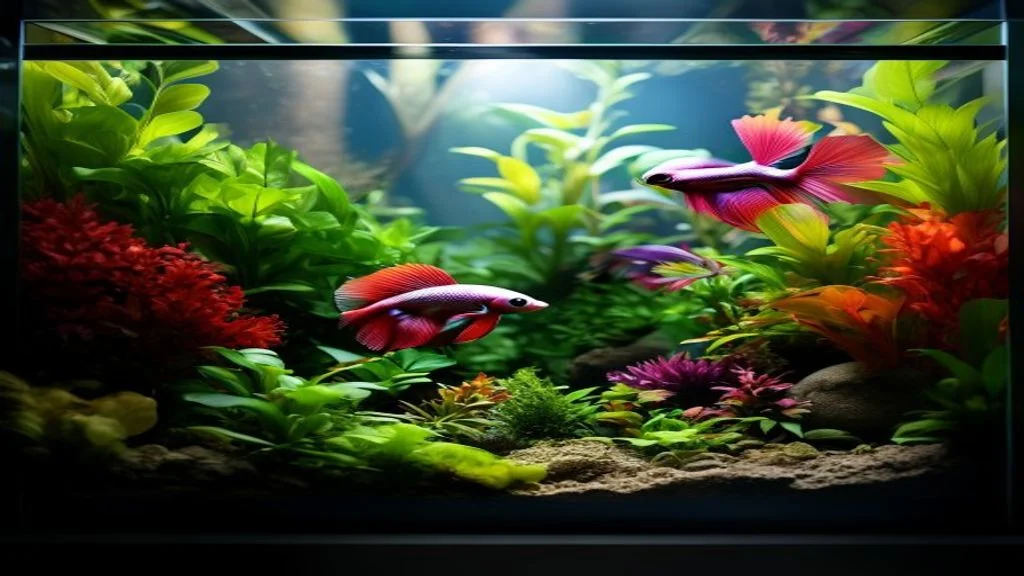
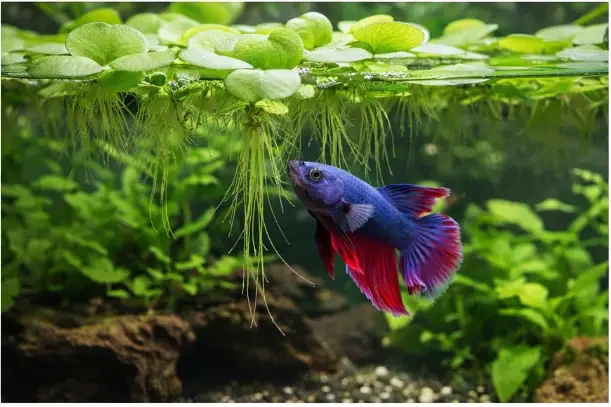
Live plants do something fake plants never can: they actively improve water quality by consuming nitrate (and some ammonia) as fertiliser, lowering the toxins behind most betta illness (nitrate levels, ammonia). They also add oxygen, give natural cover that reduces stress, and enrich a bored betta. A planted tank is genuinely more stable and healthier — see also best live plants for betta tanks and floating plants.
Easy Live Plants Beginners Can’t Kill
- Java fern — low light, attach to décor, nearly indestructible.
- Anubias — low light, slow, hardy; don’t bury the rhizome.
- Marimo moss balls — zero effort, gentle algae control.
- Amazon sword — larger background plant (needs root tabs).
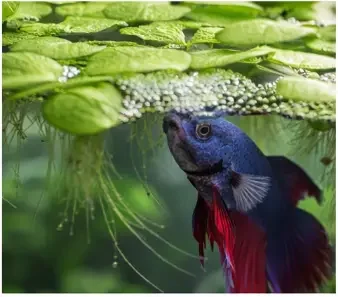
- Floating plants (e.g., frogbit) — shade + cover bettas love (floating plants for bettas).
All thrive at betta temperatures and need only modest light (see do betta fish need light).
Silk vs Plastic: Don’t Get This Wrong
If you go fake, the rule is simple: silk, not plastic. Silk (fabric) plants are soft and move naturally — fin-safe. Plastic plants are stiff, and their moulded edges fray over time, snagging and tearing a betta’s long fins (and degrading plastic can shed microplastics). The pantyhose test settles any doubt: rub nylon over the plant — if it snags or tears, it will shred fins. Most plastic plants fail this test; most silk plants pass.
Quick Decision Guide
| You want… | Choose |
|---|---|
| Best health + natural look, OK with light care | Live plants (start with Java fern/Anubias) |
| Zero maintenance, still fin-safe | Silk plants |
| Cheapest possible | Still silk — never stiff plastic |
| Hospital/breeding tank | Silk or hardy live (easy to sterilise/move) |
How to Choose Plants for a Betta: Buying Criteria
- Fin safety first: soft leaves only. Live and silk pass automatically; plastic must pass the pantyhose test or stay in the store.
- Light needs match your setup: if you have a basic LED, pick low-light live plants (Java fern, Anubias, moss) — high-light plants will melt and rot, fouling the water.
- Placement type: rhizome plants (Anubias, Java fern) attach to wood/rock and need no substrate; rooted plants (sword, crypts) need a substrate bed and often root tabs; floating plants need nothing but surface space.
- Growth rate vs effort: slow growers (Anubias) are nearly maintenance-free; fast growers (water sprite) suck up more nitrate but need trimming.
- Pest risk: tissue-culture live plants are essentially snail/pesticide-free; loose nursery plants may bring pest snails or plant-dip-needed pesticides.
- Betta comfort: bettas love broad leaves to rest on and surface cover — prioritise plants and silk pieces that offer both.
Recommended Plants & Plant Products
These are real, widely sold plants and silk products betta keepers reliably recommend. All are fin-safe; the live options are beginner-proof at betta temperatures and low light.
| Product | Type | Best for | Notes |
|---|---|---|---|
| Anubias Nana (Petite) | Live, rhizome | Best overall beginner plant | Low light, nearly unkillable; tie to wood/rock, never bury the rhizome; broad rest leaves |
| Java Fern | Live, rhizome | Best no-substrate plant | Thrives in low light, attaches to décor; tolerates a wide parameter range |
| Marimo Moss Ball | Live | Best budget / zero-effort | Just drop it in; mild nutrient export and a toy bettas nudge around |
| Amazon Frogbit / Red Root Floater | Live, floating | Best surface cover | Shade and dangling roots bettas love; keep off the filter outflow; thin it regularly |
| SunGrow / Marina Silk Betta Plant | Silk (fake) | Best fin-safe fake plant | Soft fabric, passes pantyhose test; zero maintenance; good for low-light rooms |
| Zoo Med Betta Bed Leaf Hammock | Silk leaf accessory | Best resting spot add-on | Suction-cup silk leaf near the surface; cheap, fin-safe, encourages natural resting |
Editorial picks: Best overall — Anubias Nana (impossible to kill, perfect rest leaves). Best budget / lowest effort — a Marimo moss ball plus Java fern. Best fake option — a soft silk betta plant with a Zoo Med leaf hammock. Skip stiff plastic regardless of price.
Setup & Planting Specifics
- Rhizome plants: tie Anubias/Java fern to driftwood or rock with thread or super glue gel — never bury the rhizome or it rots.
- Rooted plants: plant in ~2 inches of substrate, leaving the crown above the surface; add a root tab nearby for heavy feeders.
- Floating plants: drop on the surface away from filter flow; if your filter blows them around, add a floating ring or baffle the outflow.
- New live plants: rinse well; a quick plant dip (or a quarantine) reduces pest snails and pesticide risk before they reach the betta.
- Silk plants: rinse, then weigh down or anchor the base so they don’t uproot during water changes.
Maintenance by Plant Type
- Low-light rhizome/moss: almost nothing — wipe algae off Anubias leaves occasionally, rinse the moss ball during water changes.
- Rooted plants: trim dead leaves, replace root tabs every 1–2 months, watch for melting after transplant (normal — new growth follows).
- Floating plants: remove a handful weekly so they don’t carpet the surface and block oxygen/gas exchange.
- Silk plants: pull out and rinse algae off every few weeks; replace any piece that has gone stiff or frayed at the edges.
Dos and Don’ts
| Do | Don’t |
|---|---|
| Match plant light needs to your LED | Buy high-light plants for a dim tank (they rot) |
| Attach rhizome plants to décor | Bury an Anubias/Java fern rhizome (it rots) |
| Use silk if you want fake plants | Use stiff plastic plants near a long-finned betta |
| Thin floating plants weekly | Let floating plants seal the entire surface |
| Pantyhose-test any fake plant | Assume “betta-safe” packaging means it’s soft |
The Real Reason Fins Tear: Why Plastic Is the Worst Choice
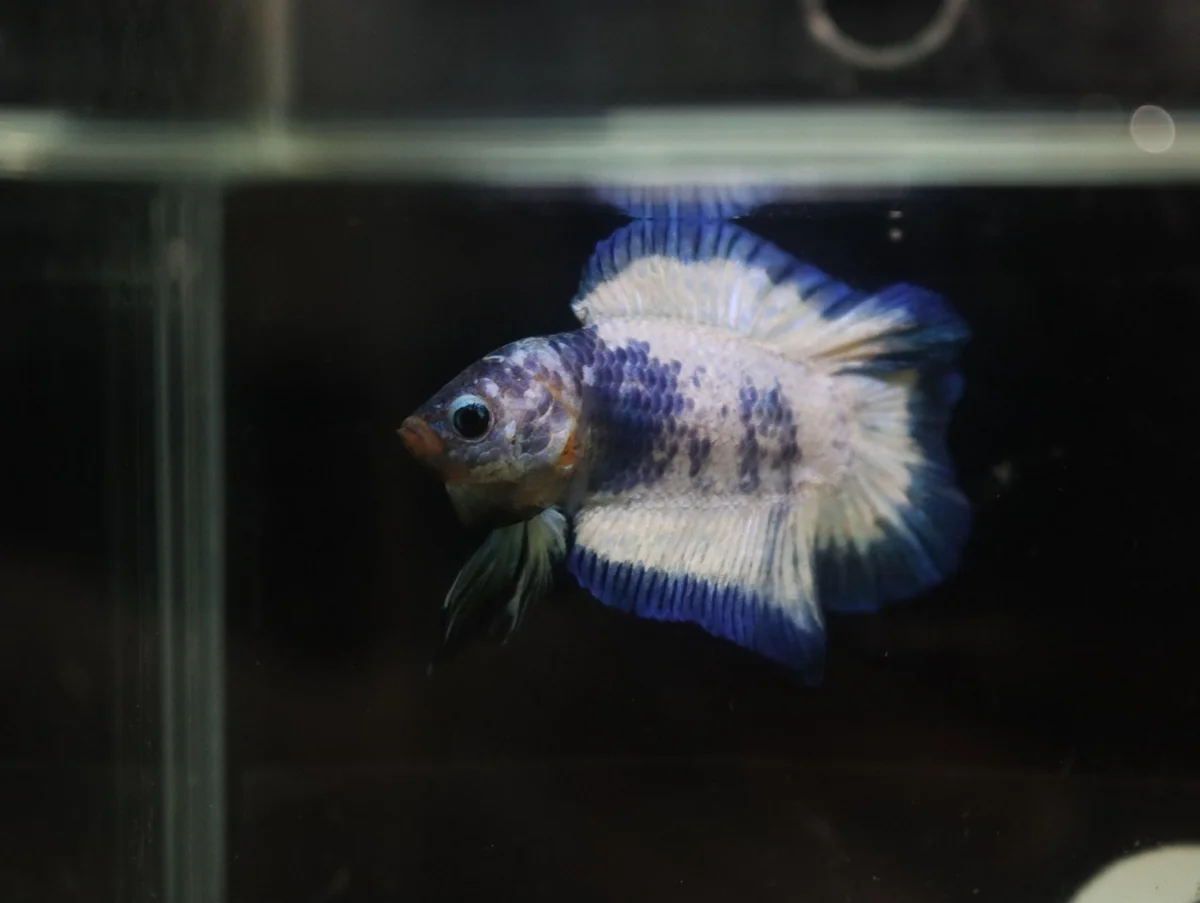
To understand the entire ranking, you have to understand the betta’s fins. A betta — especially a fancy long-finned variety like a halfmoon, veiltail, or crowntail — trails large, thin, delicate finnage that is far more fragile than it looks. Those fins are living tissue with fine rays, and they catch on anything with a hard edge as the fish turns, drifts, and squeezes past decor. This is the single fact that makes plant choice a health decision rather than a decorating one.
Hard plastic plants are dangerous for a specific, mechanical reason. They are moulded with thin edges along every leaf, and that moulding flash, plus the way the plastic stiffens and frays as it ages in water, creates exactly the kind of micro-serrated edge that snags fin tissue. The fish does not have to crash into it; it simply has to swim past it the way it swims past everything, day after day. A single snag tears the fin, and a torn fin in less-than-perfect water very reliably progresses to fin rot — which is why the “cheap” plastic plant routinely turns into weeks of treatment and a stressed fish. Degrading plastic can also shed microplastic particles into a small enclosed volume over time, an added reason it is the poorest long-term choice.
Live and silk plants avoid this entirely because the mechanism cannot occur: living leaves and soft fabric have no rigid edge to catch tissue, and they yield and bend as the fish moves through them rather than resisting. This is the whole logic of the live > silk > (only soft) plastic ranking. It is not aesthetic preference and it is not snobbery about “real” plants — it is that two of the options physically cannot shred a fin and one of them frequently does. Everything else in this guide is secondary to that.
The Pantyhose Test, Done Properly
The pantyhose test is the single most useful habit in this entire topic, and it is worth doing correctly rather than casually, because it is the only objective check that overrides marketing claims and “betta-safe” packaging.
The method: take a piece of sheer nylon pantyhose or tights — material chosen specifically because it is roughly as snag-prone as a betta’s fin tissue — and draw it firmly across every leaf, leaf edge, leaf tip, and join of the plant or ornament. Do it the way the plant will actually meet the fish: along edges and around tips, not just flat across a broad surface. If the nylon glides over every part with no catching, pulling, or pilling, the item is fin-safe. If it snags, drags, pulls a thread, or tears anywhere, that exact spot will catch a fin, and the item is not safe near a betta no matter what the label says.
Three points make the test reliable. First, test the whole item, not one leaf — plastic plants often have safe broad leaves and a vicious moulded stem or tip; one bad edge is enough to harm the fish. Second, re-test fake plants periodically, because plastic that passed when new can stiffen and develop frayed edges after months submerged; “safe once” is not “safe forever.” Third, the test cuts both ways and should defeat assumptions in both directions: most stiff plastic plants fail it even when sold as aquarium-safe, and the occasional genuinely soft plastic plant can pass — the test, not the price or the packaging, is the authority. Anything that fails stays out of the tank or goes back to the store.
How Live Plants Actively Improve Water Quality
The fin-safety argument alone would already settle plastic out of contention, but it does not explain why live ranks above silk when both are fin-safe. The answer is that a live plant is not décor — it is a working part of the tank’s chemistry, and that is something no fake plant can ever do.
The core benefit is nutrient export. Fish waste and uneaten food break down into ammonia, then nitrite, then nitrate. The first two are acutely toxic and the third accumulates between water changes and is implicated in long-term stress and poor health. Live plants take up nitrogen — readily as nitrate, and many species also use ammonia directly — and build it into their own growth. In effect, a planted tank has a second, biological filter that is constantly pulling the exact toxins behind most betta illness out of the water. In a small betta tank with limited water volume and limited buffering, that ongoing draw-down meaningfully increases stability between maintenance.
There are secondary benefits that compound this. Plants release oxygen during the day, supporting better gas exchange in a small tank. A reasonably planted tank tends to be more biologically stable overall, with fewer sharp swings, because there is more living surface for beneficial processes and more buffering against a single mistake. Plants also outcompete some nuisance algae for the same nutrients, which is why heavily planted tanks often have less of an algae problem, not more. And dense planting gives the betta genuine cover and broad resting leaves, which lowers stress — and a lower-stress betta has a stronger immune response.
Silk plants deliver the cover and the stress reduction, which is real value, but they are inert: they contribute nothing to nitrogen export, oxygen, or biological stability. That is precisely why the ranking is live > silk rather than live = silk. Both are safe; only one of them is also quietly doing water-quality work every hour of every day.
A Beginner-Proof Planted Setup, Step by Step
Most “I tried live plants and they died and rotted and fouled my water” stories come from choosing demanding plants or planting them wrong, not from live plants being inherently hard. A deliberately low-tech setup using the right species is genuinely difficult to fail.
- Pick only low-light, low-demand species to start. Anubias (especially Nana Petite), Java fern, a Marimo moss ball, and a floating plant such as frogbit. These thrive under an ordinary aquarium LED at betta temperatures with no CO2 injection and no special fertiliser regime. Avoid carpeting and high-light stem plants entirely until you have experience — those are the plants that melt and foul the water for beginners.
- Attach the rhizome plants — never bury them. Anubias and Java fern grow from a horizontal rhizome that rots if buried in substrate. Tie or glue (aquarium-safe gel) them onto driftwood or rock so the rhizome sits in open water. This single rule prevents the most common live-plant death.
- Use the moss ball and floating plant as zero-effort wins. The Marimo ball just goes on the bottom and is rolled occasionally to keep its shape; the floating plant goes on the surface, away from filter flow, and provides shade and dangling roots bettas love. Neither needs planting.
- Quarantine or dip new plants first. Rinse well and do a short plant dip or separate quarantine to reduce pest snails and any nursery pesticide before the plant ever meets the fish. Tissue-culture plants largely avoid this problem at the source.
- Expect some initial melt and do not panic. Newly added plants commonly shed older leaves as they adjust to your tank (“melt”), then push new growth. Trim away the obviously dead material so it does not decay, and wait — this is normal adjustment, not failure, and yanking the plant out is the actual mistake.
- Keep the floating plants thinned. A surface plant that carpets the entire top of the tank chokes gas exchange. Remove a handful regularly so it stays a feature, not a lid.
Run exactly that list and the failure modes that scare beginners — rotting rhizomes, melting high-light plants, a snail outbreak, an oxygen-starved sealed surface — are all designed out from the start. Low-light species, attached not buried, dipped, and thinned: that is the entire skill.
Matching Plants to the Specific Tank and Situation
The best plant choice is not universal; it shifts with the setup and the purpose of the tank. Reasoning it out beats copying someone else’s tank.
Bare-bottom or hardscape-only tanks
If there is no substrate, rooted plants are not an option, but this is not a barrier to a planted look — rhizome plants (Anubias, Java fern) attached to wood or rock and floating plants need no substrate at all. A bare-bottom tank can still be richly planted using only attach-and-float species.
Substrate tanks that want background height
With a couple of inches of substrate you can add rooted plants such as an Amazon sword for background height, planting the crown above the substrate and using a root tab nearby for these heavier feeders. Pair the tall rooted plant with foreground rhizome plants for a layered look.
Hospital, treatment, and quarantine tanks
Here the priority is the ability to sterilise or move things and to dose medication freely, so silk plants or a single hardy, easily-removed rhizome plant are ideal. You do not want a heavily rooted live aquascape in a tank you may need to strip and disinfect.
Breeding tanks
Bubble-nesting bettas use surface plant cover for the nest and fine cover for fry, so soft, easy plants and floating cover are valuable, while anything hard-edged is to be avoided around displaying, flaring fish whose fins are under extra strain.
Low-light rooms with no upgrade planned
If the tank lives somewhere dim and a stronger light is not going to happen, do not fight it with demanding plants that will rot. Either commit to the low-light live shortlist (Anubias, Java fern, moss ball) which genuinely tolerates it, or use quality silk — both are honest answers; struggling high-light plants in a dark room are not.
The unifying principle is to choose for the tank you actually have and the job it actually does, prioritising fin-safe options in every case and only adding the complexity (rooted plants, height, density) that the specific setup supports.
Common Plant Mistakes That Harm Bettas
Even keepers who avoid plastic make a handful of recurring errors. Each maps to something earlier in this guide.
- Trusting “betta-safe” packaging on a plastic plant. Labels are marketing. The pantyhose test is the authority, and most stiff plastic fails it regardless of the box.
- Burying a rhizome. Pushing Anubias or Java fern into the substrate to “plant it properly” rots the rhizome and kills the plant, then the decay degrades water quality. Attach, do not bury.
- Buying high-light plants for a dim tank. Demanding species in low light melt and rot, fouling a small tank — the opposite of the water-quality benefit live plants are supposed to give. Match the plant to the light.
- Letting floating plants seal the surface. Unmanaged surface cover blocks gas exchange and oxygenation. Thin it regularly so it stays beneficial.
- Skipping the plant dip/quarantine. Untreated nursery plants can introduce pest snails or pesticide residue straight into the tank with the fish. A quick dip or quarantine prevents both.
- Assuming a plant that was safe stays safe. Plastic stiffens and frays with age; silk can degrade and go stiff at the edges. Re-test fake plants periodically and replace anything that has hardened or frayed.
- Panicking at normal melt. Pulling out a new live plant because older leaves died is a self-inflicted failure — melt is adjustment, and new growth follows if you leave it and trim the dead parts.
The thread through all of them: fin safety verified by the test, live plants chosen and placed to match the tank’s light and structure, and a little routine maintenance. Get those right and plants become one of the highest-value, lowest-cost upgrades for a betta’s health and behaviour.
Plants are one line on the full betta starter kit checklist. Combine them with fin-safe tank decorations, the right substrate for any rooted species, and a properly sized betta tank.
Sources & Further Reading
Acuario Pets — silk vs plastic for bettas; Betta Care Hub — silk plants for betta; Bettafish.org — betta plants; Aquarium Co-Op — easy aquarium plants.
Frequently Asked Questions
Are live or fake plants better for bettas?
Live plants are best — they provide hides, oxygen, and absorb harmful ammonia/nitrate. Silk is the best fake alternative; avoid stiff plastic.
Are plastic plants bad for betta fish?
Hard/stiff plastic plants are — their edges tear delicate betta fins and can lead to fin rot. Use silk or live plants instead.
Are silk plants safe for bettas?
Yes — silk (fabric) plants are soft and fin-safe, and need no maintenance. They’re the recommended fake option.
What are the easiest live plants for a betta tank?
Java fern, Anubias, marimo moss balls, and floating plants — all low-light and very hard to kill.
Do live plants help keep betta water clean?
Yes — they absorb nitrate (and some ammonia) as nutrients, lowering the toxins that cause most betta illness, and add oxygen.
How do I test if a fake plant is safe?
The pantyhose test — rub nylon over it; if it snags or tears, it will damage your betta’s fins.
Do I need plants in a betta tank at all?
Strongly recommended — plants (live or silk) provide cover and enrichment that reduce stress and make bettas more active and colourful.
What is the easiest live plant for a beginner betta keeper?
Anubias Nana — it tolerates low light, doesn’t need substrate (tie it to wood/rock), is almost impossible to kill, and gives the betta broad leaves to rest on.
Do live plants need special lighting and CO2 in a betta tank?
Not the easy ones. Java fern, Anubias, and moss balls thrive under a basic LED with no CO2. Only high-light carpeting plants need extra equipment.
Should I quarantine or dip new live plants?
Yes, ideally. A quick plant dip or short quarantine reduces pest snails and any nursery pesticides before the plant goes in with your betta.