The best filter for a betta tank is the one most newcomers wouldn’t pick off the shelf, because betta filtration breaks the usual rule. For most fish you want more flow and more turnover; for a long-finned betta you want full biological filtration with the gentlest current you can manage. This guide ranks the filter types, names the specific models and air pumps experienced keepers actually run, and shows the cheap DIY baffles that tame a too-strong filter you already own.
Quick answer: The best filter for a betta tank is a gentle one — an air-driven sponge filter on a quiet, adjustable air pump. Bettas need full biological filtration but minimal current, so if you run a hang-on-back filter, baffle the outflow with foam or a cut bottle.
Why Bettas Need a Filter at All
A filter houses the beneficial bacteria that convert toxic ammonia → nitrite → safer nitrate — the nitrogen cycle. An unfiltered tank means constant water poisoning unless you do exhausting daily changes. So the question, like the heater, is which filter — see also do betta fish need a filter.
Flow Is the Enemy — Here’s Why
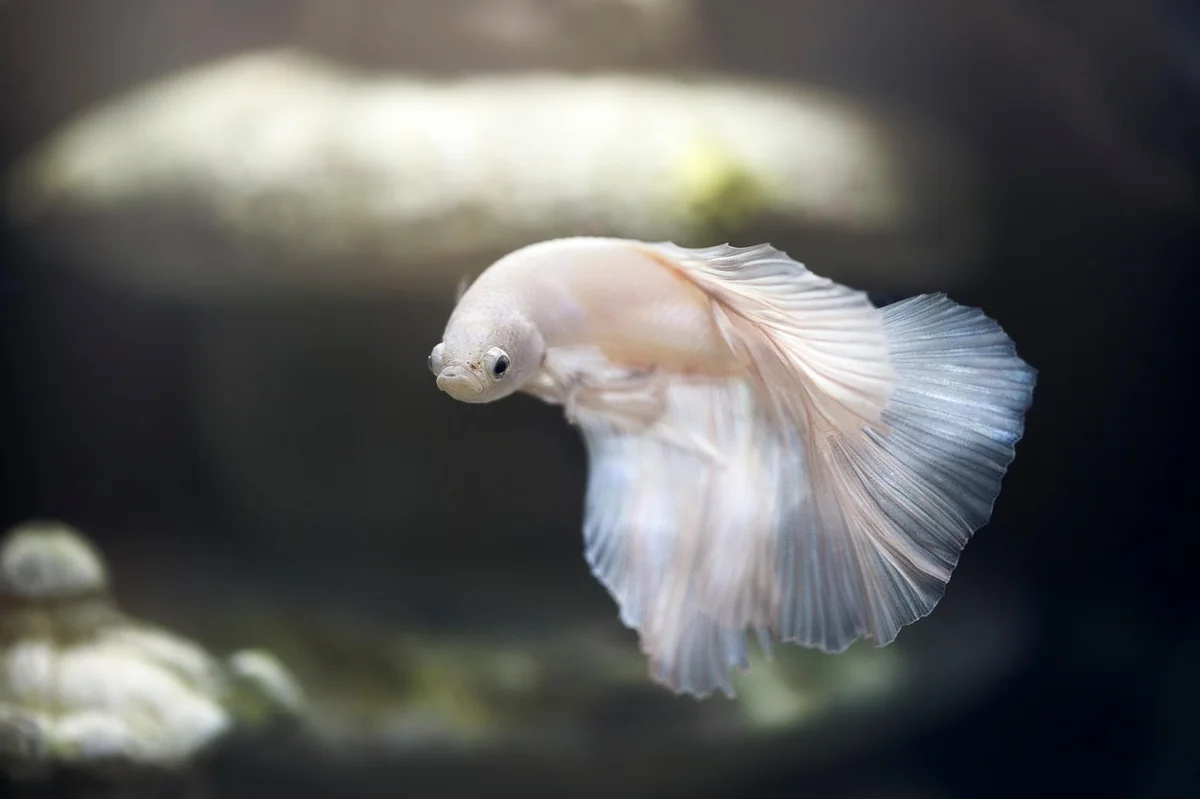
Bettas evolved in still, shallow waters and have large, drag-heavy fins. Strong filter current pushes them around, exhausts them, prevents resting, can damage fins, and destroys bubble nests. A betta constantly fighting current shows the same stress as glass surfing or clamped fins. So you want enough filtration with the least possible flow.
Best Filter Types for Bettas (Ranked)
| Filter | Why | Verdict |
|---|---|---|
| Sponge filter (air-driven) | Gentle, great biological media, fry-safe, cheap | ✅ Best for most bettas |
| Adjustable internal filter (low setting) | Controllable flow, decent media | ✅ Good if flow turns low |
| Hang-on-back (HOB), baffled | Good filtration but strong flow — must baffle | ⚠️ Only with a baffle |
| Strong HOB / powerhead, un-baffled | Far too much current | ❌ Stresses/harms betta |
A dual sponge filter on a quiet air pump is the lowest-risk, lowest-stress option for almost every betta setup — and it doubles as the safe choice for a fry/breeding tank.
How to Baffle a Too-Strong Filter (DIY)
If you already own a stronger filter, you don’t have to replace it — baffle it:
- Foam/sponge on the outflow: slip a piece of filter foam over the output nozzle to disperse the stream.
- Filter-floss stuffing: pack floss in the outflow chamber to slow water velocity.
- Water-bottle baffle: a cut plastic bottle clipped over the outflow spreads and softens the flow (a classic Aquarium Co-Op trick).
- Aim at the glass: point the outflow at the tank wall so the current breaks before reaching the betta.
- Lower the water level slightly for HOBs so the “waterfall” is shorter and gentler.
You’ll know it’s right when the betta swims calmly anywhere in the tank, fins relaxed, and can rest without being pushed around.
How to Choose a Betta Filter: Buying Criteria
- Gentle/adjustable flow: the top priority. Either inherently low-flow (sponge) or a model with a real flow control valve.
- Adequate biological media: the filter must hold enough sponge/bio media to host the bacteria for your tank size — biology over horsepower.
- Right capacity for the tank: a 3–10 gallon betta tank doesn’t need a 200 GPH canister; it needs steady, gentle turnover.
- Quiet operation: for a sponge filter that means a quiet air pump with an adjustable valve; for HOB/internal, a smooth motor.
- Fry/safety considerations: sponge filters won’t suck in fry or trap fins — important for breeders and long-finned bettas.
- Easy media access: you’ll rinse media in old tank water regularly, so pick a filter that opens without a fight.
Choosing the Best Filter for a Betta Tank: Recommended Models & Air Pumps
These are real, widely recommended low-flow filters and the air pumps that drive sponge filters quietly. Pick a filter type, then the matching pump if it’s air-driven.
| Product | Type | Best for | Notes |
|---|---|---|---|
| Aquarium Co-Op / Hygger Sponge Filter | Air-driven sponge | Best overall betta filter | Very gentle, strong bio media, fry-safe, cheap; needs an air pump + airline + check valve |
| Aquarium Co-Op USB Nano Air Pump | Air pump | Best quiet pump | Near-silent, adjustable, USB; ideal partner for a sponge filter in a bedroom tank |
| Tetra Whisper Air Pump | Air pump | Best budget pump | Inexpensive and reliable; pair with an adjustable valve to fine-tune sponge bubble rate |
| AQUEON QuietFlow Internal (with flow control) | Internal filter | Best adjustable internal | Turn flow to minimum; decent media; good if you want a tidy in-tank unit, not air-driven |
| Fluval Spec / Flex Built-in Filter | Integrated (kit tank) | Best built-in for kit tanks | Comes with the tank; usually needs a flow baffle or pre-filter sponge for a betta |
| Seachem Tidal 35 (HOB) | Hang-on-back | Best HOB if you must use one | Adjustable flow + surface skimmer; still baffle the return with a sponge for a long-finned betta |
Editorial picks: Best overall — Aquarium Co-Op / Hygger sponge filter on an Aquarium Co-Op USB nano pump. Best budget — same sponge with a Tetra Whisper pump and an adjustable valve. Best non-air option — Aqueon QuietFlow internal on its lowest setting. Best HOB (baffled) — Seachem Tidal 35.
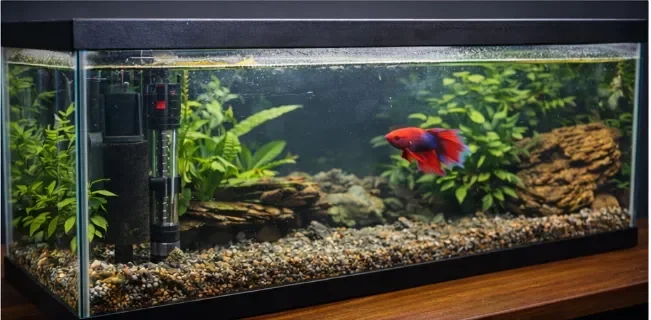
Sponge Filter Sizing & Air-Flow Specifics
- Match sponge to tank: use a sponge filter rated at or slightly above your tank volume (a “10–20 gallon” sponge in a 5-gallon tank gives extra bio capacity and even gentler bubbling).
- Air pump output: you don’t need a powerful pump — you need a quiet one with an adjustable valve so you can dial the bubbles down to a soft simmer, not a rolling boil.
- Check valve: always fit a one-way check valve on the airline to stop back-siphon if the pump stops or loses power.
- Bubble rate: set it just high enough to lift water through the sponge and ripple the surface — more than that is unnecessary current.
Filter Maintenance (Don’t Kill Your Cycle)
- Never replace all media at once — it lives there. Rinse sponge media gently in old tank water, not tap (chlorine kills bacteria).
- Skip carbon if you may medicate (it removes meds — see medication guide).
- Keep the air pump quiet with an adjustable valve; check airline/sponge monthly.
- Pair filtration with routine partial water changes (how often to clean).
- Squeeze the sponge in old tank water every 2–4 weeks so it doesn’t clog and lose flow.
Dos and Don’ts
| Do | Don’t |
|---|---|
| Run a sponge filter or adjustable low-flow filter | Run an un-baffled strong HOB or powerhead |
| Baffle a too-strong filter with foam or a bottle | Blast the betta with full filter flow |
| Rinse media in old tank water | Rinse media under chlorinated tap water |
| Fit a check valve on the airline | Skip the check valve and risk a back-siphon |
| Keep some old media when upgrading | Swap out all media at once and crash the cycle |
The Two Jobs of a Filter, and Why Bettas Split Them Apart
Almost every filtering mistake with bettas comes from not realising a filter does two separate jobs, and that a betta wants the maximum of one and the minimum of the other. Once that split is clear, every recommendation in this guide becomes obvious.
The first job is biological filtration. The filter is a home for beneficial bacteria that convert toxic ammonia to nitrite and then to far less toxic nitrate — the nitrogen cycle. This is non-negotiable. Without it, a betta sits in steadily accumulating ammonia and is being slowly poisoned unless the owner performs exhausting daily water changes. Biological capacity is about how much media (surface area for bacteria) the filter holds, sized to the tank’s waste load. A betta wants this part to be robust.
The second job is water movement. Pushing water through media inevitably creates flow and turnover in the tank. For most community fish, more flow is broadly fine or even desirable. For a betta it is the opposite: bettas evolved in still, shallow water and carry large, drag-heavy fins, so current actively works against them. A betta wants this part minimised.
The usual hobby instinct — “buy the most powerful filter you can” — optimises the wrong variable for this species. It maximises flow (bad for a betta) on the assumption that more flow means more filtration (not necessarily true; filtration capacity is about media, not current). The correct mental model for a betta is therefore: full biological filtration, least possible flow. Every type ranking, every baffle technique, and the entire case for sponge filters is just that single principle applied. You are not choosing a weak filter; you are choosing one that delivers strong biology with gentle water movement, which is a different thing entirely.
Exactly How Flow Harms a Betta
“Flow is the enemy” is repeated everywhere, but understanding the specific damage makes keepers actually act on it rather than treating it as a vague preference.
Start with the body. A betta — especially a fancy long-finned variety — trails large fins that behave like sails. The same finnage that makes it beautiful makes it a poor swimmer against current; the drag is enormous relative to the fish’s muscle. In strong flow the betta is either pushed around the tank against its will or has to swim continuously just to hold position. That is exhausting in a way it is not for a streamlined community fish, and the betta cannot simply rest, because the moment it stops swimming the current moves it.
That exhaustion cascades into health. A fish that cannot rest is chronically stressed, and chronic stress suppresses the immune system, which is the common pathway into opportunistic disease like fin rot and ich. The flow itself can also physically stress and contribute to fin damage, and torn fins in turn invite infection. Behaviourally, a flow-stressed betta shows the same signals owners ask about under other names — restless pacing, glass-surfing, clamped fins, hiding from the current — so a “behaviour problem” is frequently just an unaddressed flow problem.
There is also a reproductive and natural-behaviour cost. Male bettas build surface bubble nests; meaningful surface agitation from a strong outflow destroys these repeatedly, denying a natural behaviour and adding frustration. Put together, excessive flow is not a comfort nicety — it is a direct, multi-route stressor that shortens lives and drives the exact symptoms keepers spend money trying to treat downstream. The cheapest treatment for a long list of betta problems is often simply reducing the current.
Choosing the Right Filter Type, With the Reasoning
The ranking in this guide is not arbitrary; each type’s position follows directly from the “max biology, min flow” principle.
Air-driven sponge filter — the default best choice
A sponge filter is lifted by air bubbles rather than a motorised impeller, so it produces very gentle water movement by design — you physically cannot blast a betta with a properly run sponge filter. At the same time the sponge itself is excellent biological media with large bacterial surface area. It is also fry-safe (nothing to suck in small fish or trap fins) and inexpensive. It maximises the job a betta wants maximised and minimises the one it wants minimised, which is exactly why it is the recommended default for almost every betta and the standard choice for breeding and fry tanks.
Adjustable internal filter on its lowest setting
A motorised internal filter with a genuine flow-control valve can be acceptable because the flow is controllable down to a low level while still cycling water through media. It is a reasonable pick for someone who wants a tidy in-tank unit and no air pump, provided the flow is actually turned to minimum and confirmed gentle at the fish.
Hang-on-back filter — only when baffled
A typical HOB provides good filtration but a strong return flow and a “waterfall” that is far too much for a betta out of the box. It is acceptable only with the flow tamed by baffling. It works, but it requires the extra step and should never be run un-modified on a betta.
Strong HOB or powerhead, un-baffled — avoid
This maximises exactly the variable a betta wants minimised. Un-baffled high-flow equipment subjects a long-finned betta to continuous current it cannot escape and is a direct, ongoing stressor. It is the wrong tool for the species.
Read top to bottom, the list is simply “how gentle is the water movement, holding biological capacity adequate?” — which is the only question that matters for filtering a betta.
How to Baffle a Filter You Already Own — Step by Step
Many keepers arrive here with a too-strong filter already running, often from an all-in-one kit. The good news is that replacing it is usually unnecessary; the flow can be tamed cheaply. Work through these from simplest to most involved and stop when the betta is comfortable.
- Redirect the outflow first. The zero-cost starting move: aim the return at the tank glass or along the back wall so the stream breaks against the surface and dissipates before it reaches the betta’s swimming area. Sometimes this alone is enough.
- Add a foam/sponge cap on the output. Slip a piece of aquarium filter foam (or a pre-filter sponge) over the outflow nozzle. It disperses a concentrated jet into a soft, diffuse spread. As a bonus this adds extra biological surface and protects against intake hazards.
- Stuff filter floss in the outflow chamber. Loosely packing filter floss in the return chamber slows water velocity before it exits. Easy to adjust — add or remove floss until the flow is right.
- Build a water-bottle baffle. A cut plastic bottle clipped or fitted over an HOB outflow spreads and softens the “waterfall” dramatically — a long-standing, effectively free fix for strong hang-on-back filters.
- Lower the water level slightly (HOB only). Reducing the drop height between the filter lip and the water surface shortens and gentles the waterfall and its agitation. Useful as a fine-tune on top of the above.
- Confirm against the fish, not the equipment. The success test is behavioural: the betta should be able to swim calmly anywhere in the tank with fins relaxed, and rest without being pushed around, and any surface bubble nest should be able to hold together. If the fish is still fighting current, add more baffling.
The guiding idea is that the betta’s behaviour is the only meaningful flow meter. Keep stacking these cheap interventions until the fish is visibly relaxed; that point, not any spec on the filter box, defines “enough.”
Filter Maintenance That Doesn’t Crash the Cycle
The most damaging filter mistake after “too much flow” is cleaning the filter wrong and accidentally killing the bacteria colony, which silently undoes the entire reason the filter exists. The rules follow directly from the fact that the filter is the biological system, not just a mechanical strainer.
Never deep-clean or replace all the media at once. The beneficial bacteria live on the sponge and media; sterilising or wholesale-replacing it removes the colony and effectively returns the tank to uncycled, triggering an ammonia spike the betta then has to survive. Instead, rinse media gently in old tank water removed during a water change — never under the tap, because tap-water chlorine kills the bacteria you are trying to preserve. When media genuinely wears out, replace it partially and gradually so an established colony always remains to seed the new material; the same logic applies when upgrading filters (keep some old media running alongside the new one).
Two more practical points. Skip carbon if there is any chance you will medicate the tank, because activated carbon strips medication out of the water and wastes the treatment. And keep the sponge functioning: squeeze it out in old tank water roughly every couple to four weeks so it does not clog — a clogged sponge both loses biological efficiency and, on motorised units, can change flow behaviour. Filtration only works paired with routine partial water changes; the filter converts ammonia and nitrite to nitrate, but nitrate still accumulates and is exported by water changes, so the filter and the maintenance schedule are two halves of one system, not alternatives.
Common Betta Filtration Mistakes (and the Fix)
Most filter problems with bettas reduce to a short list of recurring errors, each tied to a principle above.
- Buying the most powerful filter “to be safe.” This optimises flow, the variable a betta wants minimised. Fix: choose for adequate media with gentle movement — a sponge filter by default.
- Running a kit or HOB filter at full force. The single most common cause of an unexplained stressed, pacing, clamped-fin betta. Fix: baffle it until the fish is visibly calm.
- Running no filter at all. “Bettas can live in bowls” leads people to skip filtration entirely, leaving the fish in accumulating ammonia. Fix: a gentle filter plus the nitrogen cycle, not heroic daily water changes.
- Rinsing media under the tap. Chlorine sterilises the bacteria colony; the tank silently goes uncycled. Fix: rinse only in old tank water.
- Replacing all media at once. Throws out the entire biological filter in one move. Fix: partial, gradual media replacement; keep old media when upgrading.
- No check valve on a sponge filter’s airline. If the pump stops or power fails, tank water can back-siphon down the airline into the pump. Fix: always fit a one-way check valve.
- Judging flow by the spec sheet instead of the fish. “It’s only rated low GPH” is irrelevant if the betta is being pushed around. Fix: tune flow to the fish’s visible comfort, not the box rating.
- Letting the sponge clog. Reduces biological efficiency and changes flow. Fix: a gentle squeeze-out in old tank water every few weeks.
Every item on this list is the same lesson in a different form: a betta filter must deliver strong biology with the gentlest possible current, be cleaned in a way that preserves the bacteria, and be judged by how relaxed the fish is — not by horsepower on the packaging.
The filter is one essential on the full betta starter kit checklist. Pair gentle filtration with the right betta tank and a correctly sized heater for a stable, low-stress home.
Sources & Further Reading
Aquarium Co-Op — How to Slow the Flow / DIY Filter Baffle; NippyFish — reduce filter current; ModestFish — best betta filters; Bettaboxx — best filter for a betta.
Frequently Asked Questions
What is the best filter for a betta tank?
An air-driven sponge filter on a quiet adjustable air pump — gentle flow, strong biological filtration, and cheap. It suits almost every betta setup.
Do betta fish need a filter?
Yes — a filter hosts the beneficial bacteria that process toxic ammonia and nitrite. The key is choosing a gentle, low-flow filter.
Why is filter flow bad for bettas?
Bettas have heavy fins and evolved in still water. Strong current exhausts them, stresses them, can tear fins, and destroys bubble nests.
How do I reduce my betta filter’s flow?
Baffle the outflow with foam, filter floss, or a cut water bottle, aim it at the glass, or lower the water level slightly for HOB filters.
Are sponge filters good for bettas?
Yes — they’re the top recommendation: gentle, effective biological media, fry-safe, and inexpensive.
How do I clean a betta filter without restarting the cycle?
Rinse sponge/media gently in old tank water (never chlorinated tap), and never replace all media at once — the beneficial bacteria live in it.
Can a betta live without a filter?
Only with exhausting daily water changes to control ammonia. A gentle filter is far safer and easier — strongly recommended.
What size sponge filter for a 5-gallon betta tank?
Use one rated at or slightly above your tank size — a “10–20 gallon” sponge in a 5-gallon tank adds bio capacity and bubbles even more gently. Pair it with a quiet, adjustable air pump.
Do I need a check valve on a betta sponge filter?
Yes. A one-way check valve on the airline prevents tank water back-siphoning into the pump if the power goes out or the pump stops.
How often should I clean a betta sponge filter?
Squeeze it out in old tank water every 2–4 weeks so it doesn’t clog and lose flow. Never deep-clean it in tap water — that kills the beneficial bacteria.
Disclosure: This article contains affiliate links. As an Amazon Associate I earn from qualifying purchases. If you buy through these links, bettafishh.com may earn a commission at no extra cost to you. We only recommend products we genuinely believe are good for your betta. See our full disclaimer.