
Rare betta fish are almost all ordinary Betta splendens in colors that are hard to breed true. True purple, solid melano black, pure white, stable green and clean orange or yellow are the ones most often named. A label is not proof, though. Plenty of fish sold as rare are simply uncommon this month, and one of the rarest of all, the albino, is a color good breeders avoid. This guide covers which colors really are rare, why, what they cost and how to buy one without overpaying.
The Rarest Betta Colors and Why They Are Rare
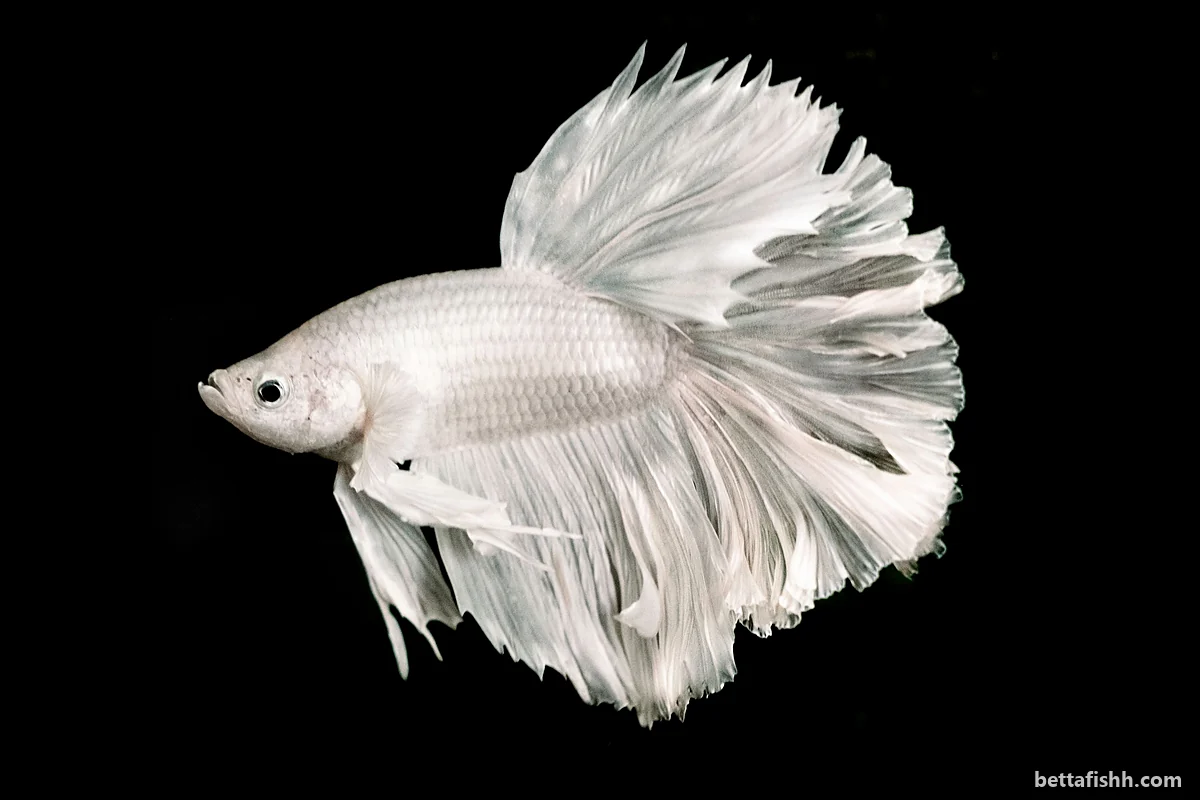
Colors in a betta come from stacked layers of pigment and reflective cells. A color becomes rare when those layers are hard to line up, or when the gene behind it causes problems in breeding. The white fish at the top of this page shows the look buyers want in a platinum: a pearly body and pale fins with no colored patches.
| Color | Why it is rare | What to check |
|---|---|---|
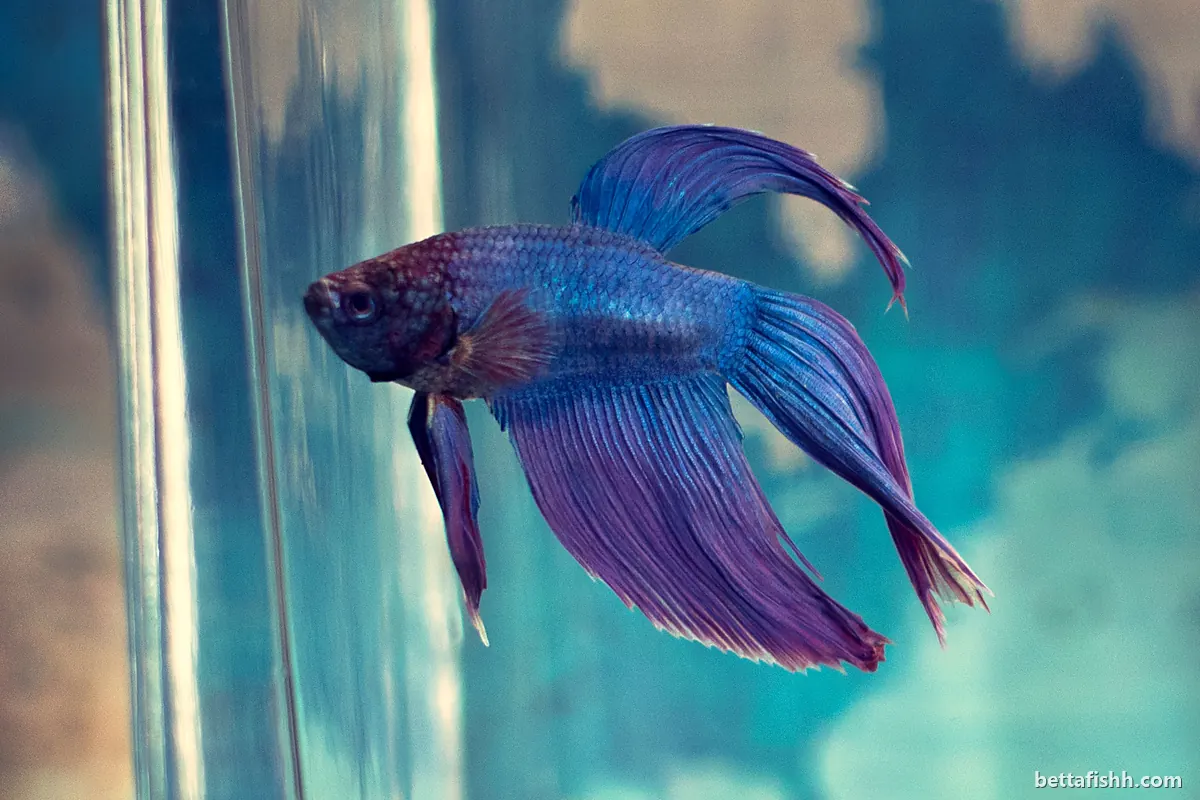
| True purple | Bettas have no purple pigment. It comes from blue iridescence over red | Most “purple” fish are lavender, mauve or copper-violet, and may look different in other light |
| Albino | Needs a complete lack of melanin, plus pink or red eyes | Avoid. Light-sensitive eyes can lead to vision loss, and ethical breeders will not produce them |
| Melano black | Melano females are frequently infertile, so lines are hard to continue | The deepest black with little shine. A dark steel or blue fish is not a melano |
| Platinum or pure white | Opaque white is unstable, and the marble gene can add patches | A white fish can develop color months later |
| Green | There is no green pigment. It comes from blue reflecting over a yellow or dark base | Turns turquoise or blue under some lights |
| Solid orange | The genes are recessive, and marbling has to be bred out | Look for dark blotches, which can appear as it ages |
| Solid yellow | Recessive, and takes generations to remove red and black | True lemon with no flecks is the hard part |
The fish below shows what many sellers mean by purple. Its body is mostly blue, and the violet appears in the long fins, because this color comes from light reflecting over red rather than from a purple pigment. It may look bluer or redder as the light changes. A true, even purple across the whole fish is far harder to find.
Rare Patterns and Named Varieties
These names describe a combination of colors or scales. They are uncommon rather than truly scarce, and like koi types they are seller names, so definitions shift from shop to shop.
| Variety | What it looks like |
|---|---|
| Black samurai | A metallic white or silver mask over a dark black body |
| Black orchid | A dark body with blue streaks, as sellers describe it |
| Mustard gas | Yellow fins with a blue or dark body, a striking bi-color |
| Rose gold | Metallic gold mixed with white and amber, most often on halfmoons |
| Orange dalmatian | Orange and gold with spots of red on the fins |
| Teal dragon scale | Teal and dark blue, with thick metallic scales |
| White opal | A white body with pastel shimmer that needs good light to show |
| Cellophane | A pale, nearly see-through body with dark eyes, often mistaken for an albino |
On that last one: cellophane is not among the rarest colors, but it is unpredictable to breed and can change with age. The eyes are the test, since an albino has pink or red eyes and a cellophane has dark ones. The wider picture of tails and patterns is in betta fish types and colors.
Are Rare Fin Types a Thing Too?
Yes, but with fins, rare is not always better. Very heavy types such as rosetails and feathertails carry so much fin that they can struggle to swim, and they tear easily. A hardy plakat or a well-formed halfmoon in an unusual color is usually a better buy than an extreme fin type. For popular types that often get called rare and are not, see koi betta and crowntail betta.
How Much Do Rare Bettas Cost?
| Where | Typical price | Notes |
|---|---|---|
| Pet store | Up to about $50 | Rarely a truly rare color, though surprises happen |
| Breeder or specialist exporter | About $40 to $80 | Shipping is extra; you often choose the exact fish from a photo |
| Top show or collector fish | Several hundred dollars and up | Priced on form and rarity together |
Those are from listings we checked in November 2026. One Thai breeder’s rare range was on sale at about $40 to $80. One Indonesian exporter’s listings ran from $19 into the low thousands, with most near $75. Breeders say the best colors appear in just a handful of fish from a spawn of several hundred fry, which is why a true show fish costs so much.
The most widely reported record is about 53,500 baht, roughly $1,500, paid in November 2016 for a plakat in the colors of the Thai flag. It sold in a Facebook auction group with an opening bid of 99 baht, and it was an unusual moment rather than a guide to value. A betta is not an investment: it lives only 3 to 5 years, and its colors may not last even that long.
How to Buy a Rare Betta Without Overpaying
- Ask what the label means. “Rare” has no official definition. Ask which color or line you are paying for, and compare a few sellers.
- Ask to see the exact fish. Good sellers photograph each one, in natural light if you ask. Heavy editing and blue lighting can create colors that are not really there.
- Ask about the marble gene. Whites, solid colors and anything with koi in its background may change. If your heart is set on a color, buy an adult.
- Check its health before its color. Look for clear eyes, intact fins and normal swimming. Signs of a healthy betta lists what to look for.
- Read the shipping terms. Long journeys are hard on fish, so look for a live arrival policy, and have the tank cycled and heated before it ships.
- Skip the albino. Buying one rewards breeding for a fish with poor eyesight.
Then quarantine it and introduce it gently, as with any new fish.
Do Rare Bettas Need Special Care?
No. Color changes nothing about what a betta needs, and an expensive fish in a bad tank declines just as fast as a cheap one:
- Size: 5 gallons is the minimum and 10 gallons is easier to keep stable. See the betta tank size guide.
- Heater: an adjustable heater holding 78–80°F, about 25 W for 5 gallons and 50 W for 10 gallons; see the best heater for a betta tank.
- Filter: a sponge filter or a baffled hang-on-back with gentle flow; see the best filter for a betta tank.
- Plants and decor: live plants or silk plants, and smooth decorations with no sharp edges.
- Lid: all bettas can jump.
- Cycle first: ammonia and nitrite should read 0 before the fish goes in. Follow how to set up a betta tank.
The one real exception is eyesight. A pale-eyed fish may struggle to find food, so feed it slowly and in the same spot. Long or heavy fins need a gentle current and soft decor. If a color fades after you bring the fish home, see why a betta loses color before you assume the seller misled you.
Rare Colors vs Rare Species
Everything above is about Betta splendens, which is bred in huge numbers. It is one of more than 75 species in the genus, and some of the others are genuinely hard to find. Betta mahachaiensis, for instance, is known from only a handful of brackish, coastal locations in central Thailand, and it needs conditions a normal betta tank does not provide. Wild-type bettas are for experienced keepers who can match those needs.
So are betta fish rare? In pet stores, no. In nature, wild Betta splendens is a different story, as the IUCN lists it as Vulnerable because of pollution and habitat loss. The fish in your local store are captive bred and have no effect on those wild populations.
Sources
A-Z Animals, Why Are Purple Bettas So Rare (color genetics, albino, melano, green, orange, yellow, white). Hepper, 8 Rare Betta Fish Colors (named varieties). Thailand Betta Fish and Rare Betta Fish Store (listed prices, November 2026). Khaosod English and New Straits Times, November 2016 (auction record). Seriously Fish, Betta mahachaiensis. Wikipedia, Siamese fighting fish (IUCN status). Bettafishh care standards.
Frequently Asked Questions
What is the rarest betta fish color?
True purple is usually named first, since bettas have no purple pigment. Pure albino is rarer still, but good breeders avoid it because of eye problems. Solid melano black, pure platinum white and stable green are also very hard to find.
What is the rarest type of betta fish?
Among pet bettas, it is a color rather than a type, such as a true purple. As species, wild bettas like Betta mahachaiensis, known from a handful of locations in Thailand, are far harder to find.
Are betta fish rare?
No. Betta splendens is one of the most widely sold aquarium fish. Wild populations are a different matter, as the IUCN lists the species as Vulnerable.
Are black bettas rare?
Solid melano black bettas are. Melano females are frequently infertile, which makes the line hard to keep going. Dark steel and blue-black fish are far more common.
Are cellophane bettas rare?
Not especially. They are uncommon and unpredictable to breed, but they are not among the rarest colors. They are often confused with albinos, so check the eyes: a cellophane has dark eyes.
Do albino bettas exist?
Yes, but they are very rare. A true albino has no melanin at all and has pink or red eyes. Those eyes are sensitive to light and can lose their sight, so ethical breeders do not produce them.
What is the most expensive betta fish?
The most widely reported sale is about 53,500 baht, roughly $1,500, paid in 2016 for a plakat in the colors of the Thai flag. Most rare bettas from breeders cost about $40 to $80.
Do rare bettas need different care?
No. They need the same 5 gallons or more, 78–80°F water, gentle filtration and varied diet as any other betta. Fish with heavy fins or poor eyesight just need a little extra gentleness.