
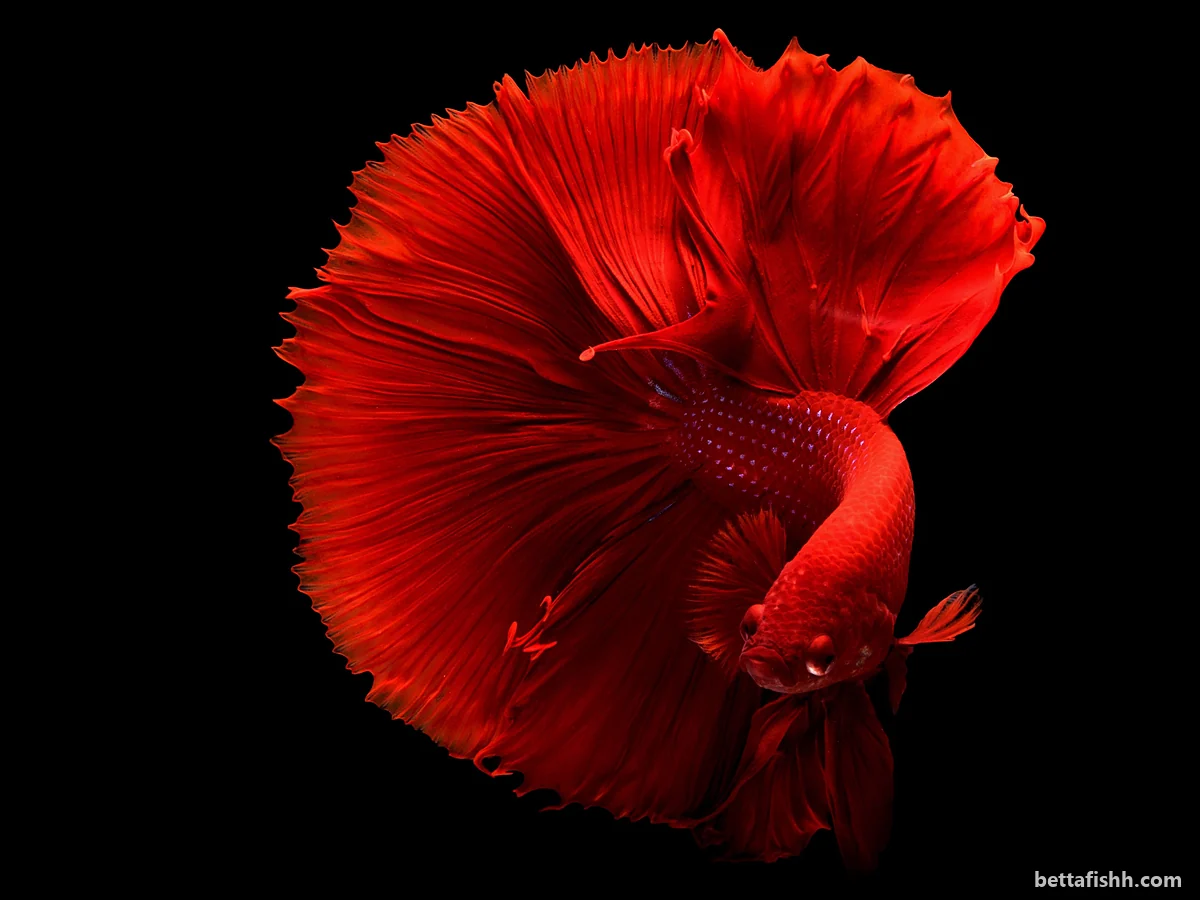
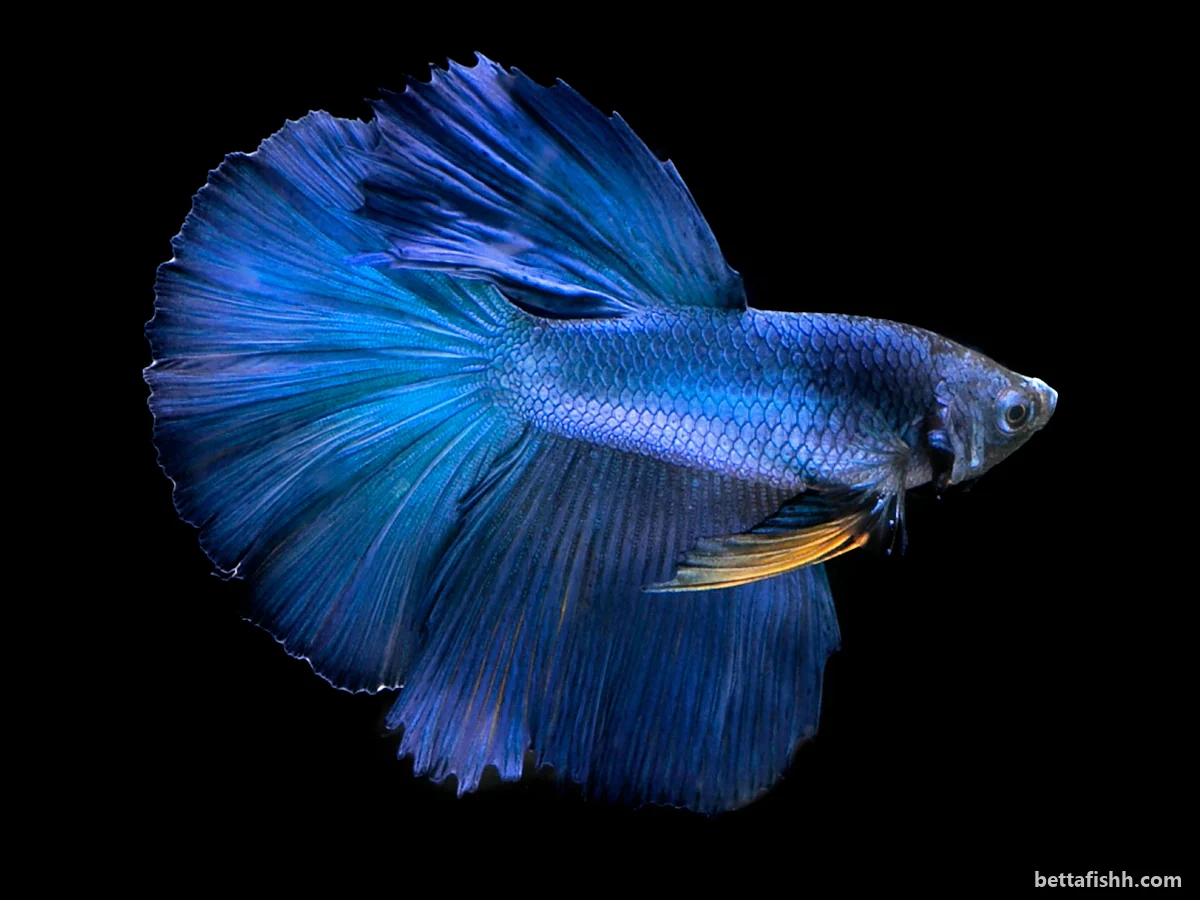
A halfmoon betta is the show star of the betta world. When it flares, its tail opens into a clean half circle, a full 180 degrees from top to bottom, and the effect is hard to beat in a planted tank. That spectacular tail also makes it heavier and more delicate than most bettas. This guide shows how to tell a true halfmoon from the similar types, how it compares with plakats, veiltails and crowntails, how to sex one, and how to keep those fins intact.
Halfmoon Betta at a Glance
| Halfmoon betta | |
|---|---|
| Species | Betta splendens (a tail type, not a separate species) |
| Adult size | About 2.25 to 3 inches including the tail |
| Lifespan | 3 to 5 years with good care (see betta lifespan) |
| Tank size | 5 gallons minimum; 10 gallons is easier to keep stable |
| Temperature | 78–80°F (25.5–26.7°C) |
| Water | Ammonia 0, nitrite 0, nitrate 20 ppm or lower, pH 6.5–7.8 and stable |
| Diet | Carnivore: 2–3 soaked pellets once or twice a day, plus frozen treats |
| Temperament | Territorial; keep males alone |
| Biggest risks | Torn fins, tail biting and tiredness in strong flow |
The 180 Degree Test: Is It a True Halfmoon?
The name is a measurement. Watch the fish flare, then look at the angle between the top and bottom edges of the tail. Several types look alike, and many fish sold as halfmoons fall a little short. Sources differ slightly on the exact cut-offs, so treat these as a guide:
| Type | Tail spread when flaring | How to spot it |
|---|---|---|
| Delta | Clearly under 180 degrees | A triangle shape, narrower toward the body |
| Super delta | Close to 180 degrees, but not quite | Looks like a halfmoon with the corners cut off |
| Halfmoon | A full 180 degrees | Straight top and bottom edges form a D shape |
| Over-halfmoon | More than 180 degrees | The tail wraps slightly past the half circle |
| Rosetail | About 180 degrees or more, with extra branching | Ruffled, feathery edges from heavy ray branching |
Do not judge a young fish too soon. Many halfmoons do not show their full spread until about 4 to 6 months old, and a resting fish folds its tail, so wait for a flare before you decide.
Halfmoon vs Plakat, Veiltail and Crowntail
| Compared with | The main difference | Choose it if |
|---|---|---|
| Plakat | Plakats have short, tough fins; a short-finned fish with a 180 degree tail is a halfmoon plakat (HMPK) | You want an active fish that is less prone to fin damage |
| Veiltail | A veiltail’s tail droops and is uneven; a halfmoon’s stands out in an even fan | You want a low-cost, easy-to-find fish |
| Crowntail | A crowntail has reduced webbing and spiky edges; a halfmoon has full webbing and smooth edges | You like the spiky look and will be careful with decor |
Care is the same for all of them: the same water, temperature and food. The differences are in fin care and how strong a swimmer the fish is. For every tail type together, see betta fish types and colors.
Halfmoon Betta Male vs Female
Only males grow the full 180 degree show tail. A female halfmoon has a short tail that spreads into a small, rounded fan, so she can look very like a halfmoon plakat. Compare these signs on an adult:
| Sign | Male halfmoon | Female halfmoon |
|---|---|---|
| Tail | Large and long, opening to 180 degrees | Short, wide and rounded |
| Other fins | Long, full dorsal and anal fins | Short and neat |
| Egg spot | None in most fish | Small white dot behind the belly fins |
| Belly fins | Long and pointed | Shorter |
| Body | Longer and slim | Shorter and rounder, especially with eggs |
| Beard | Large; shows clearly when flaring | Small and often hidden |
The trickiest case is a short-finned male, because a young HMPK male can pass for a female. Check the egg spot and belly fins before you assume. The full method is in male vs female bettas, and care specifics are in the female betta fish guide.
Halfmoon Betta Colors and Types
Halfmoons come in nearly every betta color and pattern. Common listings include:
- Solid colors: red, blue, black, white and yellow.
- Butterfly: a solid body with color fading to a pale outer band on the fins, which shows off the tail shape well.
- Koi and marble: patches that can shift over months, thanks to the marble gene; see why is my betta losing color.
- Metallic and dragon scale: shiny or thick scales. Heavy scaling can cover the eyes in some lines, so check before you buy.
- Trade names: mustard gas and samurai are popular labels used by sellers.
- Double tail halfmoon: a tail split into two lobes, often with a shorter body, which needs small meals.
How to Protect Halfmoon Fins
A 180 degree tail is a lot of fin to carry. It adds drag, tires the fish on long swims, and tears more easily than short fins.
- Use very gentle flow. If the tail is pushed sideways, baffle the filter or switch to a sponge filter.
- Provide resting spots. A leaf or hammock near the surface lets the fish breathe without constant swimming.
- Choose smooth decor. Use the pantyhose test on every ornament, and avoid hard plastic plants.
- Limit long flaring. Short flares are fine, but block constant reflections and keep other bettas out of sight; see why is my betta flaring.
- Watch for tail biting. Big-tailed fish may bite their own fins when stressed or bored. A clean gap that stays the same size points to biting.
- Keep the water clean. Dark edges or a tail that gets shorter over a few days points to fin rot.
Halfmoon Betta Tank Setup
- Size: 5 gallons is the minimum and 10 gallons is easier to keep stable. Choose a long tank with a low water line if you can, because the fish has to swim to the surface for air. See the betta tank size guide.
- Heater: an adjustable heater holding 78–80°F, about 25 W for 5 gallons and 50 W for 10 gallons; see the best heater for a betta tank.
- Filter: a sponge filter or a baffled hang-on-back. Long fins act like a sail, so the current should be barely visible; see the best filter for a betta tank.
- Plants and decor: live plants or silk plants and smooth decorations only. If nylon snags on an item, it will catch a fin.
- Lid: all bettas can jump.
- Cycle first: ammonia and nitrite should read 0 before the fish goes in. Follow how to set up a betta tank.
Change 25–30% of the water each week in a 5-gallon tank, or 20–25% in a 10-gallon, with dechlorinated, temperature-matched water.
Feeding a Halfmoon Betta
Feed 2–3 soaked pellets once or twice a day, and add frozen bloodworms, brine shrimp or daphnia a couple of times a week. A heavy tail makes a bloated fish even clumsier, so do not overfeed. Portions are in how many pellets to feed a betta and food choices in best betta fish food.
Halfmoon Temperament and Tank Mates
Halfmoons are as territorial as other bettas, so never keep two males together. In a mixed tank, the big tail is a handicap: the fish is slow, and fin nippers treat it as a target. A nerite snail is the safest companion in 5 gallons or more. Shrimp need at least 10 gallons, and small peaceful schooling fish need 15–20 gallons or more. See the best tank mates for betta fish.
Is a Halfmoon Betta Good for Beginners?
Yes, if you plan around the fins. The water care is simple, but this type is less forgiving of strong filters and rough decor than a plakat. Set up the tank first, and read the beginner betta care mistakes before you buy.
Sources & Further Reading
Hepper, Halfmoon Betta (180 degree tail, price, color names); Gensou, Platinum Halfmoon Betta Care Guide and Fancy Betta Varieties Guide (drag, age of full spread, tail types); Build Your Aquarium, The Half-Moon Betta Fish; Thailand Betta Fish, halfmoon grades. Sources differ on lifespan, temperature and how far an over-halfmoon spreads; the figures here follow this site’s care standards.
Frequently Asked Questions
What makes a betta a halfmoon?
Its tail opens to a full 180 degrees when it flares, with straight top and bottom edges that form a D shape. If the spread is clearly less, it is a delta or super delta.
Are halfmoon bettas aggressive?
Yes, as much as other bettas. Males are territorial and must be kept apart. Individual fish vary, and their big tails make them slow, so they often lose out to fast or nippy tank mates.
Are halfmoon bettas rare?
No. They are widely sold in pet stores and online. Particular colors and high-grade show fish are harder to find and cost more.
How much does a halfmoon betta cost?
Usually about $8 to $40 in stores and online, depending on sex, color and seller. Show-grade fish from specialist breeders cost far more.
How long do halfmoon bettas live?
About 3 to 5 years with good care, the same as other bettas. Clean, warm water and a varied diet make the biggest difference.
Are HMPK and halfmoon the same?
Not quite. HMPK means halfmoon plakat: a short-finned fish with the same 180 degree tail shape. A standard halfmoon has long fins.
Do female bettas have halfmoon tails?
They have the same genetics, but the fins stay short, so the result is a small, rounded fan rather than the long show tail of a male.
Why is my halfmoon betta always resting?
A big tail is tiring, so some rest is normal, especially near the surface. If the fish also hides, clamps its fins or stops eating, test the water and check the signs of stress.