
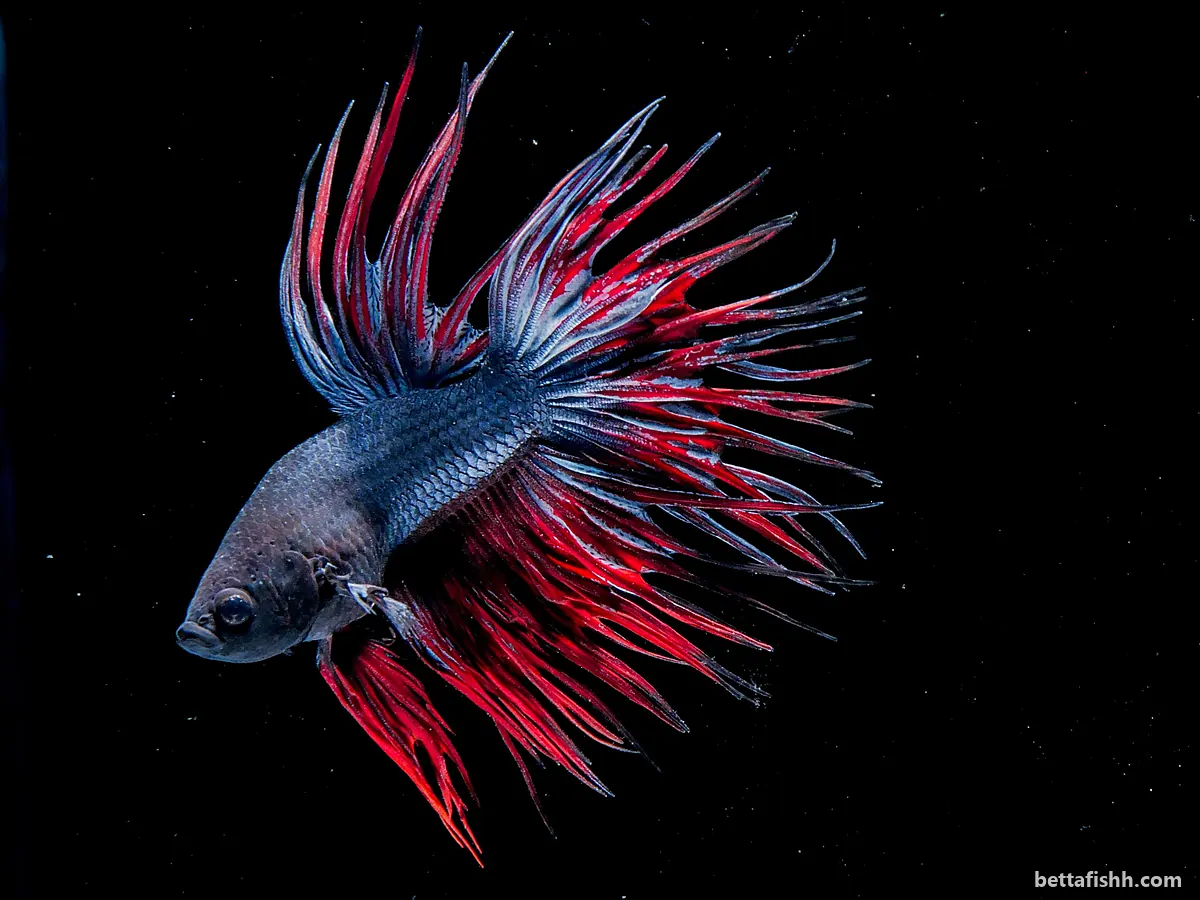
A crowntail betta, also sold as a crown tail fighter fish, is the spiky one in the betta aisle: its fins end in sharp points, as though someone cut a crown into the edge of the tail. Those points are the fin rays left bare by reduced webbing. They make the crowntail one of the most striking bettas you can buy, and also one of the fussiest about decor. This guide explains what makes the fins, the ray types and colors, how to tell a female from a male, and how to keep those rays in good shape.
Crowntail Betta at a Glance
| Crowntail betta | |
|---|---|
| Species | Betta splendens (a fin type, not a separate species) |
| Adult size | About 2.25 to 3 inches including the tail |
| Lifespan | 3 to 5 years with good care (see betta lifespan) |
| Tank size | 5 gallons minimum; 10 gallons is easier to keep stable |
| Temperature | 78–80°F (25.5–26.7°C) |
| Water | Ammonia 0, nitrite 0, nitrate 20 ppm or lower, pH 6.5–7.8 and stable |
| Diet | Carnivore: 2–3 soaked pellets once or twice a day, plus frozen treats |
| Temperament | Territorial; keep males alone |
| Biggest risk | Snagged or torn rays from rough decor, nipping fish or strong flow |
What Makes a Crowntail Betta Different?
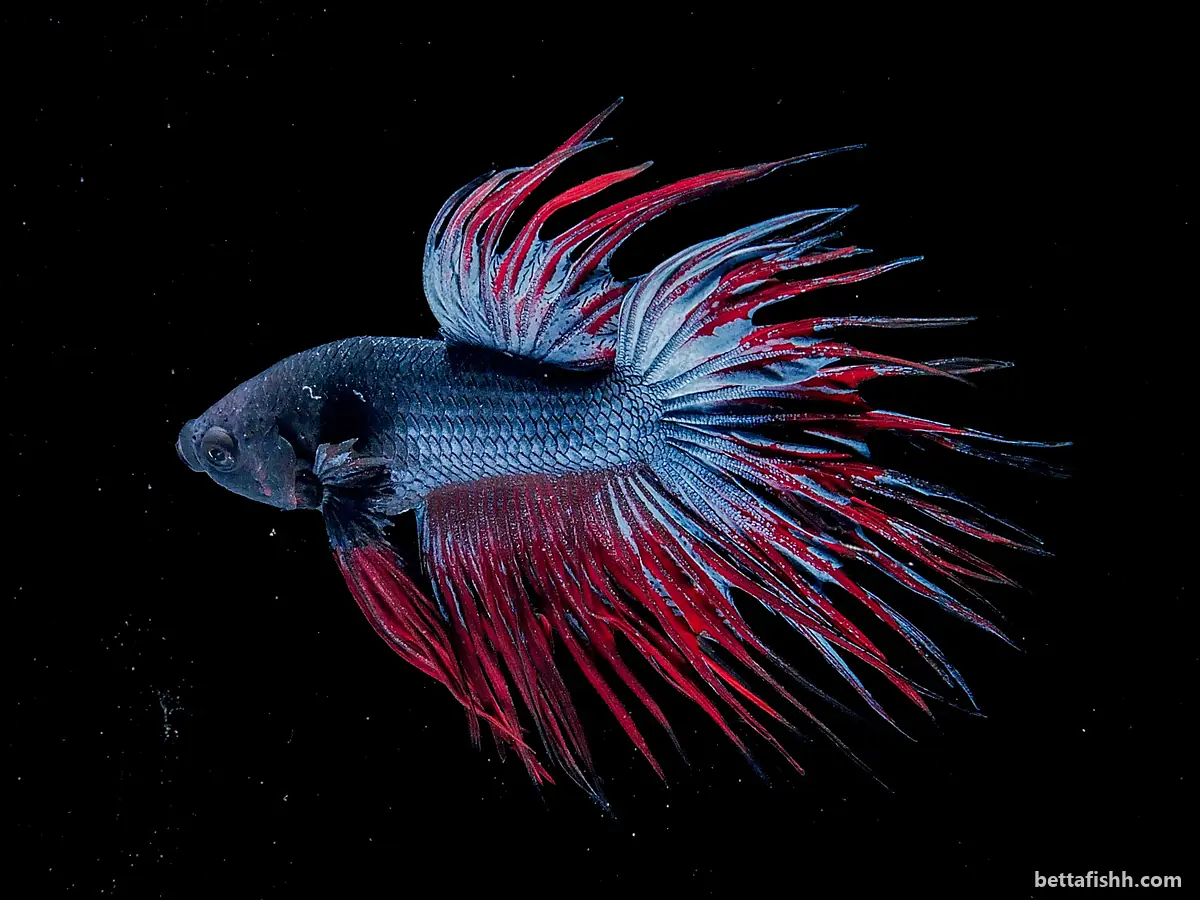
Every betta fin is built from thin rays joined by a clear membrane called webbing. In a crowntail the webbing stops short, so the rays carry on past it as bare spikes. The effect shows most on the tail, but the dorsal and anal fins have it too. Well-bred fish have even, evenly spaced rays, and the tail can spread wide when the fish flares.
The type is a modern one. Hobby accounts usually credit Indonesian breeder Achmad Yusuf with establishing it in the late 1990s under the name “Cupang Serit” (cupang is the Indonesian word for betta). Other writers point to older mentions of similar fish, so the exact origin is not settled. What is certain is that crowntails are a captive-bred line, not a wild form. See betta fish types and colors for how they compare with the other tail types.
Crowntail Ray Types
Breeders and sellers grade crowntails by how each ray splits at the tip. You will see these names in listings:
| Type | What the rays do | Look |
|---|---|---|
| Single ray | Each ray ends in one point | Simple, comb-like edge |
| Double ray | Each ray splits once into two points | Fuller, more even crown |
| Triple ray | Rays split into three points | Dense, detailed edge |
| Crossed ray (king crowntail) | Rays cross over one another | A lattice look at the fin edge |
| Crowntail plakat | Short fins with the same spiky edge | Compact; see the plakat betta guide |
For a pet, ray count matters far less than a healthy fish with straight rays and no curled or broken tips. Grades mostly affect price and show results.
Crowntail Betta Male vs Female
Female crowntails do exist, and their rays are easy to see, so the spiky edge alone does not tell you the sex. Compare these signs on an adult fish:
| Sign | Male crowntail | Female crowntail |
|---|---|---|
| Tail and fins | Long, with dramatic rays | Short, with shorter rays that still stick out past the webbing |
| Egg spot | None in most fish | Small white dot behind the belly fins |
| Body | Longer and slim | Shorter and rounder, especially with eggs |
| Beard | Large; shows clearly when flaring | Small and often hidden |
| Color | Usually deeper | Can be bright but is often a little paler |
| Bubble nest | Common | Rare, though some females build small ones |
Young males can have short fins, so a small fish in a store may not stay that way. The full method is in male vs female bettas, and care specifics are in the female betta fish guide.
Crowntail Betta Colors
Crowntails come in most betta colors. Shades of red and blue are the ones you will see most often in stores, and specialist sellers offer the rest:
- Solid and metallic: red, blue, black and white, with steel or metallic shine on some fish.
- Black orchid and black venom: very dark fish, mostly from specialist breeders.
- Multicolor and bi-color: two or more colors, often a contrast between body and fins.
- Koi and marble: patches that can change as the fish ages. This is the marble gene at work; see why is my betta losing color.
- White dragon: a thick, pale layer of scales over the body, also from specialist breeders.
How to Protect Crowntail Fins
This is the part of crowntail care that really differs from other bettas. The rays have little webbing to support them, so they snag easily, and a damaged ray may regrow bent or not as long as before. Prevention is much easier than repair.
- Use soft decor only. Choose live or silk plants and smooth caves. Do the pantyhose test: rub nylon over an item, and if it snags, it will catch a ray too. See best betta tank decorations.
- Keep the flow gentle. Use a sponge filter or a baffled hang-on-back, and put a leaf or hammock near the surface for resting.
- Avoid fin nippers. Those long spikes tempt tetras, barbs and other nippers.
- Reduce boredom and stress. Some crowntails bite their own tails. Add plants and hides, and remove mirrors or strong reflections that keep the fish flaring.
- Keep the water clean. Clean water helps damaged fins regrow and prevents infection. Keep up weekly water changes and test for ammonia and nitrite.
Normal Crowntail Fins or Fin Rot?
New owners often mistake a healthy crowntail for a sick one, because spiky fins look ragged at first glance. Fin rot can also hide in a crowntail for the same reason. Compare what you see:
| What you see | Most likely | What to do |
|---|---|---|
| Even spikes all along the fin; color reaches the tips; same length week to week | Normal crowntail fins | Nothing |
| A single torn ray or a clean gap that stays the same size | Snag or tail biting | Check decor and stress; keep the water clean |
| Dark or pale edges, and fins getting shorter over a few days | Fin rot | Test the water and start fin rot treatment promptly |
| Rays curling inward with no other symptoms | Fin curl; water quality, genetics and age are the usual causes | Test the water and keep it stable; curl from genetics or age will not reverse |
A simple check is to take a photo of the fins every day for a few days. True fin rot visibly progresses, while an old snag holds steady.
Crowntail Betta Tank Setup
- Size: 5 gallons is the minimum and 10 gallons is easier to keep stable. A long tank beats a tall one, since a heavy-finned fish tires reaching the surface. See the betta tank size guide.
- Heater: an adjustable heater holding 78–80°F, about 25 W for 5 gallons and 50 W for 10 gallons; see the best heater for a betta tank.
- Filter: a gentle sponge filter suits crowntails best; see the best filter for a betta tank.
- Plants: broad, soft leaves near the surface give resting spots; see the best live plants for betta tanks.
- Substrate: fine, smooth sand or rounded gravel; see the best substrate for a betta tank.
- Lid: all bettas can jump.
- Cycle first: ammonia and nitrite should read 0 before the fish goes in. Follow how to set up a betta tank.
Change 25–30% of the water each week in a 5-gallon tank, or 20–25% in a 10-gallon, and match the temperature so the fish stays calm.
Feeding a Crowntail Betta
Feed 2–3 soaked pellets once or twice a day, and add frozen bloodworms, brine shrimp or daphnia a couple of times a week. Good protein supports fin regrowth, but extra food does not speed it up and only fouls the water. Portions are in how many pellets to feed a betta and food choices in best betta fish food.
Crowntail Temperament and Tank Mates
A crowntail behaves like any other betta: curious, territorial, and ready to flare at another betta or its own reflection. Never keep two males together. The extra care comes from the fins, because any fish that nips will treat those spikes as a target.
The safest choice is a nerite snail in 5 gallons or more. Shrimp need at least 10 gallons, and small peaceful schooling fish need 15–20 gallons or more, and only species that do not nip. See the best tank mates for betta fish for sizes and fish to avoid, and why is my betta flaring if your fish never stops displaying.
Is a Crowntail Betta Good for Beginners?
Yes, with one condition. The water care is the same as for any betta, so a first-time keeper can manage it, but you need to choose decor carefully and accept that the fins will not stay perfect forever. If you want a tougher, lower-risk fish, a plakat betta has short fins that resist damage. Whichever you pick, read the beginner betta care mistakes first.
Sources & Further Reading
Aquariadise, Crowntail Betta Care Guide (origin, decor); Hepper, Crowntail Betta (webbing, fin care); Tankarium, Crowntail Betta Fish (tank, decor, health); Thailand Betta Fish, crowntail grades and ray types. Sources differ on origin, lifespan and minimum tank size; the figures here follow this site’s care standards.
Frequently Asked Questions
Why does my crowntail betta look like it has ragged fins?
Spiky edges are normal in a crowntail, because the webbing stops short of the rays. Worry only if the edges darken or the fins get shorter over a few days, which points to fin rot.
Do crowntail fins grow back?
Often, but not always perfectly. In clean water a torn fin can regrow, though the new ray may be bent, shorter or uneven. Prevention with soft decor and gentle flow matters more than treatment.
Are there female crowntail bettas?
Yes. Females have the same reduced webbing with shorter rays. Look for a white egg spot, a rounder body and a smaller beard to confirm the sex.
How big do crowntail bettas get?
About 2.25 to 3 inches long including the tail. King crowntails are sold for their ray pattern; a true giant is bred specifically for body size.
How long do crowntail bettas live?
About 3 to 5 years with good care, the same as other bettas. Clean, warm water and a varied diet make the biggest difference.
What is a king crowntail betta?
Sellers use the name for a crowntail with crossed rays, which form a lattice at the fin edge. It is a grade of crowntail, not a separate species.
Why is my crowntail betta biting its tail?
Usually stress or boredom: too small a tank, poor water, strong flow, or constant reflections. Check the water first, then add plants and hides. A clean gap that stays the same size points to biting rather than rot.
Can a crowntail betta live with other fish?
Sometimes, in 15–20 gallons or more with peaceful fish that do not nip. A nerite snail is the safest companion in a smaller tank. Never keep two males together.